
Read Range Test Uncertainty: Why Two Laboratories Disagree on the Same Card
Smart Card Manufacturing Notes
Read Range Test Uncertainty: Why Two Laboratories Disagree on the Same Card
Published: November 20, 2026 | ZOWINDA Application Engineering
Two laboratories measure the same card against the same standard and report 4.2 metres and 5.8 metres. Both are competent, and neither is wrong in the way that word usually means. The difference lives in the definition of a successful read and in the uncertainty budget each laboratory does or does not control. A read-range figure published without its conditions and its uncertainty is not a specification; it is a marketing number, and decisions built on comparing such numbers are built on sand.
Where the Metres Come From and Where They Leak
A measured range is the distance at which the tag stops answering, and every quantity on that path carries an uncertainty. The field strength the bench actually delivers differs from the value the amplifier display claims, by tenths of a decibel in a calibrated setup and by whole decibels in an uncalibrated one, and range in metres scales roughly with field, so a single decibel of error is worth around ten per cent of the number. The reference antenna gain, the cable losses, the power meter calibration and the drift between calibrations all fold into that one error term, and most disagreements between laboratories trace back to it before anything exotic is blamed.
The definition of a successful read contributes an error of the same order and is quoted less often. The field at which a tag answers once is not the field at which it answers reliably: the difference between a single valid response and, say, one hundred valid responses out of one hundred attempts can be twenty to forty per cent of the reported range, depending on the chip and the margin design. Two laboratories using different success criteria can measure the same card perfectly and still disagree by exactly the amount that makes procurement meetings unpleasant. The criterion must be written down next to every range figure, because without it the figure has no meaning.
Geometry leaks range in both directions. Orientation matters at HF because a card antenna is directional: tilting the card away from its best angle costs tens of per cent, and a test that does not fix the tilt is measuring the operator as much as the card. Surroundings matter more than intuition suggests; a metal bench, a cable tray or a steel door a metre away adds reflections that can raise or lower the local field. Height above a ground plane, the position of the operator and even the dielectric of the table surface belong to the measurement, and a photograph of the setup documents more of the uncertainty budget than a paragraph of prose.
None of this means the number is hopeless; it means the number must travel with its budget. A laboratory that calibrates its bench with reference tags on a fixed interval, fixes the geometry, defines the read criterion, repeats the measurement and reports the distribution rather than a single value can state an expanded uncertainty and defend it. Two such laboratories will still disagree, but by an amount their budgets predict, which is the difference between a measurement and an opinion. Internally, the same discipline turns range from a launch-day snapshot into a trend that catches inlay drift long before customers do.
Building a Range Measurement You Can Defend in Five Steps
- Define the read before measuring it. Fix the success criterion, for example one hundred valid responses out of one hundred attempts at the reported distance, and print it next to every result. Most inter-laboratory disputes end the moment both parties compare criteria instead of numbers.
- Calibrate the bench and keep it calibrated. Use calibrated reference tags on a fixed interval to anchor field strength and detect drift between instrument calibrations. Record the reference values with dates; a bench that cannot show its drift has no uncertainty budget.
- Fix the geometry and photograph it. Specify card height, orientation, tilt and clearance from conductive surroundings, and keep a photo of the setup with the raw data. Geometry that is not fixed is uncertainty that is not measured.
- Repeat and record the distribution. Measure repeated up-and-down crossings of the threshold and report the mean with spread. A single crossing is an anecdote; the distribution is the measurement and is what reveals marginal or erratic tags.
- Publish the number with its uncertainty. State the range together with the field strength, the read criterion, the geometry and the expanded uncertainty. This costs one line in the datasheet and converts the figure from marketing into engineering.
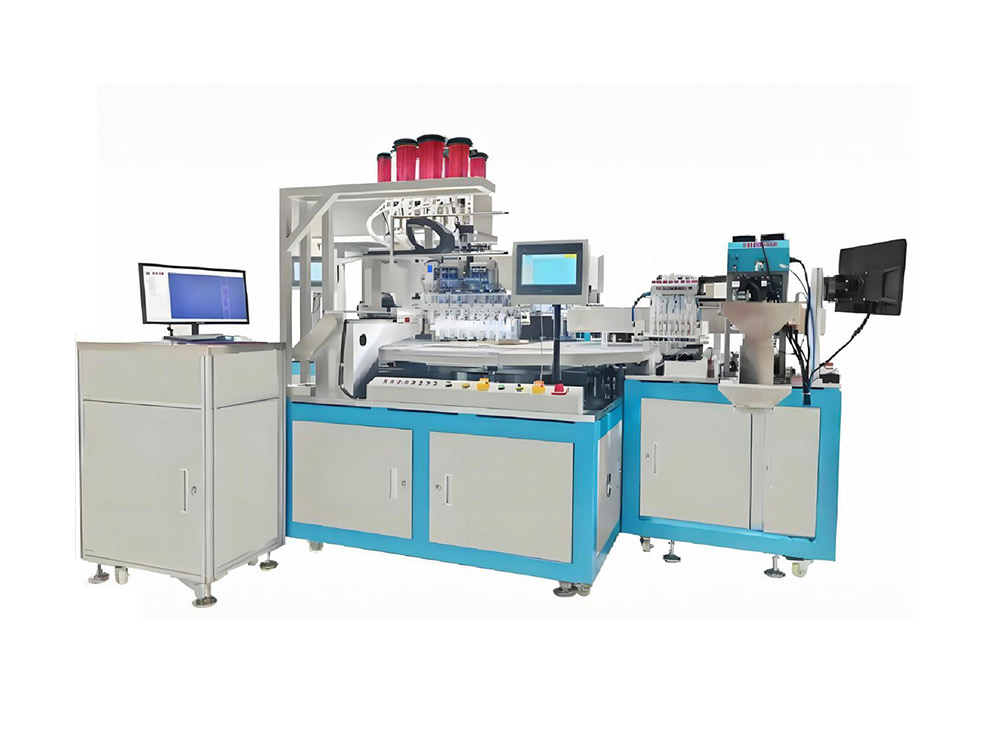
Consistent inlay construction is the precondition for a reproducible range measurement; the bench defines the rest of the budget. Equipment: Integrated Inlay Manufacturing System.
What a Defensible Measurement Practice Gets Right
✓ The read criterion is part of the result
Single-response and full-reliability ranges differ by tens of per cent, so the criterion travels with every number, in datasheets, in acceptance tests and in vendor comparisons.
✓ Reference tags anchor the drift
Periodic calibration with stable reference tags catches amplifier and antenna drift before it silently shifts every result, and gives inter-laboratory comparisons a common anchor.
✓ Geometry is controlled, documented and repeated
Height, tilt, surroundings and operator position are fixed and photographed, so the measurement can be reproduced by anyone who reads the record.
✓ Trend beats snapshot
The same disciplined setup applied to production samples turns range into a control chart that catches inlay and process drift while it is still cheap to fix.
Reference Values for a Range Measurement Budget
Reference bands for 13.56 MHz card and label range measurements on a calibrated bench. Achievable uncertainty depends on equipment class, environment and procedure, and must be established for your own setup rather than copied.
Where the Discipline Applies
Anywhere a range figure is used to make a decision that costs money:
- Vendor and inlay comparison during sourcing, where only identical setups compare
- Incoming quality control of inlays and finished cards
- Product datasheets and customer acceptance documentation
- Correlation checks between bench range and production frequency data
- Dispute resolution when two parties report different numbers for one card
Frequently Asked Questions
Why do our internal numbers differ from the supplier datasheet?
Almost always because the setups and criteria differ, not because anyone measured badly. Ask the supplier for the field strength, the read criterion, the geometry and the uncertainty, then reproduce their setup once. The residual difference is usually inside the combined uncertainty.
Is a bigger range figure always a better card?
Only when the measurements are comparable. A card tuned to flatter the bench can underperform in the real reader geometry, so the comparison that matters is made in your application geometry, with the bench figure as a controlled reference.
Do we need an anechoic chamber for this?
For 13.56 MHz card measurements, a disciplined open bench with controlled surroundings and documented geometry usually achieves a defensible budget; full chambers are more valuable at UHF and for antenna pattern work. The chamber does not define the read criterion, and the criterion is usually the larger error.
Next Step
More equipment in this range is listed on the ZOWINDA CardMachine product page, and related application notes appear in our Industry News section.
Related reading:
- RFID on Metal: Ferrite Backing Thickness and the Read Range Budget
- RFID in Wet Environments: Dielectric Loading, Detuning and the Fixes That Hold
- Contactless Card Read Range: Diagnosing Antenna Resonance and Detuning
- Automatic Frequency Test Machine for RFID and NFC Cards
- Inlay Sheet Yield Maths: Where a Two Percent Layout Change Pays
- Printed Antenna Tolerance: Which Dimension Actually Moves Resonance
Ready to boost your production efficiency?
Contact us for a tailored solution and quotation on inlay production, card testing and personalisation equipment.
Email: info@zowinda.com
WhatsApp: +86 186 2085 0485
 Read Range Test Uncertainty: W
 RFID in Wet Environments: Diel
 RFID on Metal: Ferrite Backing
 Booklet Spine Adhesive: Why Fl
Please contact us with your request
We are ready to answer your questions.