
Automatic Frequency Test Machine for RFID and NFC Cards
Automatic Frequency Test Machine for RFID and NFC Cards: Engineering Notes from the Production Floor
Published: November 04, 2026 | ZOWINDA Application Engineering
Every RFID card is a resonant circuit: the inductance of its antenna and the input capacitance of its chip set the frequency at which the card answers a reader best. That frequency is decided long before the card reaches a reader - by antenna geometry at embedding, by lamination pressure that shifts the dielectric, by the tolerance of the chip itself. When it lands outside the window the standard defines, the card still answers a bench reader and still fails at the edge of range in the field. An automatic frequency test machine measures that resonance on every card and turns a hidden process drift into a number.
Why Resonance Frequency Is the First Electrical Gate
HF and NFC cards are specified to resonate at 13.56 MHz within a tolerance that depends on card type and customer specification. Above that window the card couples weakly at the low end of the reader field; below it, the response becomes sensitive to nearby metal and to detuning inside a stack of cards. Both extremes look identical on a functional read test, because the card does work - it simply works over a shorter distance than the design intended.
The frequency also moves during manufacturing without anyone changing the design. Embedding tolerance shifts antenna inductance in proportion to turn spacing; lamination pressure and temperature change the effective dielectric constant of the sheet stack; the chip input capacitance varies batch to batch inside its own tolerance. Measuring the finished card is the only way to see the sum of those effects, and measuring every card is the only way to catch a drift on the shift where it starts rather than a month later at a customer complaint.
Measurement Sequence
- Card feed. Cards are singulated and presented to the test position automatically at line rate, removing the operator from the measurement.
- Fixed coupling. A calibrated test antenna couples to the card at a constant distance and orientation, which is what makes one frequency reading comparable with the next.
- Frequency sweep. The station sweeps drive frequency and resolves the resonance peak, rather than taking a single-point reading that can hide a marginal card.
- Binning. Each result is compared with the recipe pass window and the card is sorted or flagged with its measured value attached.
- Data output. Per-card values are logged against the batch and exported to SPC, so drift is visible before yield moves.
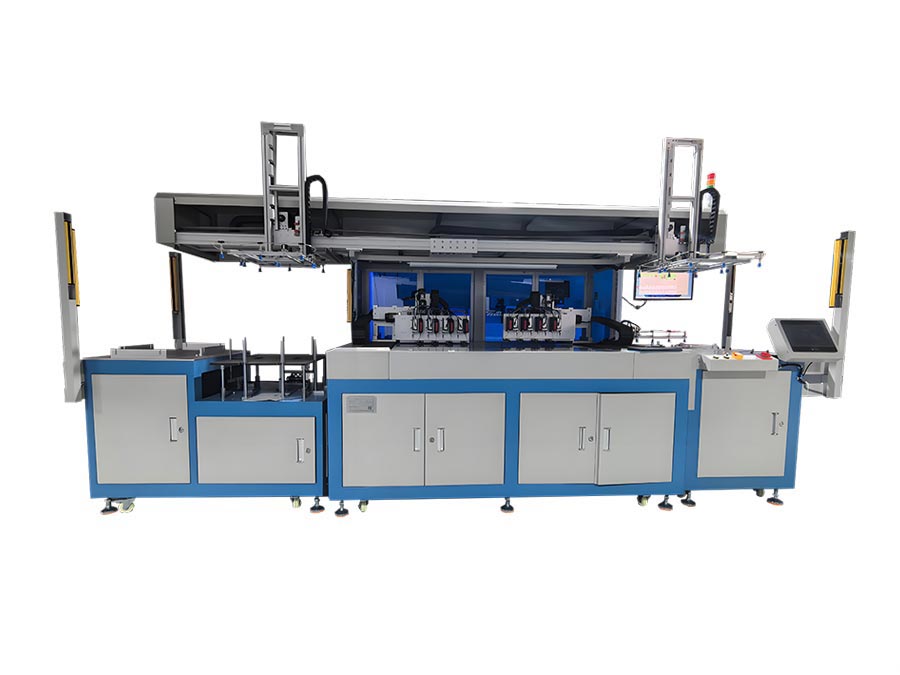
Figure: automatic frequency test station measuring the resonance of finished RFID and NFC cards. Equipment: Automatic Frequency Test Machine for RFID and NFC Cards.
Key Advantages
✓ Fixed Coupling Geometry
The card sits at the same distance and angle for every measurement, the precondition for comparing readings across shifts and machines.
✓ Sweep Instead of Single Point
Resolving the peak yields true centre frequency plus a view of Q, so a marginal card is visible while it is still a trend and not yet a reject.
✓ Per-Product Windows
Each card type carries its own limits and sweep settings, so a mixed-product line needs recipe selection rather than a second station.
✓ SPC-Ready Data
Measured values rather than bare pass flags let process owners see embedding or lamination drifting and correct it at the source.
Technical Data
Frequency windows, sweep range and resolution are configured to the card specification and to the standard your products are certified against. ZOWINDA confirms the limits against your antenna design before shipment.
Where It Belongs in the Line
The station earns its place at two points: after lamination, as the first electrical gate on the finished card body, and before personalization, so that cards entering a high-value run are already known good on RF. It also closes the loop on embedding. When measured frequency drifts high or low across a run, turn spacing, wire tension and embedding pressure are the first place to look, and the trend line shows how far the recipe has to move.
- Post-lamination RF screening of HF and NFC cards
- Pre-personalization gate for payment and transit cards
- Embedding process drift monitoring
- Incoming inspection of bought-in card bodies
Frequently Asked Questions
Is frequency testing the same as a read test?
No. A read test proves a card can communicate inside one particular reader field; it says nothing about where the resonance sits. Two cards can return the same read result with resonance a megahertz apart, and only one of them will hold range in the field.
Can it measure UHF cards as well?
The standard configuration is built around 13.56 MHz HF and NFC coupling, where most card and inlay volume sits. UHF measurement needs different coupling and calibration, so discuss your product mix with ZOWINDA before ordering.
How does it handle mixed production?
Card type, pass window and sweep resolution are all recipe parameters. Changing product is a recipe selection and the station applies the correct limits without re-teaching the mechanics.
Next Step
More equipment in this range is listed on the ZOWINDA CardMachine product page, and related application notes appear in our Industry News section.
Related reading:
- Auto Wire Embedding Machine (2-in-1 System)
- Integrated Inlay Manufacturing System
- ICC Backside Spot Pressure Tester for Smart Card Quality Control
Ready to boost your production efficiency?
Contact us for a tailored solution and quotation on the Automatic Frequency Test Machine for RFID and NFC Cards.
Email: info@zowinda.com
WhatsApp: +86 186 2085 0485
 Automatic IC Module Testing Ma
 Automatic Frequency Test Machi
 Three Wheel Tester for ICC Car
 Auto Wire Embedding Machine (2
Please contact us with your request
We are ready to answer your questions.