
RFID in Wet Environments: Dielectric Loading, Detuning and the Fixes That Hold
Smart Card Manufacturing Notes
RFID in Wet Environments: Dielectric Loading, Detuning and the Fixes That Hold
Published: November 20, 2026 | ZOWINDA Application Engineering
Water does not behave like metal, but an RFID label on a wet or liquid-filled surface fails almost as reliably. The difference matters because the mechanisms differ: a conductive surface cancels the antenna and shifts resonance down while a dielectric loads it, adds capacitance and adds loss, and the loss changes with how much of the tag is wet. The fixes therefore differ too, and a qualification programme that measures only dry tags will certify a product that fails in exactly the conditions it was bought for.
Water Is a Lossy Dielectric, Not a Mirror
At 13.56 MHz water has a relative permittivity on the order of eighty and a substantial loss component, which places it somewhere no tag designer wants it: close enough to couple strongly into the antenna, lossy enough to absorb energy from it. A label lying on a liquid-filled container or soaked fabric sees its stray capacitance to the surrounding medium rise sharply, the resonant frequency drops, and part of the reader field is dissipated in the dielectric before it ever reaches the chip. The tag does not stop resonating; it resonates somewhere the reader no longer excites it efficiently, and with a poorer quality factor than it had in air.
The signature that distinguishes dielectric loading from metal mounting is variability with wetness. A tag on solid steel is consistently bad in a consistent direction. A tag on a container is bad by an amount that depends on fill level, container material, the conductivity of the contents and how much of the antenna is in contact with liquid. Electrolyte-rich contents, brines, aqueous detergents and biological fluids load and absorb far more than oils, which are dielectrics with modest loss. A partially wet label can even read better than a fully dry one by accident, because the resonance happened to shift toward the reader band, which makes accidental bench results treacherous to extrapolate.
The practical fixes follow from the mechanism. First, put low-loss distance between the antenna and the liquid: a PET overlay, a foam layer or an engineered housing of a few tenths of a millimetre to a millimetre substantially reduces capacitive coupling, the same logic as spacing but without the mirror problem metal poses. Second, design the antenna deliberately detuned upward so that the wet state lands on resonance, accepting reduced dry performance, which is only honest if the product is only ever used wet. Third, buy margin in the chip: a lower threshold field compensates part of the lost quality factor. What does not work is sealing alone: waterproofing keeps water out of the antenna traces but does nothing about the field coupling to the dielectric around them.
One further hazard hides inside the laminate itself. Condensation and absorbed moisture in layered constructions shift resonance and, given ionic residues and time, feed the electrochemical migration mechanism that produces intermittent, humidity-linked field failures months later. A wet-environment qualification that only measures range on the day of assembly is therefore incomplete; the wet-dry cycling and the biased humidity exposure belong to the same programme, because both mechanisms begin where water meets the antenna.
Qualifying a Tag for Wet Service in Five Steps
- Fix the wet test geometry before the first measurement. Define the container material, contents, fill level and tag position exactly, because each of them moves the result. A qualification without a fixed wet geometry produces numbers that cannot be reproduced by anyone, including yourself.
- Sweep the resonance dry and wet on the same sample. Measure the frequency response of the same tag in both states. The shift and the broadening of the resonance tell you how much of the problem is detuning and how much is loss, and the two are fixed by different changes.
- Set the acceptance on the wet state, not the dry one. Specify the minimum read performance with the tag fully wet in the worst declared geometry. Dry performance is a reference point for the design, not a purchase criterion for a wet-use product.
- Cycle wet and dry, then re-measure. Repeated wetting and drying shows whether degradation is reversible loading or permanent change, such as delamination, corrosion or moisture absorbed into the laminate that does not leave. Permanent drift after cycling is a reliability failure even if day-one numbers pass.
- Verify with the real product, never a substitute card. Dummy cards in a beaker answer a different question. The final qualification runs with production tags on production containers, because the contents, the wall thickness and the contact geometry are all part of the antenna design at that point.
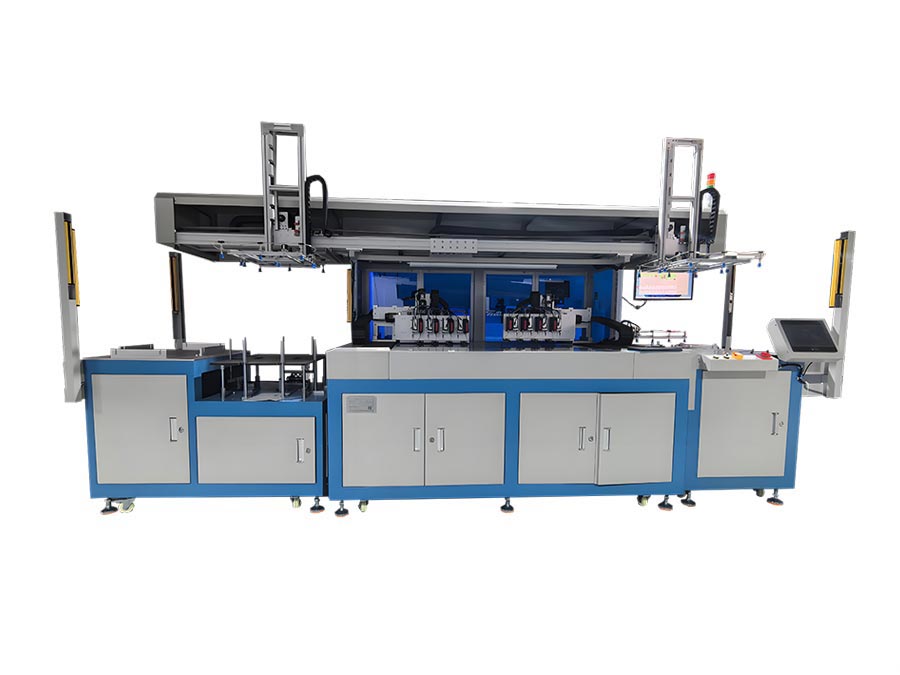
Frequency response measured before and after environmental exposure is what separates dielectric detuning from simple loss. Equipment: Automatic Frequency Test Machine for RFID and NFC Cards.
What a Wet-Use Design Gets Right
✓ The two mechanisms are diagnosed separately
Detuning and dielectric loss are measured as distinct quantities before any fix is chosen, because a thicker spacer helps one, a retune helps the other, and guessing wastes a qualification cycle.
✓ Performance is specified wet
The acceptance criterion is the fully wet state in the declared geometry, which is the state the customer bought the product for and the only one it will reliably live in.
✓ Distance and dielectric, not just sealing
A low-loss spacer between antenna and liquid plus a controlled housing does what a waterproof membrane alone cannot, because the field couples through the environment regardless of where the water is.
✓ Condensation and migration are in scope
Wet-dry cycling and humid exposure are part of the qualification, closing the gap between a tag that reads wet on day one and a tag that still reads wet after a season in service.
Reference Values for Wet-Environment Qualification
Reference bands for 13.56 MHz labels and cards on or near liquids. Actual values depend on contents, container, geometry, antenna design and chip selection, and must be confirmed by measuring your own product in its declared wet state.
Where the Qualification Applies
Anywhere the antenna spends its life touching or near a dielectric that is not air:
- Laundry and textile tags through wash, spin and damp storage cycles
- Sample and reagent containers in laboratories and blood banks
- Beverage crates and returnable packaging washed between uses
- Fluid bags and medical disposables with printed labels in contact
- Outdoor asset labels exposed to rain, condensation and humidity
Frequently Asked Questions
Does a waterproof laminate solve the problem?
No. Sealing keeps liquid out of the antenna traces and prevents corrosion, but the reader field still couples into the dielectric around the antenna, so detuning and absorption remain. Waterproofing is necessary for durability and useless for RF performance.
Can I simply retune the antenna to compensate?
Partly. A design detuned upward reads well wet and measurably worse dry, which is acceptable only if the product never has to work dry. If it must serve both states, the honest route is a wider-bandwidth design and separate acceptance for each state.
Why do phone-based NFC tests disagree with our reader tests?
A phone antenna is itself detuned by the case, the hand and the grip position, so the measurement chain includes an uncontrolled variable. Phone results are useful for demonstrations and useless for acceptance numbers, which should come from a fixed reader geometry.
Next Step
More equipment in this range is listed on the ZOWINDA CardMachine product page, and related application notes appear in our Industry News section.
Related reading:
- RFID on Metal: Ferrite Backing Thickness and the Read Range Budget
- Read Range Test Uncertainty: Why Two Laboratories Disagree on the Same Card
- Contactless Card Read Range: Diagnosing Antenna Resonance and Detuning
- Card Face Printing and Read Range
- Automatic Frequency Test Machine for RFID and NFC Cards
- Electrochemical Migration at the Module Edge: Bias, Moisture and Ionic Cleanliness
Ready to boost your production efficiency?
Contact us for a tailored solution and quotation on inlay production, card testing and personalisation equipment.
Email: info@zowinda.com
WhatsApp: +86 186 2085 0485
 Read Range Test Uncertainty: W
 RFID in Wet Environments: Diel
 RFID on Metal: Ferrite Backing
 Booklet Spine Adhesive: Why Fl
Please contact us with your request
We are ready to answer your questions.