
Booklet Spine Adhesive: Why Flexibility Beats Peel Strength
Smart Card Manufacturing Notes
Booklet Spine Adhesive: Why Flexibility Beats Peel Strength
Published: November 19, 2026 | ZOWINDA Application Engineering
A passport is a booklet, and a booklet is a mechanism. Ten years of validity means thousands of page turns, a spine that is folded flat in a pocket and reopened in a cold airport, and a data page whose laminate carries both a chip module and an antenna. The adhesive at the spine is therefore not a stationery consumable. It is the part that decides whether the data page survives its own hinge.
The Spine Is a Hinge, Not a Glue Joint
A lap shear or peel specimen measures an adhesive in a geometry that never occurs in a booklet. In the real spine the load is a repeated fold: every opening applies a bending moment that puts the outer plies in tension and the inner plies in compression, and the glue line has to absorb that strain without cracking. The properties that matter are elongation at break, glass transition temperature relative to the operating range, and elastic recovery. Peak peel force measured on a rigid specimen at twenty-three degrees Celsius tells you almost nothing about any of them.
A high-modulus, highly crosslinked adhesive usually wins the peel test and loses in the field. At minus ten degrees Celsius it is below its glass transition, it has no elongation left, and the first hard fold starts a craze at the glue line that propagates with every subsequent page turn. A softer adhesive with a transition temperature well below the cold end survives the fold but creeps when the booklet is stored closed and warm, which is the other half of the problem and the half that a fold test never sees.
Creep is the slow failure. A booklet in a pocket, or a stack of five hundred in a consignment box, sits under sustained load at the spine for weeks. A viscoelastic adhesive flows under that load, the page block shifts, and the spine opens into a fan. The specification therefore has to cover elongation at the cold end and creep resistance at the hot end at the same time, which is exactly why a moisture-cure polyurethane hot melt and a formulated EVA behave so differently even though both are sold as bookbinding adhesives.
The data page is the complication that makes this a card problem rather than a printing problem. It is a laminate of polycarbonate or PET-G layers with the chip module and the antenna inlay inside, which makes it the stiffest leaf in the block. At the spine it takes the highest bending strain of any page. Once the glue line cracks, the load path moves into the laminate itself, and a cracked antenna turn or a delaminated layer at the hinge appears later as a reading failure with no visible binding defect. Binding and electrical tests therefore have to run on the same booklets, not on two parallel samples.
How to Qualify a Booklet Spine
- Write the operating envelope before choosing an adhesive. Minus ten to plus fifty degrees Celsius in use, with transport excursions beyond that, a ten-year validity, and an expected five thousand to twenty thousand page turns. Every later decision is a comparison against that envelope.
- Choose by transition temperature and elongation, not by datasheet peel. Require a glass transition temperature below the cold end of the range, typically minus twenty degrees Celsius or lower for a polyurethane hot melt, and elongation at break above one hundred per cent. Peel strength on a rigid specimen is a secondary number.
- Cycle in the geometry of the product, with the real data page. Book bend at the spine and page turning at minus ten, twenty-three and plus fifty degrees Celsius, on booklets that contain the actual laminated data page with its module and inlay. A paper dummy qualifies the glue, not the product.
- Add a parked-load creep test. A closed booklet under a defined load at fifty degrees Celsius for seven to fourteen days, then measure spine offset and glue line opening. This is the test that predicts the fan-shaped spine from a consignment box, and it takes two weeks rather than two years.
- Measure electrical behaviour after mechanical cycling. Resonance frequency, read range and, where possible, chip-to-antenna continuity on the same booklets that were cycled. A binding pass with a bent antenna is a field failure that carries a good binding record.
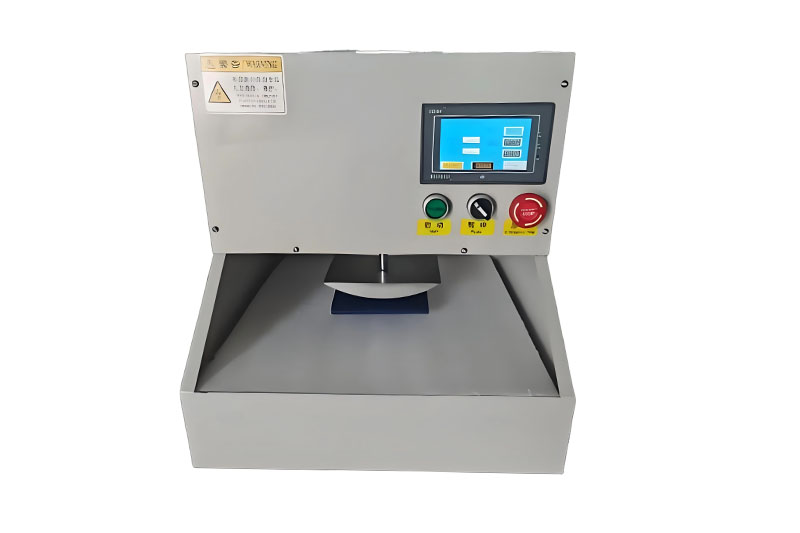
Book bend testing at the spine is the geometry that matters; a flat peel specimen is a different material. Equipment: PT086 Book Bend Stress Tester for ePassport Back-Pocket Durability.
Rules That Keep the Hinge Working
✓ Flexibility at the cold end is the pass or fail
Elongation at break and the glass transition temperature decide whether the first cold fold cracks the glue line. A stiffer adhesive simply moves the failure earlier in the life.
✓ Creep at the hot end is the slow failure
Viscoelastic flow under a parked load opens the spine over weeks. A two-week creep test at fifty degrees Celsius finds it long before a field complaint does.
✓ The data page is the stiff leaf
It carries the highest bending strain in the block, so it defines both the adhesive choice and the cycle specification. Treating it as one page among many is the most common qualification error.
✓ Bind and test the same samples
Mechanical results from one batch and electrical results from another cannot be combined into a statement about durability. One booklet, both measurements, one record.
Reference Values for Spine Qualification
Reference bands for polycarbonate and PET-G ePassport booklet constructions with a laminated data page. Actual values depend on body material, page count, sewing pattern, adhesive chemistry and the storage conditions of the issuing programme, and must be confirmed on your own booklet construction.
Where Hinge Durability Decides the Product
The same fold-and-creep reasoning applies to any bound document that carries electronics or a security laminate:
- ePassport and eID booklets with a laminated polycarbonate data page
- Visa and border-control booklets with high page counts and repeated opening
- Booklet-format residence permits and seafarer documents carried continuously
- Secure booklets with a spine-applied security thread or an anti-tamper label
- Any bound document where a reading failure is discovered before the binding defect is visible
Frequently Asked Questions
Is a stronger adhesive always better for a spine?
No. The spine is a hinge that flexes on every page turn, so it needs a compliant adhesive that survives strain rather than a strong one that resists it. High peel strength on a rigid specimen often correlates with early cracking in a fold.
Why does the data page tear at the sewing line?
The thread concentrates load at the perforations, and the laminated data page has the least elongation of any leaf in the block. It is both the stiffest page and the one with the highest value, which is why the sewing pattern and the adhesive have to be qualified together.
Can a paper dummy be used for process trials?
For setting up a binder, yes. For durability qualification, no. The data page changes the stiffness of the block and changes the failure mode, so a dummy produces a passing result that the real booklet will not reproduce.
Next Step
More equipment in this range is listed on the ZOWINDA CardMachine product page, and related application notes appear in our Industry News section.
Related reading:
- Electrochemical Migration at the Module Edge: Bias, Moisture and Ionic Cleanliness
- Contact Plate Life: Wear, Fretting and Contact Resistance Drift
- PT086 Book Bend Stress Tester for ePassport Back-Pocket Durability
- PT087 Dynamic Flexison Tester for Passport Bending Fatigue
- PT089 Sheet Turning Stress Tester for Passport Page Hinge Fatigue
Ready to boost your production efficiency?
Contact us for a tailored solution and quotation on inlay production, card testing and personalisation equipment.
Email: info@zowinda.com
WhatsApp: +86 186 2085 0485
 Booklet Spine Adhesive: Why Fl
 Contact Plate Life: Wear, Fret
 Electrochemical Migration at t
 Laser Marking on Card Faces: C
Please contact us with your request
We are ready to answer your questions.