
ePassport Cover Bond Ageing: When the Data Page Loosens
Smart Card Manufacturing Notes
ePassport Cover Bond Ageing: When the Data Page Loosens
Published: November 27, 2026 | ZOWINDA Application Engineering
An ePassport is a book before it is an electronic device. Its data page is bonded into a cover that is opened, closed, bent and carried in a pocket for years, while the chip and antenna inside are expected to keep working. A bond that looks strong on the day of manufacture can lose adhesion slowly as humidity and repeated flexing work at the hinge. The failure is rarely dramatic: the page starts to lift at one corner, the cover refuses to lie flat, and only then does the reader begin to see an intermittent antenna.
What Ages a Booklet Bond
The cover-to-data-page joint is a composite structure, not a single glue line. There is the cover board, the inner lining, the adhesive, the back of the data page and often a protective film or an inlay layer inside that page. Each material has a different coefficient of expansion and a different response to moisture. When the booklet is exposed to humidity, the paper-based components swell more than the plastic layers, so the joint sees a shear stress that is not present in a dry laboratory. Over time that stress can move the bond line even when the initial peel strength was high.
The hinge is the critical region. A booklet opens around a narrow strip, and every opening cycles that strip through a tight bend. The adhesive there is loaded in peel and shear at the same time, which is a much harder condition than the flat peel test used on a sample coupon. If the cover board is too stiff or the adhesive layer too thin, the strain concentrates at the edge of the bond and a micro-crack starts there. Once it starts, moisture enters the crack and accelerates the next cycle.
Heat adds a second ageing path. A passport in a pocket sees body temperature, and in some climates it sees far more. A hot car or an airport tarmac pushes the adhesive closer to its softening point, where creep becomes measurable. A bond that passed a short peel test at room temperature can slowly yield under a small sustained load at elevated temperature. This is why an accelerating test that only raises humidity can miss the dominant mechanism in a hot, humid market.
The antenna sits inside the same moving structure. A data-page inlay placed close to the hinge sees repeated bending exactly where the bond is loosening. The conductor can crack, the tuning can shift as the layer geometry changes, or the reader can see an intermittent response that looks like a chip problem. Diagnosing this as an electronics fault wastes time: the root cause is mechanical, and it begins at the cover bond long before the RF performance changes.
Five Controls for a Durable Booklet Bond
- Test the hinge, not only a flat coupon. Use a book-bend or flexing fixture that opens and closes the completed booklet through the intended radius. Record resistance or RF performance during the cycles so an intermittent joint is visible.
- Match cover stiffness to the bond. A stiffer cover board makes a better-looking book but drives strain into a smaller hinge region. Qualify the board and adhesive as a pair, not as separate purchases.
- Control adhesive thickness and spread. Measure the bonded area and the glue line on sectioned samples at start-up and after a material change. Thin spots at the hinge edge become crack initiators later.
- Age under combined humidity and heat. Expose samples to a damp-heat programme that reflects the market, then bend and read them. A single-factor test will not reproduce the creep and swelling that occur together in service.
- Watch the first signs at the corner. Treat corner lift, a cover that will not lie flat, or a new rustle at the hinge as a process signal. Section the sample and look at the bond line before increasing the test severity.
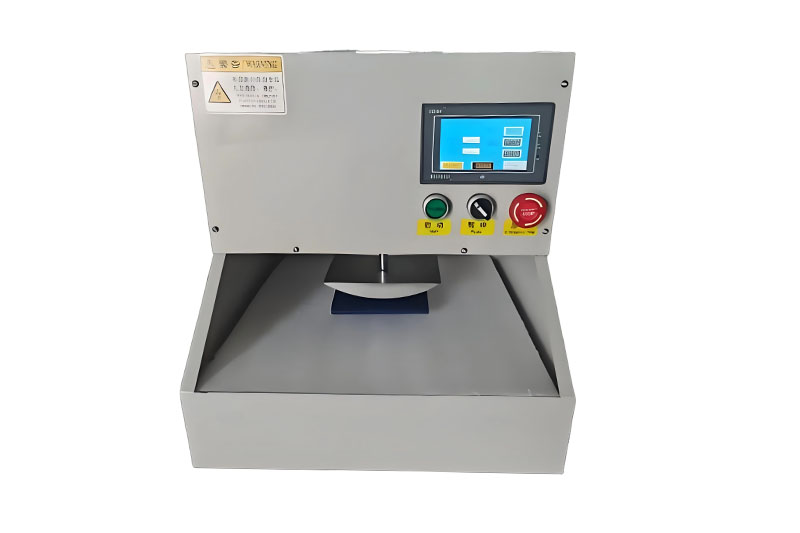
Repeated book bending at the hinge is the load case a flat peel coupon does not reproduce. Equipment: PT086 Book Bend Stress Tester.
Failure Modes That Appear in Service
✓ Corner lift after months of use
The bond line has lost adhesion at the hinge edge. The page still reads, but the lifted corner catches in the pocket and the damage grows with every opening.
✓ Intermittent reader response
The inlay conductor near the hinge develops a hairline crack. The passport reads in one orientation and fails in another, which is often reported as a reader problem.
✓ Cover will not close flat
Uneven adhesive spread or differential swelling has set a permanent curl. The booklet looks serviceable but the hinge is under constant load even when closed.
✓ Peel test passes, field fails
The coupon was pulled flat and fast at room temperature. It never saw the combined peel, shear, humidity and heat that the hinge sees for years.
Reference Checks for Booklet Bonding
These checks describe a durability programme for booklet-style documents rather than a universal specification. Cover construction, adhesive chemistry, inlay layout and issuing authority requirements all change the limits, so agree the test plan with the customer before qualification.
Where Booklet Bond Control Pays Back
A booklet that survives years of handling protects both the document and the reader infrastructure. The work is mostly mechanical: understand the hinge, test the whole book and treat the first signs of lift as a process warning.
- ePassport programmes with a long in-service life and a demanding climate profile.
- Booklets that combine a data-page inlay with a stiff cover board.
- Manufacturers seeing intermittent read failures that follow a binding line rather than a chip lot.
- Suppliers changing cover stock, adhesive or inner lining after an initial qualification.
- Quality teams replacing flat peel coupons with a test that reproduces real opening cycles.
Frequently Asked Questions
Is a high peel strength enough?
No. A flat peel coupon measures one load case at one speed and temperature. The hinge sees peel and shear together, repeated thousands of times, often damp and warm. Both tests are needed.
Why does the reader fail before the page looks damaged?
The inlay conductor near the hinge cracks or detunes before the bond is visibly open. RF change is often the first measurable sign of a mechanical problem.
Can a more flexible cover solve the problem?
It usually reduces strain at the hinge, but it changes the feel and durability of the booklet. Qualify cover and adhesive together so stiffness is balanced against handling life.
Next Step
More equipment in this range is listed on the ZOWINDA CardMachine product page, and related application notes appear in our Industry News section.
Related reading:
- Metallic Ink on Card Faces: The Read-Range Penalty Behind Finishes
- Print Adhesion on PVC and PET-G: Why the Same Ink Fails
- Booklet Spine Adhesive: Why Flexibility Beats Peel Strength
- Gold Bump Flip-Chip or Wire Bonding: Choosing the Module Interconnect
- Contact Plate Life: Wear, Fretting and Contact Resistance Drift
- Card Edge Notch Milling: Depth, Stress and Crack Initiation
- Lamination Bubble Detection: Vision and Acoustic In-Line Checks
- Card Batch Traceability: Serialisation and the Audit Trail
- RFID in Wet Environments: Dielectric Loading, Detuning and the Fixes That Hold
Ready to boost your production efficiency?
Contact us for a tailored solution and quotation on inlay production, card testing and personalisation equipment.
Email: info@zowinda.com
WhatsApp: +86 186 2085 0485
 ePassport Cover Bond Ageing: W
 Print Adhesion on PVC and PET-
 Metallic Ink on Card Faces: Th
 Lamination Bubble Detection: V
Please contact us with your request
We are ready to answer your questions.