
Lamination Pads and Pressure Uniformity: The Quiet Yield Lever
Smart Card Manufacturing Notes
Lamination Pads and Pressure Uniformity: The Quiet Yield Lever
Published: November 21, 2026 | ZOWINDA Application Engineering
When laminated card yield drifts down a few percent over a month, the investigation usually starts with the recipe: temperatures, times, pressure setpoints, material lots. Sometimes the culprit is none of them. Between the hot platens and the card sheets sit the lamination pads, consumable surfaces that distribute force and carry the texture of every cycle, and they wear in ways that no recipe change can compensate. A pad that has scarred, delaminated or dished presses its own history into every sheet it touches, and the result appears downstream as thickness gradients, bonding defects, inlay shift and intermittent chips, all of which look like material problems.
What a Pad Does and How It Fails
A lamination press closes on a stack: platen, pad, release surface, card sheets, release surface, pad, platen. The pad exists because no platen is perfectly flat and no stack is perfectly even. It is the compliant layer that turns a force applied at a few large points into a distributed pressure field across the whole sheet area. That compliance is finite and directional, and it degrades with use: scratches from a careless knife or a trapped inlay tail become impressions that transfer to every card; heat cycling embrittles the surface; repeated loading near the edges of the loading area dishes the pad so the centre of a sheet sees more pressure than its rim, or the reverse.
Pressure nonuniformity writes itself into the product in several currencies at once. Thickness follows pressure: where the stack is squeezed harder, the softened PVC flows thinner, and a card map across the sheet shows a systematic gradient that SPC will eventually catch. Bonding follows pressure too: under-pressed regions leave interlayers that pass the eye but fail the peel or the bend, the classic delamination-after-a-week defect. And around embedded inlays, pressure asymmetry is the mechanism that shifts antennae and stresses modules, because the softened core flows unevenly around stiff islands. A chip that survives the press but cracks in bending test three weeks later is often paying a pressure debt incurred on a worn pad.
The economics are quietly favourable to replacement. Pads are cheap; the costs of running them past their life are a drifting thickness distribution, a slow rise in press-related scrap that no single shift attributes correctly, and the worst one: intermittent rejects that pass every test at the press and fail in personalisation or in the field, where the diagnostic cost is highest. Plants that track pad cycles as a consumable, with a fixed replacement interval based on measured pressure maps rather than on appearance, convert a diffuse yield leak into a scheduled expense.
Temperature rides on the same stack and fails the same way. A dished or delaminating pad insulates unevenly, so the thermal map across the sheet stops matching the platen map, and the recipe that was qualified against a healthy stack now produces under-laminated corners. Any plant that re-qualifies its lamination recipe after a press overhaul knows the effect; the same discipline applies to pads, which change more often and more gradually.
Owning Pad Health in Five Steps
- Map the pressure field, do not infer it. Pressure-sensitive film between pads at operating load shows the true distribution in minutes, including the dishing and edge effects that a flatness gauge on a cold platen will miss. Repeat the map on new pads to record the baseline.
- Track pad cycles in the production record. Count cycles per pad like tooling, with its loading position, because a pad used always at the same daylight wears there. Cycles plus maps beats judging pads by eye, since a dangerous surface can look clean.
- Set the replacement trigger on evidence. Replace on cycle count, on pressure-map degradation or on the card thickness map drifting, whichever comes first. Define the trigger before the drift, so the decision is never made under yield pressure.
- Re-verify the recipe after any pad change. Thickness, peel or bend sampling and module-stress checks on the first sheets after replacement confirm the stack is back to baseline. A pad change is a recipe event even though the recipe did not change.
- Include pad condition in yield diagnosis. Before blaming material lots or operators for a slow yield drift, check the pad history and the last pressure map. The cheapest investigations start with the consumable nobody counts.

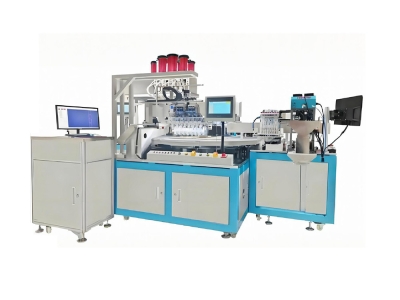
Inlay sheet production is where pad condition is paid for: pressure asymmetry around stiff islands becomes shift, stress and scrap. Equipment: High-Speed RFID Card Production Inlay Sheet Manufacturing Line.
What a Disciplined Press Room Gets Right
✓ Pressure maps on a schedule
Film maps at operating load, taken on new pads and periodically in service, turn an invisible consumable into a measurable one and catch dishing before it reaches the product.
✓ Pads treated as counted tooling
Cycle counts per pad, with position history, replace eyeballing. Replacement is scheduled by evidence, so yield drifts never have to be diagnosed backwards from scrap.
✓ Thickness maps as the early warning
A nine-point or grid thickness map per sheet catches pressure gradients at the source. It costs seconds per sheet and finds in weeks what SPC on finished cards finds in months.
✓ Pad changes handled as recipe events
First-article verification after every pad swap, covering thickness, bonding and inlay position, closes the loop between the consumable and the qualified process.
Reference Values for Press Pad Management
Reference notes for managing lamination pads in multi-daylight card and inlay presses. Cycle life depends on pad construction, press temperature and loading discipline, and must be established from your own pressure maps and thickness data.
Where the Discipline Applies
Any laminated construction pressed between platens, wherever the yield conversation has become circular:
- RFID inlay and dual-interface lamination, where stiff islands punish asymmetry
- Financial and ID card production under SPC on thickness and bonding
- SIM and module card lamination with fragile die and tight bending specs
- Multi-daylight presses shared across products of different stack heights
- Any plant re-qualifying a lamination recipe after press maintenance
Frequently Asked Questions
How often should lamination pads be replaced?
There is no universal number: a disciplined plant derives the interval from its own evidence. Start from a pressure map on new pads, track cycles, and re-map periodically; the first time the map or the sheet thickness map drifts against cycle count, you have your interval. Plants that guess usually run pads far past the economical point because worn pads look fine.
Can we compensate for a worn pad by raising press pressure?
Raising pressure raises the average and the damage together: the thin spots get thinner and the bonding defects move rather than disappear. It can mask a gradient for a while and simultaneously push over-pressed regions into new defects. The correct compensation is a pad that distributes force evenly again.
Do we need pressure film at every pad change?
No. Film mapping is for establishing baselines and diagnosing drift; between those points, cycle counts and the sheet thickness map carry the monitoring. A full map is cheap compared with one week of unexplained yield loss, so the schedule depends on how much of your scrap is press-related.
Next Step
More equipment in this range is listed on the ZOWINDA CardMachine product page, and related application notes appear in our Industry News section.
Related reading:
- Card Face Ink Abrasion: Why Rub Counts Decide Field Life
- SIM Cards in Wearables: Micro-Motion Fretting in a Damp World
- Inlay Sheet Yield Maths: Where a Two Percent Layout Change Pays
- Booklet Spine Adhesive: Why Flexibility Beats Peel Strength
- Dual-Interface Ferrite: Why Sheet Thickness Beats Permeability on the Datasheet
Ready to boost your production efficiency?
Contact us for a tailored solution and quotation on inlay production, card testing and personalisation equipment.
Email: info@zowinda.com
WhatsApp: +86 186 2085 0485
 SIM Cards in Wearables: Micro-
 Lamination Pads and Pressure U
 Card Face Ink Abrasion: Why Ru
 Read Range Test Uncertainty: W
Please contact us with your request
We are ready to answer your questions.