
Card Face Ink Abrasion: Why Rub Counts Decide Field Life
Smart Card Manufacturing Notes
Card Face Ink Abrasion: Why Rub Counts Decide Field Life
Published: November 21, 2026 | ZOWINDA Application Engineering
A bank card survives four years of pockets, reader rollers and kiosk slots, and most of that survival is decided at the surface. The printed face is the part every holder touches and every reader rubs, and when it fails the complaint is cosmetic but the consequence is commercial: faded branding, illegible pan numbers worn to ghosts, pigment transferred onto reader rollers until operators reject the card as dirty. Ink abrasion looks like an ink problem, but in practice it is a system property of ink, card body and overlay, and the rub count on the datasheet only predicts reality when the test was specified as carefully as the ink was chosen.
What Actually Removes Ink from a Card
Four mechanisms wear a printed card face, and they respond to different fixes. Abrasion is the obvious one: hard or sharp asperities sliding across the surface cut and plough the ink layer, which is the wallet-pocket mechanism and the reader-roller mechanism at once. Adhesive transfer is subtler: soft surfaces in contact under pressure, such as two cards face to face in a wallet or a card against a plastic sleeve, pull ink components out by adhesion, leaving a gloss shadow before any colour is visibly lost. Fatigue follows bending: a flexed card stretches its surface, and an ink film that cannot follow the strain develops micro-cracks that then abrade a hundred times faster. Chemical attack rounds out the list: sweat, hand creams and disinfectants swell or hydrolyse binder systems, so the ink that survived ten thousand dry rubs can fail in a month of damp pockets.
The ink systems behave differently against these mechanisms. Solvent-based screen inks cure by evaporation and leave a relatively soft, but thick and well-adhered, film; they resist adhesive transfer well and abrade with warning. UV-cured inks crosslink into a hard, chemically resistant network within seconds, which makes them excellent against solvents and abrasion, but a highly crosslinked film has low elongation, so it is the system most likely to micro-crack on a deeply embossed or frequently flexed card. Digital and re-transfer prints sit at the opposite extreme, with thin films that follow flexing happily but offer little sacrificial thickness. None of these is universally better; the right question is which mechanism dominates in the card service life.
The card body underneath decides half of the outcome. The same ink printed on PVC, on PETG and on polycarbonate shows measurably different rub lives, because surface energy, the migration of plasticisers and the mechanical modulus under the film all change how load transfers into the ink. A soft, plasticiser-rich PVC lets a hard UV film sit on a moving foundation, so the film cracks; a stiff polycarbonate supports the film but its low surface energy challenges adhesion, so the failure mode flips to lifting. This is why an ink qualified on one core cannot be carried to another core on the strength of the ink datasheet alone, and why laminators who change core suppliers should expect to re-qualify their print shop too.
Overlamination is the industry standard answer, and it works by moving the wear plane. A clear overlay film or a well-formulated varnish takes the abrasion so the ink never does, but an overlay is only as good as its adhesion: a delaminating corner concentrates every mechanism at its edge, and a worn overlay with a scratched surface scatters light long before the ink below is touched. The quality question for a printed card is therefore never only how many rub counts the ink survives, but which layer is designed to wear, and whether that layer wears predictably instead of peeling in patches.
Specifying a Rub Test That Predicts the Field in Five Steps
- Choose the apparatus for the mechanism, not by habit. Rotary Taber-type wheels, linear rub testers and crockmeters load and stroke differently, and each favours a different failure mode. Match the instrument to the dominant service mechanism, pocket abrasion or roller contact or face-to-face transfer, before writing an acceptance number.
- Fix the consumables as part of the specification. Abrasive grade, cotton vs synthetic fabric, artificial sweat or dry contact, load in newtons and stroke length belong in the same document as the rub count. A count without its consumables is a password without a lock: it can be made to mean anything.
- Define the acceptance as a measurement, not an adjective. Visual grades are a start, but pair them with a colour-difference limit against an unworn reference, gloss retention or a density drop on the printed patches. A measurable limit makes supplier comparison and incoming inspection possible; no visible wear is not a limit.
- Age the samples before testing. UV inks continue crosslinking for days after printing, and plasticisers migrate at room temperature. Test at a fixed interval after production, and repeat after damp-heat ageing, because the ink that passes fresh can fail aged and the field only ever sees the aged card.
- Test the finished laminate, not the printed sheet. Overlay, pressure and core all move the result. Run the rub programme on production cards through the real lamination cycle, and include the edges and embossed characters, which wear first and are the parts holders actually notice.
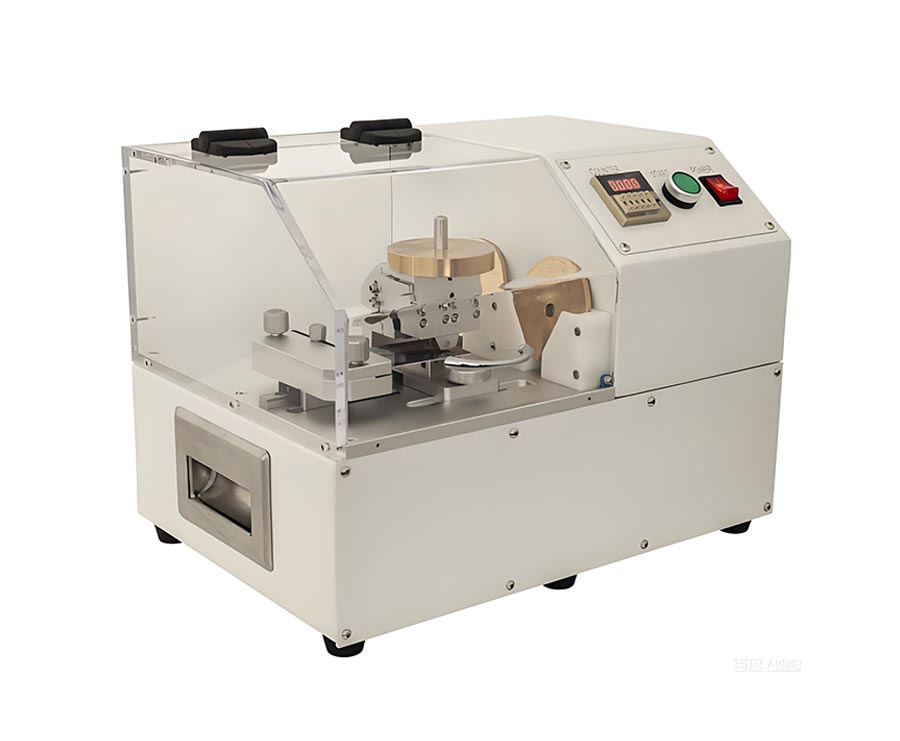
Mechanical reliability testing under controlled load and stroke is how a printed face is qualified before a single card reaches a pocket. Equipment: Three Wheel Tester for Card Mechanical Reliability Testing.
What a Wear-Resistant Printed Card Gets Right
✓ One layer is designed to wear
The construction names its sacrificial surface, usually the overlay, and the rub specification is written against that layer. Ink is never left as the primary wear plane on a long-life card.
✓ Ink chosen for the core, not from a catalogue
The print system is qualified on the actual card body through the actual lamination cycle. Core changes trigger re-qualification instead of surprises.
✓ Elongation matched to flexing
Cards that live in wallets are bent thousands of times, so the face film is selected with enough elongation, or enough overlay support, to survive fatigue as well as abrasion.
✓ Acceptance is numeric and aged
Colour-difference and gloss limits, measured after defined ageing, replace adjectives. Incoming inspection can therefore reproduce the qualification instead of re-arguing it.
Reference Values for Card Face Wear Qualification
Reference bands for card face wear qualification. Exact limits depend on ink system, core material, overlay construction and the declared service environment, and must be established on your own production cards.
Where the Discipline Applies
Any laminated or printed card whose face must survive its declared life without complaint:
- Payment and ID cards with multi-year service lives and daily reader contact
- Transport cards carried loose in pockets and tap-read thousands of times
- Gift and loyalty cards where the printed face is the whole product
- Event and access badges exposed to sweat, sun and repeated handling
- Any printed face change that accompanies a core or overlay change
Frequently Asked Questions
Our UV ink passes 2000 rubs on the datasheet but scuffs in the wallet. Why?
Datasheet counts are measured on the ink under the supplier conditions, usually on glass or on a standard substrate, fresh-cured, dry media. Your card adds a different core, an overlay, plasticiser migration, wallet flexing and damp. The datasheet number is a starting point, not a field prediction; the only honest number is measured on your finished card with your consumables.
Is a thicker ink film always more abrasion resistant?
Thickness buys sacrificial wear but costs flexibility, and adhesion must carry the heavier film. On a card that is flexed daily, a thick hard film can crack and lose far faster than a thinner one that follows the substrate. Match film properties to the dominant mechanism instead of buying thickness.
Do we need to re-run wear qualification when we change lamination pressure?
If the change affects surface finish, overlay adhesion or residual stress in the face, yes. Pressure changes that only affect bonding are safer, but a quick rub comparison on old versus new settings is cheap insurance against a subtle finish difference turning into a field complaint.
Next Step
More equipment in this range is listed on the ZOWINDA CardMachine product page, and related application notes appear in our Industry News section.
Related reading:
- Lamination Pads and Pressure Uniformity: The Quiet Yield Lever
- SIM Cards in Wearables: Micro-Motion Fretting in a Damp World
- Card Face Printing and Read Range
- Printed Antenna Tolerance: Which Dimension Actually Moves Resonance
- Contact Plate Life: Wear, Fretting and Resistance Drift
Ready to boost your production efficiency?
Contact us for a tailored solution and quotation on inlay production, card testing and personalisation equipment.
Email: info@zowinda.com
WhatsApp: +86 186 2085 0485
 SIM Cards in Wearables: Micro-
 Lamination Pads and Pressure U
 Card Face Ink Abrasion: Why Ru
 Read Range Test Uncertainty: W
Please contact us with your request
We are ready to answer your questions.