
PT086 Book Bend Stress Tester for ePassport Back-Pocket Durability
PT086 Book Bend Stress Tester for ePassport Back-Pocket Durability: Engineering Notes from the Test Floor
Published: November 06, 2026 | ZOWINDA Application Engineering
Every passport failure story starts in a pocket. The booklet is carried in a rear trouser pocket, sat on, and bent around the spine hundreds of times before its first year is out - and the part that suffers most is the one part that cannot be soft: the data page, with its embedded antenna, its chip module and its laminate stack. A book bend stress test recreates that single, specific load - bending about the spine at a controlled radius - and does it in a repeatable way, so a durability claim can be a number instead of an opinion.
What the Book Bend Test Loads
The fixture clamps the booklet and bends it about the spine axis to a set angle and a set radius. That geometry matters more than the angle itself. A bend distributed over 100 mm of cover barely strains the inlay; the same angle concentrated over a 25 mm radius puts the data page into tension along a narrow band, and that band is exactly where the antenna turns run. Bending about the spine also loads the construction asymmetrically: the cover, the data page and the visa pages have different stiffness, so the interfaces between them see shear rather than pure tension.
This is why a book bend result cannot be inferred from a flat flexing test. Flexing reverses curvature across the whole booklet and stresses the hinge evenly; bending about the spine concentrates the entire displacement into the spine region and drives the data page laminate in shear against the cover. The two tests find different defects: flexing finds a brittle antenna, bending finds a weak adhesive bond.
How a Test Run Is Built
- Mount the booklet square in the clamps. The spine is seated against the radius former. A booklet mounted skewed loads one corner instead of the spine band and the result is not comparable to the next sample.
- Set bend radius and angle. Radius is the variable that decides severity. Two testers running the same angle at different radii are not running the same test, so radius is recorded per run.
- Set cycle count and dwell. A single bend to the limit shows whether the construction survives once. Repeated bends with a short dwell show whether the adhesive creeps under sustained load.
- Run and inspect at intervals. Booklets are pulled at defined cycle counts and checked for delamination, whitening at the hinge, chip module lift and read performance.
- Record and release. Pass and fail are decided against the acceptance criteria of the programme - ICAO durability guidance, a national booklet specification or an internal standard.
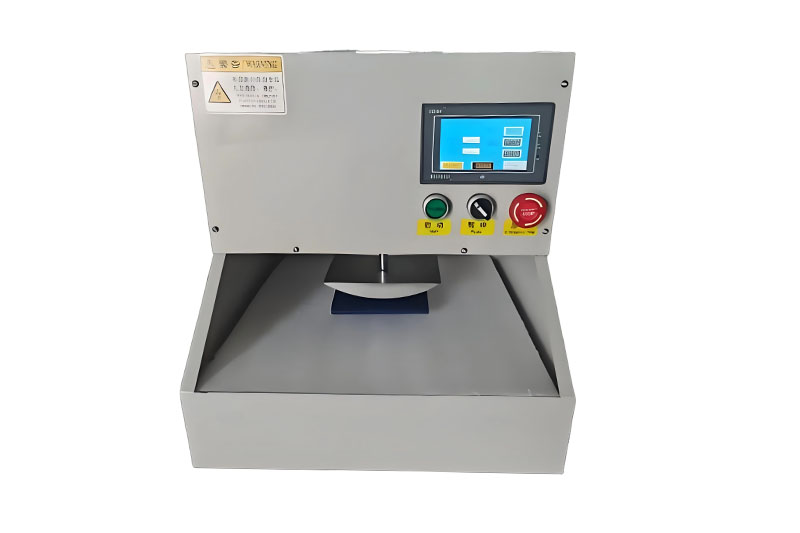
Figure: PT086 book bend stress tester with adjustable spine radius and programmable bend cycles. Equipment: PT086 Book Bend Stress Tester for ePassport Back-Pocket Durability.
Engineering Advantages
✓ Radius-Controlled Bending
The bend is defined by a former rather than by hand force, so severity is a parameter and not an operator skill.
✓ Spine-Axis Loading
Loading about the spine reproduces the back-pocket case that flat flexing cannot reach, and it isolates the cover-to-data-page bond.
✓ Programmable Cycling
Angle, radius, cycle count and dwell are recipes, which makes a 500-cycle screening run and a 20,000-cycle qualification run the same test at different settings.
✓ Post-Test Read Verification
Mechanical damage that does not yet show as a visible crack usually shows as a shift in resonance or a drop in read range - the tester is a fixture, the reader is your instrument.
Technical Data
Bend radius, angle, cycle count and acceptance criteria are set from the durability clause of your programme and from the booklet construction you are qualifying. ZOWINDA specifies the fixture against the format and thickness you supply.
Where It Fits in a Qualification Programme
The most valuable use is comparative. Absolute pass marks depend on a programme and a clause, but a relative result is available immediately: run ten booklets from supplier A and ten from supplier B through the same recipe and the delamination onset cycle count separates them without argument. The second use is forensic. When a field return stops reading and shows no external damage, bending a sibling booklet from the same batch under inspection often reproduces the failure at a cycle count far below the qualified figure - which turns a complaint into a process parameter to check, usually lamination pressure at the data page edge.
- Design verification of a new booklet construction
- Incoming comparison of cover or inlay suppliers
- Batch screening after a laminate or adhesive change
- Root-cause work on field returns that fail to read
Frequently Asked Questions
Is a book bend test the same as a dynamic flexing test?
No. Flexing reverses curvature across the booklet and loads the hinge in a symmetric way; bending about the spine concentrates displacement into the spine band and shears the data page against the cover. They find different defects, and a durability programme normally needs both.
How many cycles is a pass?
That is set by your programme, not by the machine. The tester delivers the cycles; the acceptance clause decides how many. ZOWINDA configures the fixtures and the recipe range, and the qualification figure comes from the standard your booklet is certified against.
Can the same tester run different booklet formats?
With the right clamps, yes. Data page format is fixed by ICAO guidance, but cover thickness, page count and construction vary between national programmes, so clamp sets are specified per format rather than assumed.
Next Step
More equipment in this range is listed on the ZOWINDA CardMachine product page, and related application notes appear in our Industry News section.
Related reading:
- Three Wheel Tester for ICC Card Mechanical Reliability
- ICC Backside Spot Pressure Tester for Smart Card Quality Control
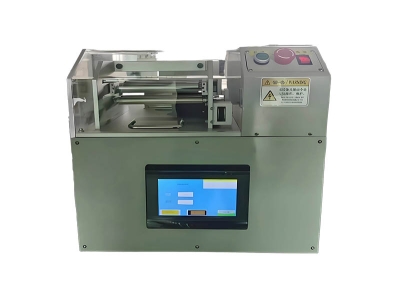
- PT087 Dynamic Flexison Tester for Passport Bending Fatigue
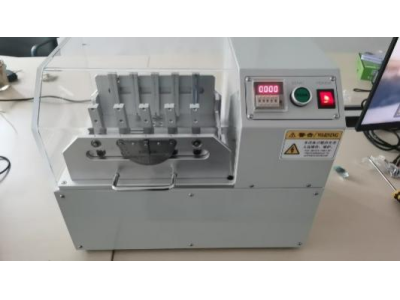
- PT088 Passport Torsion Stress Tester for Booklet Fatigue
Ready to boost your production efficiency?
Contact us for a tailored solution and quotation on the PT086 Book Bend Stress Tester for ePassport Back-Pocket Durability.
Email: info@zowinda.com
WhatsApp: +86 186 2085 0485
 PT088 Passport Torsion Stress
 PT087 Dynamic Flexison Tester
 PT086 Book Bend Stress Tester
 Auto Patch Pick and Place Mach
Please contact us with your request
We are ready to answer your questions.