
PT087 Dynamic Flexison Tester for Passport Bending Fatigue
PT087 Dynamic Flexison Tester for Passport Bending Fatigue: Engineering Notes from the Test Floor
Published: November 06, 2026 | ZOWINDA Application Engineering
One bend rarely breaks a passport. Ten thousand bends do, and they do it quietly: the antenna does not snap on cycle 4,000 - it work-hardens, micro-cracks, and starts to read short at cycle 7,000 while the booklet still looks new. Fatigue is a cumulative process, which is why a single-displacement test cannot describe it. A dynamic flexison tester exists to count cycles at a fixed displacement and find the point where a booklet stops being reliable, not the point where it stops working at all.
Why Cycle Count Is the Real Variable
Bending a ductile structure within its elastic range costs nothing. Push the same structure past yield and every cycle consumes a little of its remaining life, so the number of cycles to failure falls steeply as displacement rises. That curve - displacement against cycles to failure - is the only useful description of a booklet construction, and it cannot be produced without a machine that repeats the same displacement thousands of times without drift. Hand flexing produces one point, badly.
The second reason is that fatigue damage is invisible before it is fatal. Copper antenna wire that has been cycled does not discolour and does not open; its grains reorganise, resistance creeps up, and the resonant frequency drifts until the card reader in the field is reading a marginal tag. A visible-crack inspection after flexing therefore under-reports the failure, which is why read performance is measured at intervals rather than only at the end.
Setting Up a Fatigue Run
- Clamp the booklet so the flex line falls on the intended zone. A fatigue test is only meaningful if every sample bends along the same line. Clamping position defines that line and is fixed by the fixture, not by the operator.
- Set stroke and rate. Stroke sets damage per cycle and rate sets how fast the damage accumulates. Rate is kept inside a range where the material is not being heated, otherwise the run measures something else.
- Choose the cycle budget and the inspection ladder. A qualification run is expensive; a screening run is cheap. Pulling samples at 1k, 5k, 10k and 20k builds the curve from one run.
- Measure read performance at each pull. Read range, resonance and current draw are recorded per sample. This is where marginal failures appear before any visible damage does.
- Cut and inspect the hinge zone. Destructive cross-section after cycling shows whether the antenna failed by fatigue, whether the adhesive crept, and whether the inlay whitened before the wire broke.
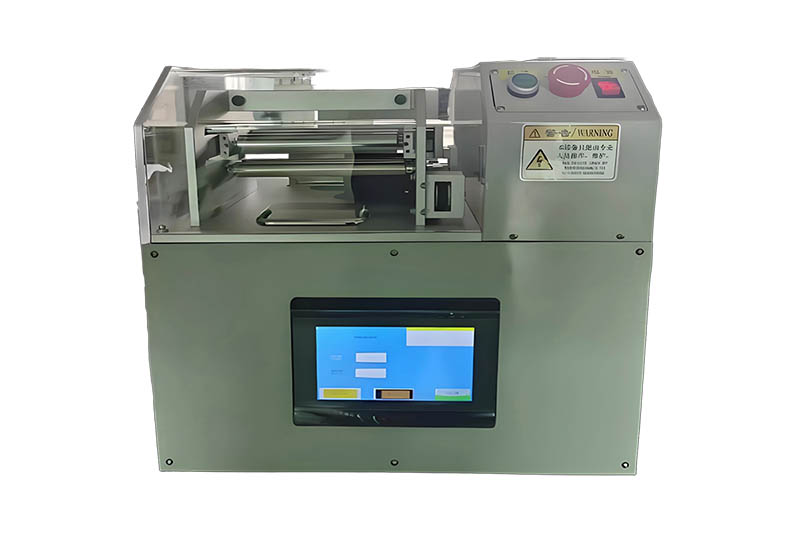
Figure: PT087 dynamic flexison tester cycling booklets at programmable stroke and rate. Equipment: PT087 Dynamic Flexison Tester for Passport Bending Fatigue.
Engineering Advantages
✓ Programmable Stroke and Rate
Displacement per cycle and cycles per minute are both recipes, so a screening run and a qualification run differ by settings rather than by hardware.
✓ No Drift Over Long Runs
A fatigue result is worthless if stroke drifts 0.2 mm over 20,000 cycles. The frame and drive are specified for continuous operation so cycle 20,000 is the same test as cycle 10.
✓ Counted, Not Estimated
Cycles are counted by the controller. Extrapolating from a shorter run is how a booklet gets qualified to a number nobody actually tested.
✓ Pairs With Electrical Measurement
The tester delivers mechanical cycles while a reader or impedance analyser tracks the electrical result, so degradation is captured as a trend instead of a verdict.
Technical Data
Stroke, rate, cycle budget and acceptance criteria follow the durability clause of your programme and the construction being qualified. ZOWINDA sets up the fixture and the recipe range against the booklet format and thickness you supply.
What the Curve Tells You
A fatigue curve converts a design argument into a purchasing decision. Two constructions that both pass a single-bend test at 10 mm radius can differ by a factor of five in cycles to failure - and the difference is usually the inlay, not the cover. Once the curve exists, a supplier change becomes a testable question rather than a commercial one: run the new material through the same ladder and compare the knee. The same ladder also protects against a subtle trap, where a stiffer cover improves the feel of a booklet and quietly reduces the fatigue life of the antenna underneath it, because a stiffer cover moves the neutral axis away from the wire.
- Comparing two inlay thicknesses before a design freeze
- Verifying that a new adhesive did not trade peel strength for fatigue life
- Justifying a service-life claim with a measured curve
- Screening returned batches against a known-good construction
Frequently Asked Questions
How is this different from the book bend tester?
The book bend tester loads the booklet about its spine at a controlled radius, which is the back-pocket case and shears the data page against the cover. The dynamic flexison tester cycles a reciprocating bend to build a fatigue curve. One is a severity fixture, the other is a life counter.
Should the booklet be read during cycling or only between pulls?
Between pulls is sufficient for most programmes and gentler on the sample. Continuous monitoring is used when the failure of interest is intermittent - a joint that opens only at a particular curvature - and it needs a reader positioned so the booklet is read at the same point in every cycle.
What stroke should we start with?
Start from the durability clause of your programme and from the curvature the booklet actually sees in service, then confirm the fixture can hold that stroke repeatably. The stroke is a specification input, not a machine default.
Next Step
More equipment in this range is listed on the ZOWINDA CardMachine product page, and related application notes appear in our Industry News section.
Related reading:
- PT086 Book Bend Stress Tester for ePassport Back-Pocket Durability
- PT088 Passport Torsion Stress Tester for Booklet Fatigue
- Three Wheel Tester for ICC Card Mechanical Reliability
Ready to boost your production efficiency?
Contact us for a tailored solution and quotation on the PT087 Dynamic Flexison Tester for Passport Bending Fatigue.
Email: info@zowinda.com
WhatsApp: +86 186 2085 0485
 PT088 Passport Torsion Stress
 PT087 Dynamic Flexison Tester
 PT086 Book Bend Stress Tester
 Auto Patch Pick and Place Mach
Please contact us with your request
We are ready to answer your questions.