
PT089 Sheet Turning Stress Tester | ePassport Page Folding & Torsion Durability Test Machine
PT089 Sheet Turning Stress Tester | ePassport Page Folding & Torsion Durability Test Machine: Engineering Notes from the Test Floor
Published: November 07, 2026 | ZOWINDA Application Engineering
A passport is read by being flipped through, and every flip is a controlled mechanical insult. The visa pages hinge at the spine, the data page hinges where it is bound in, and a single holder may turn those pages several times a month for a decade. A sheet turning stress test is the closest laboratory analogue to that real usage: it turns the pages one by one, at a defined angle and rate, and counts how long the construction survives the habit of its owner. Bend testers load the booklet as an object; a sheet turning tester loads it the way a border officer and a traveller actually use it.
What Page Turning Loads That Bending Does Not
When a page is turned, the load is not distributed across the booklet - it is concentrated at the hinge line of that one sheet. The cover stays flat while the page sweeps through its arc, so the paper, the laminate and any inlay inside the page are stressed in tension along a moving band, and the stitching or glue line at the spine sees a peeling action on every turn. A bend test bends all pages together and never exercises one sheet against the rest of the book; turning does, which is why a booklet can pass a flat bend test and still shed pages in the field.
The second difference is cumulative asymmetry. Travellers do not turn pages from both ends equally, and the tester can be programmed to reproduce that pattern - more cycles from the front, fewer from the back, or a defined mix. The damage profile that results matches what inspectors actually see on returned booklets: the first and last pages are the worn ones, because those are the ones hands find first. Testing that reproduces the usage pattern tests the right hinges.
How a Page-Turning Test Is Run
- Mount the booklet square on the turning fixture. The spine is registered against the fixture datum so every sheet turns about the same axis. A skewed booklet loads one page more heavily and the run stops being comparable.
- Programme the turning pattern. Turn angle, turn rate, which sheets are exercised and in what sequence are all recipe parameters. The default recipe mirrors front-to-back reader behaviour.
- Set the cycle budget and inspection ladder. A screening run answers quickly whether a construction is obviously weak; a qualification run counts to the programme figure. Pulls at intermediate counts build the degradation curve.
- Inspect hinges and page roots at each pull. Whitening along the fold, hairline cracks at the page root and loosening at the spine are the visible signatures. Read performance is checked too, since an antenna crossing the hinge degrades before it visibly cracks.
- Record and release against the programme clause. Pass and fail come from the durability clause of the passport programme or an internal standard; the tester supplies the counted, repeatable cycles that clause needs.
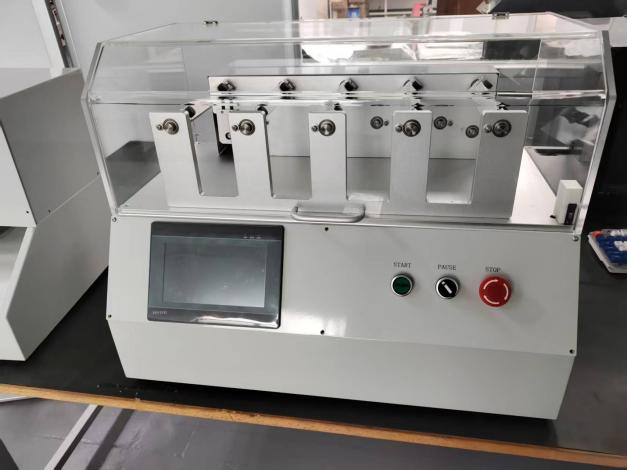
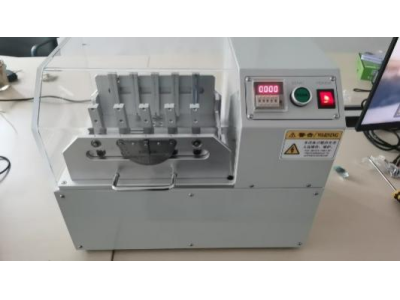
Figure: PT089 sheet turning stress tester turning booklet pages at programmable angle and rate. Equipment: PT089 Sheet Turning Stress Tester | ePassport Page Folding & Torsion Durability Test Machine.
Engineering Advantages
✓ Reader-Realistic Motion
The turning stroke reproduces how a page is actually flipped - a sweep about the spine, not a crush - so the damage mode matches field failures instead of bench artefacts.
✓ Selectable Sheet Targeting
Individual sheets or sheet groups can be exercised, which isolates the data page hinge from the visa page hinges and attributes the failure precisely.
✓ Recipe-Based Cycles
Angle, rate, pattern and count are stored recipes, so a supplier comparison run and a qualification run are the same machine at different settings, and results stay comparable across labs and shifts.
✓ Electrical Verification at Pulls
Mechanical wear on an inlay shows up first as resonance drift and read-range loss; the inspection ladder measures it rather than waiting for a visible crack.
Technical Data
Turn pattern, cycle count and acceptance criteria follow the durability clause of your programme and the booklet construction being qualified. ZOWINDA specifies fixtures and the recipe range against the format and thickness you supply.
Where It Fits in a Durability Programme
The most informative result is comparative. Two binding methods that look identical on a specification sheet separate immediately when ten booklets of each are run through the same turning recipe: the cycle count at which the first page root whitens is a number a supplier can be held to. The second use is complaint reproduction. A returned booklet with a loose first page is an anecdote until the same failure is produced in a counted run on a sibling sample - then it becomes a question about one process parameter, usually the spine glue application width, and a conversation with the supplier that ends in a change instead of an argument.
- Design verification of a new booklet binding construction
- Comparing stitching versus gluing versus thread-sealing at the spine
- Batch screening after a cover or adhesive change
- Reproducing field complaints of loose or shedding pages
Frequently Asked Questions
How is a sheet turning test different from a dynamic flexing test?
Flexing bends the whole booklet as one object and accumulates fatigue at the hinge; turning exercises one sheet against the rest of the book and peels the spine line. Flexing finds a weak antenna, turning finds a weak binding. A complete programme runs both.
Can the tester turn pages from both directions?
Yes. Turning direction, sheet selection and pattern are recipe parameters, so the fixture can reproduce a front-to-back reader, a back-to-front one, or a mixed pattern that matches the statistics of actual usage.
Do we need to read the chip during the run?
Between pulls is sufficient for most programmes and keeps the sample handling simple. Continuous read monitoring is used when the failure of interest is an intermittent antenna break that only opens at a particular turn angle.
Next Step
More equipment in this range is listed on the ZOWINDA CardMachine product page, and related application notes appear in our Industry News section.
Related reading:
- PT086 Book Bend Stress Tester for ePassport Back-Pocket Durability
- PT088 Passport Torsion Stress Tester for Booklet Fatigue
- PT095 Data Page and Cover Warpage Tester - MRP Passport Flatness Test
- PT093 Peel Strength Tester - Passport Cover Peel Resistance Test Machine
Ready to boost your production efficiency?
Contact us for a tailored solution and quotation on the PT089 Sheet Turning Stress Tester | ePassport Page Folding & Torsion Durability Test Machine.
Email: info@zowinda.com
WhatsApp: +86 186 2085 0485
 PT093 Peel Strength Tester - P
 PT095 Data Page & Cover Wa
 PT089 Sheet Turning Stress Tes
 PT088 Passport Torsion Stress
Please contact us with your request
We are ready to answer your questions.