
Contactless Card Test Programme: One Matrix for Electrical, Mechanical and Functional
Smart Card Manufacturing Notes
Contactless Card Test Programme: One Matrix for Electrical, Mechanical and Functional
Published: November 12, 2026 | ZOWINDA Application Engineering
Most card test programmes are a list of tests somebody inherited, run in whatever order the lab has free capacity. The tests themselves are usually correct. What is missing is the link between a test and the failure it is supposed to prevent, which is why a card can pass everything on the list and still fail in a wallet, a turnstile or a passport gate. A programme is not a list; it is an order, with a reason for each step.
Three Kinds of Test, Three Different Questions
Electrical tests ask whether the card still works as a resonant circuit: resonance position, bandwidth, load modulation depth and the field at which the chip starts. They are fast, they are the cheapest screening available, and they are the only category that can be run on every card rather than on a sample. A programme that starts anywhere else is spending money before it has spent the cheapest money.
Mechanical tests ask whether the card still works after the abuse a card receives. Bending, torsion, peel strength, surface pressure and flatness each target a specific interface: the antenna-to-body bond, the module-to-cavity bond, the cover-to-core laminate, the printed layer. They are slow, destructive and sample-based, which is precisely why they must be paired with an electrical re-test afterwards. A mechanical result on its own tells you the card survived a fixture; it does not tell you the card still reads.
Functional and environmental tests ask whether the credential still behaves as a credential: transaction sequences, cryptographic responses, behaviour after temperature and humidity cycling. These are the closest proxy for the field, and they are also the slowest, so the whole art of a programme is deciding what runs on every card, what runs on a sample, and what runs only at qualification.
The Order That Makes the Results Mean Something
- Screen electrical before anything destructive. Resonance and load modulation on the incoming population. Anything outside the window is removed before it consumes test time, and the distribution becomes the baseline you will compare against later.
- Record the baseline at the reference plane. Measure at the standard positions with a calibrated reader, so later results are comparable to a scheme requirement rather than to the bench you happen to own.
- Apply mechanical stress one interface at a time. Bending, torsion, pressure and peel each attack something different. Running them in sequence on one sample tells you the card failed; running them on separate samples tells you where.
- Re-test electrically after every mechanical step. This is the step most programmes skip. Post-stress resonance drift and a rise in the starting field are the earliest visible signs of a bond that is failing but not yet open.
- Finish with a functional pass on the survivors. Only cards that still read should be taken through transaction and cryptographic testing. Otherwise a logical failure gets blamed on the reader protocol.
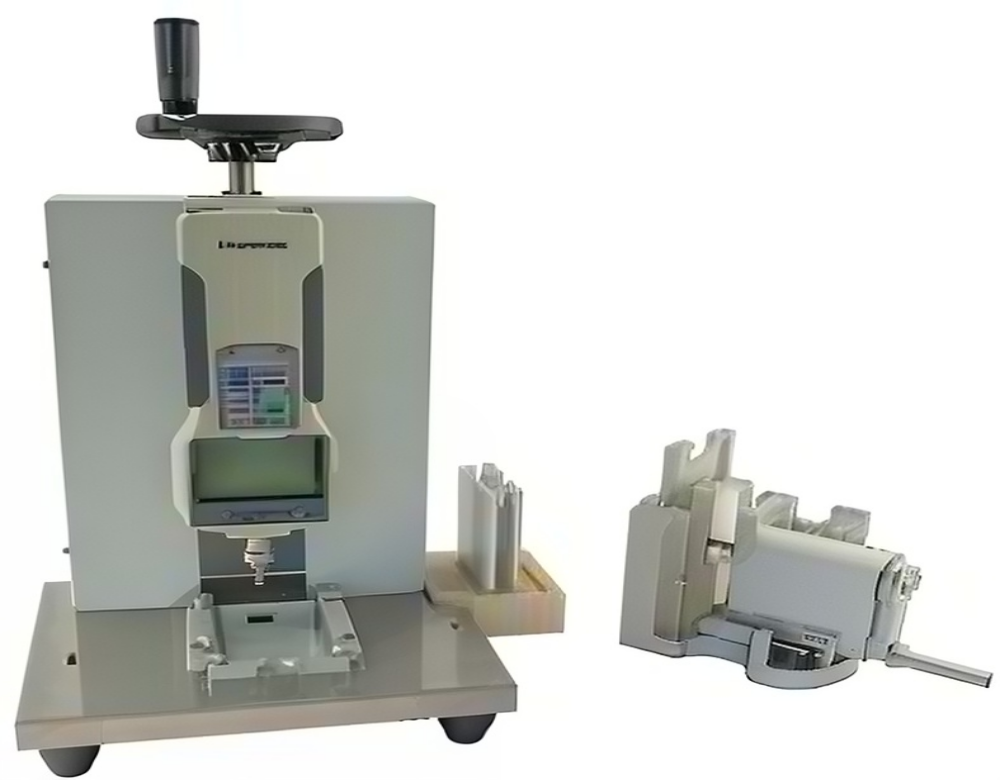
Figure: mechanical stress applied at a defined interface, followed by an electrical re-test, is what turns a destructive test into evidence. Equipment: ICC Backside Spot Pressure Tester.
What Each Layer Buys You
✓ Cheap Screening at 100 Percent
Electrical measurement on every card catches tuning drift and process excursions while the batch is still in the building, at a cost per card that no mechanical test can approach.
✓ Interface-Specific Mechanical Evidence
Pressure, peel, bend and torsion results are only useful when they name the interface that failed. A pass or fail on a whole card is a data point; an interface is a corrective action.
✓ Post-Stress Re-Test as the Real Signal
Field failures are dominated by cards that were electrically fine when shipped and degraded afterwards. Post-stress electrical data is the closest laboratory proxy for that.
✓ Sampling That Matches the Risk
One hundred percent electrical plus sampled destructive testing is a defensible programme. Sampled electrical testing plus sampled destructive testing is a programme that finds problems late.
Building the Matrix
Test methods and pass limits come from the standard and scheme you are qualified against. What this matrix fixes is the order and the pairing, which is where most programmes lose the value of tests they are already paying for.
Where a Matrix Changes Outcomes
The value of the matrix is not that it adds tests. It is that it stops tests from being read in isolation. A resonance reading means something different before and after a bend; a peel result means something different when it is paired with a post-stress range measurement. Once the pairing is fixed, the programme produces evidence that survives contact with a customer, and each new failure mode arrives with the test that should have caught it already identified. The companion notes on antenna resonance and on inlay sheet yield explain the two measurements this programme depends on most.
- Qualifying a new card body or a new adhesive without repeating field failures
- Answering a customer complaint with an interface rather than an opinion
- Deciding sampling rates for a new product introduction
- Auditing a subcontractor whose cards pass their own tests but fail yours
Frequently Asked Questions
Why re-test electrically after a mechanical test?
Because the mechanical result only says the card survived the fixture. Most degradation from bending, torsion or pressure shows up first as a resonance shift or a higher starting field, long before the card stops working entirely. Re-testing converts a destructive test into a trend.
Can electrical testing replace mechanical testing?
No. Electrical tests are sensitive to tuning and to some bond degradation, but they cannot see a laminate that will delaminate after fifty bend cycles. They are a screening layer, not a substitute.
How many cards should be destroyed per lot?
Enough to see the failure mode you are worried about, taken from the same population the electrical screening passed. The number matters less than the rule that every destructive result is followed by an electrical one.
Next Step
More equipment in this range is listed on the ZOWINDA CardMachine product page, and related application notes appear in our Industry News section.
Related reading:
- Contactless Card Read Range: Diagnosing Antenna Resonance and Detuning
- Inlay Sheet Yield Maths: Where a Two Percent Layout Change Pays
- ICC Backside Spot Pressure Tester for Smart Card Quality Control
- PT093 Peel Strength Tester for Passport Cover Peel Resistance
- PT095 Data Page and Cover Warpage Tester for ePassport Booklets
Ready to boost your production efficiency?
Contact us for a tailored solution and quotation on inlay production, card testing and personalisation equipment.
Email: info@zowinda.com
WhatsApp: +86 186 2085 0485
 Contactless Card Test Programm
 Inlay Sheet Yield Maths: Where
 Contactless Card Read Range: D
 Automated Card Sealing, Labeli
Please contact us with your request
We are ready to answer your questions.