
Automated Card Sealing, Labeling and Sorting Machine for Card Fulfilment
Smart Card Manufacturing Notes
Automated Card Sealing, Labeling and Sorting Machine for Card Fulfilment
Published: November 11, 2026 | ZOWINDA Application Engineering
The last three steps of card fulfilment look like three jobs. A card is sealed into its carrier, the carrier gets a label, and the carrier is sorted to a destination. Treat them as three jobs and you get three queues, three counts, and one persistent error mode: a carrier that is sealed correctly, labeled with somebody else's identity, and sorted to a destination that matches the label rather than the card inside. Nothing at any individual station reports a failure, because no station ever saw the whole carrier.
Why the Label Must Follow the Seal, Not the Card
Label content is an identity claim, and identity is only meaningful against a sealed carrier. If the label is applied before sealing, the seal operation becomes an unverified transformation of a labeled object, and any error in that transformation is invisible: a double carrier, a mis-inserted card, a carrier that failed to close. Applying the label after the seal inverts the relationship, so the label certifies a finished object, and the seal integrity check happens before the identity is committed to paper.
Sorting depends on that same claim. A sorter that reads the label is trusting the label; a sorter that reads the card and compares it to the label is verifying the carrier. The difference matters at exactly the rate that manual rework is expensive, because the failure mode it catches, a valid label on a wrong card, is the one that reaches the cardholder and cannot be fixed afterwards. Running sealing, labeling and sorting on one transport also collapses the counting problem: one carrier, one record, one pass, one exception pocket.
The practical constraint is mechanical, not conceptual. Sealing needs pressure and dwell, labeling needs accurate placement on a surface that may be curved or flexible, and sorting needs a read window with enough time to decode. Putting all three on one transport means the carrier is handled once and never re-registered, which is what makes a three-function line more accurate than three single-function stations in series, even when the individual stations are identical.
How a Fulfilment Cycle Runs
- Collate the card into its carrier. Card and carrier are matched to the job record before the seal closes. A mismatch is rejected before any identity is printed.
- Seal and check the closure. The carrier is sealed under controlled pressure and dwell, and closure is verified. Only a verified closure is allowed to continue to labeling.
- Print and apply the label. The label is generated from the same record used for collation, then applied to the sealed carrier. Because the seal is already verified, the label certifies a finished object.
- Read the label and compare with the card. The applied label is read back and compared with the card identity, which catches the one failure no single station can see: a correct label on the wrong card.
- Sort to destination with exceptions quarantined. Carriers are sorted to their destination pocket, and any carrier failing collation, closure or label comparison goes to quarantine with its record closed as an exception.
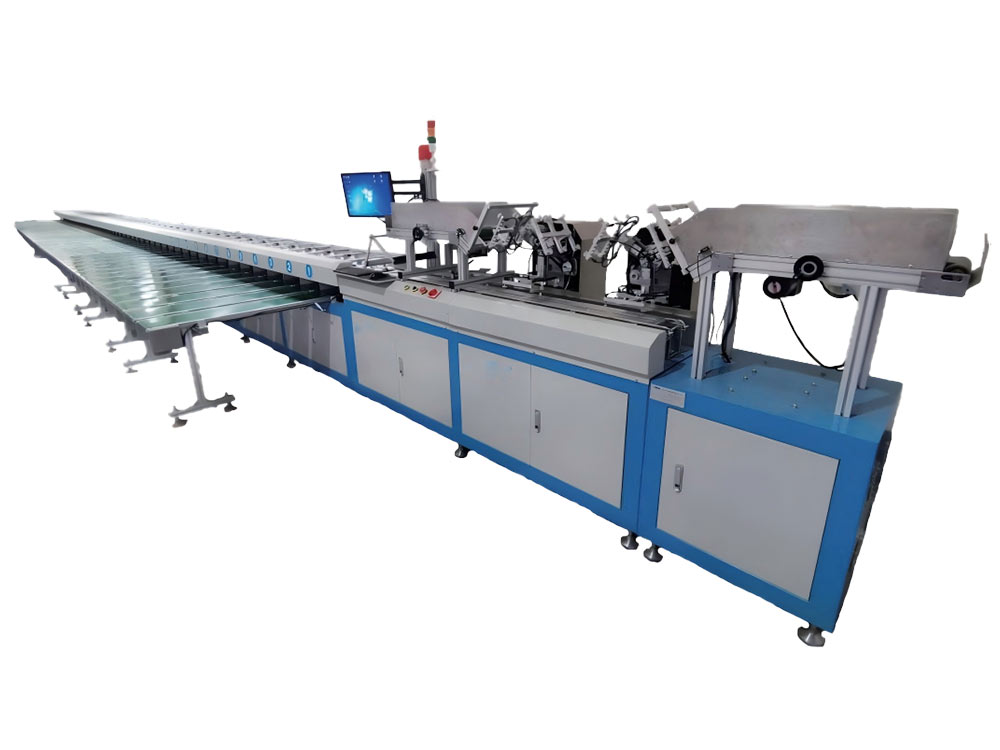
Figure: a card fulfilment line where sealing, labeling and sorting run on one transport and share a single carrier record. Equipment: Automated Card Sealing, Labeling and Sorting Machine for Card Fulfilment.
Engineering Advantages
✓ Seal Before Identity
The label is applied to a verified sealed carrier, so identity is committed only after the physical object is known to be complete.
✓ Label Read-Back Verification
Applied labels are read and compared with the card record, which catches wrong-card-in-right-carrier errors that station-level checks miss.
✓ One Transport, One Registration
The carrier is handled once, so sealing, labeling and sorting all work from the same mechanical reference instead of three.
✓ Reconciliation by Pocket
Destination pockets plus a quarantine pocket close every carrier record, making the dispatch count a report rather than a recount.
Technical Data
Throughput and pocket configuration depend on carrier format and destination layout. Values are qualified per project against the mail piece you actually dispatch.
Where It Fits in the Production Chain
Fulfilment is the part of card production that is easiest to under-automate, because each individual step is simple enough to do by hand and the errors are only expensive after the mailer leaves the building. The argument for a combined sealing, labeling and sorting line is not labour saving; it is that a carrier can only be verified as a whole object, at one place, once. Read with the personalization and sorting notes, this is the step where a credential becomes a delivery, and the last point at which a mistake can still be caught inside your own four walls.
- Bank card dispatch where carriers are mailed directly to cardholders
- SIM and scratch-card fulfilment with per-carrier identity
- Loyalty programmes with multi-destination bulk dispatch
- Bureaux that must reconcile sealed carriers to a job before handover
Frequently Asked Questions
Why not label the card before it goes into the carrier?
Because the label would then describe an intention rather than a verified object. Applying it to a sealed, closure-checked carrier means the identity claim is made against something that is known to be complete and to contain the right card.
Can the line sort by destination without reading the card?
It can, but then it is trusting the label. Reading the label back and comparing it with the card record is what turns sorting into verification, and it is the only check that catches a valid label applied to the wrong card.
What happens to a carrier that fails the closure check?
It is quarantined before labeling, with its record closed as an exception. That ordering matters: a carrier that never receives a label cannot be dispatched by mistake later, and the exception is attributable to the sealing station.
Next Step
More equipment in this range is listed on the ZOWINDA CardMachine product page, and related application notes appear in our Industry News section.
Related reading:
- Automatic Milling and Implanting Machine for Smart Card Modules
- GSM Card Personalization Machine: Automatic End-to-End Encoding and Printing Line
- Sealing and Labeling Machine for Auto Express Cardboard Envelope
- Card Sorting Machine (20/40 Outputs), Efficient and Accurate
- Automatic Sealing and Labeling Machine for Personalized Card
Ready to boost your production efficiency?
Contact us for a tailored solution and quotation on the Automated Card Sealing, Labeling and Sorting Machine for Card Fulfilment.
Email: info@zowinda.com
WhatsApp: +86 186 2085 0485
 Automated Card Sealing, Labeli
 GSM Card Personalization Machi
 Automatic Milling and Implanti
 PT085 Passport Durability Test
Please contact us with your request
We are ready to answer your questions.