
PT095 Data Page & Cover Warpage Tester - MRP Passport Flatness Test
PT095 Data Page & Cover Warpage Tester - MRP Passport Flatness Test: Engineering Notes from the Test Floor
Published: November 07, 2026 | ZOWINDA Application Engineering
Flatness is the quiet specification in every machine-readable passport. The data page must lie flat enough for optical character recognition, flat enough for the reader platen, and flat enough that the laminate does not start visibly lifting within months of issuance. None of that is measured by bending or torsion - a booklet can be mechanically sound and still curled. Warpage is a residual-stress problem: it comes out of lamination, drying and thermal cycles, and it grows with humidity and age. A warpage tester turns that slow distortion into a number measured at goods-inward, when the cause is still traceable to a batch.
Why a Passport Warps
A data page is a laminate of dissimilar layers - polycarbonate or PET-G over paper or inlay, with adhesives between. Each layer has its own coefficient of humidity expansion and its own residual tension from the conversion process. When the stack equilibrates after lamination, the layers shrink by different amounts and the stack bows toward whichever layer dominates. A curl of a fraction of a millimetre across the page is invisible on a desk and entirely visible to a flatbed document reader, which needs the data page to conform to its platen within a tolerance that is written into reader specifications for a reason.
The second driver is thermal history. A booklet that was hot-laminated and cooled under uneven pressure keeps a frozen-in stress, and every later warm cycle relaxes a little more of it. That is why warpage measured on the day of production understates warpage at issuance. The practical answer is to measure flatness under a defined conditioning routine, so a goods-inward figure and an after-ageing figure are the same measurement and can be compared against the same limit.
How Flatness Is Measured
- Condition the booklet to the reference environment. Warpage depends on humidity and temperature at measurement time. The conditioning routine is part of the method, not an optional preliminary.
- Place the booklet on the reference datum unconstrained. Clamping or weighting the cover flat would measure the clamp. The booklet rests under its own weight, exactly as it lies in a reader.
- Measure the deviation profile. Corner lift, centre bow and edge waviness are recorded against the datum. A single maximum-height figure is convenient for pass or fail; the profile is what tells you which layer is dominating.
- Record both orientations. Curl is rarely axis-symmetric. Measuring the booklet in both orientations distinguishes a machine-direction bow, which points at lamination tension, from a cross-direction dish, which points at layer mismatch.
- Compare against the programme limit and release. The acceptance limit comes from the reader-conformance requirement of the programme. A batch inside limit is released; a batch near the limit is flagged for an after-ageing check.
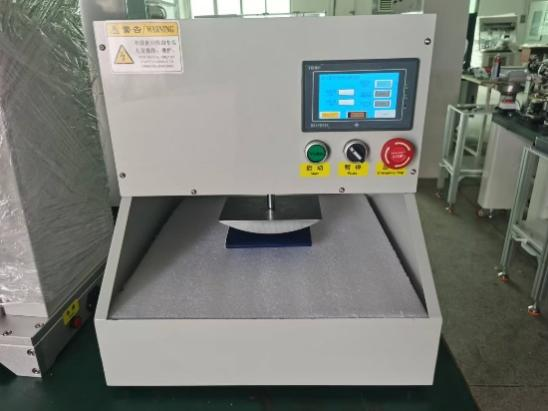
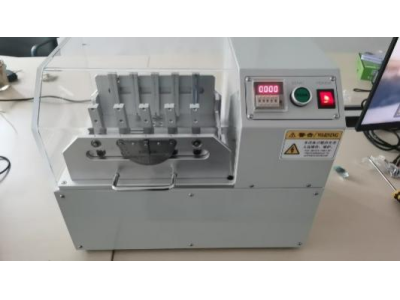
Figure: PT095 data page and cover warpage tester measuring booklet flatness on a reference datum. Equipment: PT095 Data Page & Cover Warpage Tester - MRP Passport Flatness Test.
Engineering Advantages
✓ Datum-Based Measurement
Flatness is measured against a reference surface rather than judged by eye, so a 0.4 mm corner lift is a fact, and two inspectors cannot disagree about it.
✓ Profile, Not Just a Number
Recording the whole deviation profile separates machine-direction bow from cross-direction dish, and that distinction is what points the correction at the right lamination parameter.
✓ Conditioning-Aware Method
The measurement is defined together with its conditioning routine, which is what makes a goods-inward result comparable with an after-ageing result and with a supplier figure.
✓ Covers the Whole Booklet
The data page and the cover are measured in one setup, because a flat data page on a warped cover still fails the reader check - the reader sees the booklet, not the page alone.
Technical Data
Conditioning routine, measurement orientations and acceptance limits follow the reader-conformance requirement of your programme. ZOWINDA specifies the datum and the record format against the booklet formats you test.
What the Profile Tells the Factory
The diagnostic value is in the shape of the deviation. A uniform machine-direction bow almost always points at unbalanced lamination roll tension or an asymmetric cooling press, and it responds to a settings change within a shift. A cross-direction dish points at layer mismatch - one supplier of cover film replaced another, or a paper gauge drifted - and it responds to material, not to machine settings. A booklet that is flat when measured and curls after ageing points at trapped solvent or an under-cured adhesive. Three different causes, three different owners in the factory, and none of them can be told apart from a single maximum-height number without the profile behind it.
- Goods-inward control of data page and cover laminate suppliers
- Setting and auditing lamination cooling pressure after a process change
- Investigating reader reject rates that correlate with a batch
- Before-and-after checks in humidity and thermal ageing studies
Frequently Asked Questions
Is warpage a defect on its own, or only cosmetic?
It is functional. Document readers specify a flatness tolerance for the data page because optical capture and chip coupling both degrade as the page lifts off the platen. A curled booklet may pass every electrical test and still fail at the border reader.
Why measure the cover as well as the data page?
Because the reader presents the whole booklet. A flat data page bonded into a warped cover arrives at the platen warped, and the cover distortion usually has a different root cause from the page distortion, so measuring both in one setup saves a second routing.
Can flatness be checked with a simple gauge instead?
A feeler gauge gives one number at one point, taken by one operator, with no profile and no record. That is enough to sort obviously bad parts and not enough to diagnose a drifting lamination process, which is the situation where flatness data actually pays for itself.
Next Step
More equipment in this range is listed on the ZOWINDA CardMachine product page, and related application notes appear in our Industry News section.
Related reading:
- PT086 Book Bend Stress Tester for ePassport Back-Pocket Durability
- PT087 Dynamic Flexison Tester for Passport Bending Fatigue
- PT089 Sheet Turning Stress Tester | ePassport Page Folding and Torsion Durability
- PT093 Peel Strength Tester - Passport Cover Peel Resistance Test Machine
Ready to boost your production efficiency?
Contact us for a tailored solution and quotation on the PT095 Data Page & Cover Warpage Tester - MRP Passport Flatness Test.
Email: info@zowinda.com
WhatsApp: +86 186 2085 0485
 PT093 Peel Strength Tester - P
 PT095 Data Page & Cover Wa
 PT089 Sheet Turning Stress Tes
 PT088 Passport Torsion Stress
Please contact us with your request
We are ready to answer your questions.