
PT093 Peel Strength Tester - Passport Cover Peel Resistance Test Machine
PT093 Peel Strength Tester - Passport Cover Peel Resistance Test Machine: Engineering Notes from the Test Floor
Published: November 07, 2026 | ZOWINDA Application Engineering
Every delamination complaint starts as a bond that was weaker than the process believed. The cover-to-data-page joint in an ePassport carries no electrical function and no optical function until the day it fails - and when it fails, the failure is not a subtle read error but a visibly separating document, a refund, and a batch audit. Peel strength is the measurable quantity behind that risk: the force required to separate the laminated layers, measured at a defined angle and rate. It is the one test that converts "the lamination looks good" into a force in newtons per width that can be tracked batch to batch.
What Peel Strength Actually Tells You
A peel measurement integrates everything that went wrong upstream: surface preparation, adhesive weight, lamination temperature, pressure and dwell, and the cleanliness of the tooling. That is both its weakness and its value. It does not tell you which parameter drifted, but it is sensitive to all of them, which makes it the ideal single goods-inward and end-of-line gate - a low peel number is an unambiguous signal that something in the lamination process changed, even before anyone knows what. Tracking the number over time converts the test from a pass or fail gate into a process drift detector.
The second thing peel strength reveals is the failure mode, not just the force. A strong bond that fails in the cover material is a different result from a weak bond that fails cleanly at the adhesive line, and both differ from an adhesive that leaves residue on one surface. Recording where the separation ran is as important as recording the peak force, because the failure location points to the layer that owns the problem - and that is the layer whose supplier or process step gets the corrective action.
Running a Peel Test
- Prepare the specimen with a defined peel front. The layers are separated over a short starting tab so the peel front begins at a consistent position. Where the peel starts changes the measured force, so the preparation is standardised.
- Clamp in the peeling fixture. One layer is gripped by the moving head, the other by the fixed clamp. Grip alignment matters: an off-axis pull adds a normal force component and inflates or deflates the reading.
- Set angle and rate. Peel force depends on angle - a 90-degree peel and a T-peel of the same bond produce different numbers - and on rate, because viscoelastic adhesives are stiffer when pulled fast. Both are fixed by the method so results are comparable.
- Run and record the force trace. The force is recorded continuously, not as a single peak. The average over the steady region is the peel strength; spikes and drops in the trace mark adhesive starvation or contamination along the bond line.
- Classify the failure and file the record. Adhesive failure, cohesive failure, or substrate failure are recorded per specimen. The force value and the failure mode together are the batch record that a supplier conversation can act on.
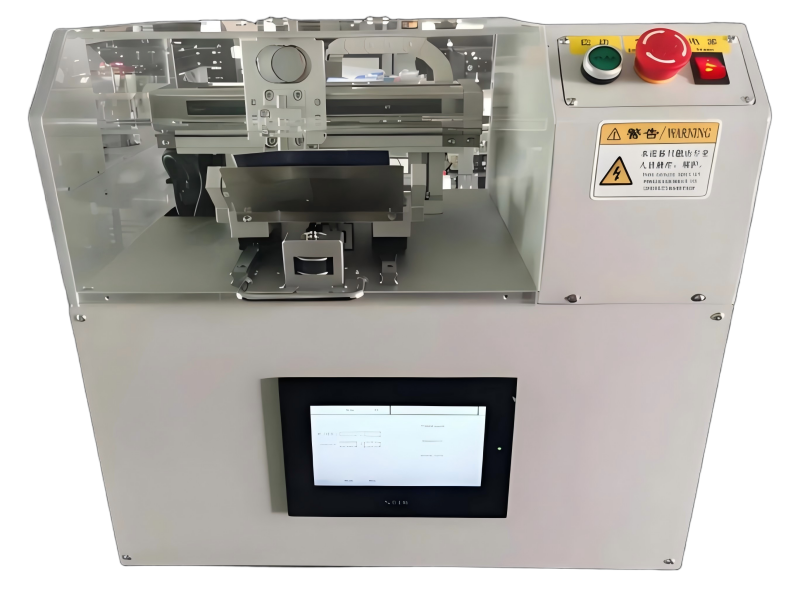
Figure: PT093 peel strength tester measuring cover-to-data-page bond force at a controlled peel angle. Equipment: PT093 Peel Strength Tester - Passport Cover Peel Resistance Test Machine.
Engineering Advantages
✓ Angle- and Rate-Controlled Peeling
Peel angle and pull rate are method parameters held by the fixture and drive, so a result from this week is comparable with a result from last quarter and with a supplier certificate.
✓ Continuous Force Trace
Recording the full trace rather than a peak exposes starvation, contamination and inconsistent adhesive weight along the bond line - defects a single number hides.
✓ Failure-Mode Discipline
The method treats where the bond failed as part of the result, which is what turns a force figure into a corrective action aimed at the right layer.
✓ Batch-to-Batch Tracking
Steady peel averages are plotted over time, so lamination drift shows as a trend weeks before it produces a field delamination and a returned batch.
Technical Data
Peel angle, pull rate and acceptance force follow the bond clause of your programme and the adhesive system in use. ZOWINDA specifies grips and the method parameters against the specimen geometry you supply.
Using Peel Data Across the Supply Chain
The force trace is where the money is. A bond that peels at a healthy average but shows regular dips every few millimetres is telling you the adhesive weight varies across the web - a nozzle or roller issue, not an adhesive issue. A trace that starts strong and decays toward the end of the specimen points at surface contamination that appeared mid-run. And a batch whose average dropped ten percent with no visible change in the parts is the earliest possible warning that something upstream moved. None of these signatures survives being compressed into a single pass or fail figure, which is why the tester is specified to record the whole trace and why the batch record keeps it, not just the summary.
- Goods-inward verification of laminated data page and cover deliveries
- Qualifying a new adhesive or a new cover film supplier
- Auditing lamination temperature, pressure and dwell settings
- Root-causing field delamination returns with a comparable test
Frequently Asked Questions
What peel angle should we specify?
Follow the method your programme or customer already recognises, and keep it fixed. The absolute force changes with angle, so switching methods mid-programme destroys the history you are building. ZOWINDA configures the fixture for the angle your standard calls for.
Is a higher peel number always better?
Up to the point where the failure moves out of the adhesive line and into the substrate. A bond that fails in the cover film can show a higher force than a well-bonded specimen and still be the worse construction, which is why failure mode is recorded alongside the force.
How many specimens per batch?
Enough to see the distribution, not just the average - peel is a property with real scatter because it integrates several process variables. ZOWINDA helps you set a specimen count and a sampling plan that matches the batch size and the risk of the lamination step.
Next Step
More equipment in this range is listed on the ZOWINDA CardMachine product page, and related application notes appear in our Industry News section.
Related reading:
- PT086 Book Bend Stress Tester for ePassport Back-Pocket Durability
- PT088 Passport Torsion Stress Tester for Booklet Fatigue
- PT089 Sheet Turning Stress Tester | ePassport Page Folding and Torsion Durability
- PT095 Data Page and Cover Warpage Tester - MRP Passport Flatness Test
Ready to boost your production efficiency?
Contact us for a tailored solution and quotation on the PT093 Peel Strength Tester - Passport Cover Peel Resistance Test Machine.
Email: info@zowinda.com
WhatsApp: +86 186 2085 0485
 PT093 Peel Strength Tester - P
 PT095 Data Page & Cover Wa
 PT089 Sheet Turning Stress Tes
 PT088 Passport Torsion Stress
Please contact us with your request
We are ready to answer your questions.