
GSM Card Personalization Machine: Automatic End-to-End Encoding and Printing Line
Smart Card Manufacturing Notes
GSM Card Personalization Machine: Automatic End-to-End Encoding and Printing Line
Published: November 11, 2026 | ZOWINDA Application Engineering
A personalization line is usually specified with one number, cards per hour, and usually disappoints against it. The reason is that the number describes a machine, while the output describes a sequence of handoffs: the card is encoded, printed, verified, and sorted, and between those four operations it is picked up, moved, buffered and picked up again. At every handoff a card can wait, and the card that waits holds up every card behind it. Sizing a line by its fastest station is how a factory ends up with an expensive machine idling behind a queue.
Four Handoffs, One Throughput
Encoding, printing, verification and sorting each have their own characteristic time and their own failure mode. Encoding is dominated by data transfer and secure key handling, printing by head speed and curing, verification by camera exposure and imaging time, sorting by mechanical travel to a pocket. A line only runs at the speed of the slowest of these, but it loses extra time at each interface, because the buffering that absorbs variation is also the place where a stalled card stops being visible to the operator.
The design question is therefore not how fast each station is but how much variation the line can absorb without an operator. A line with generous buffers hides a stop but also hides the cause; a line with tight coupling surfaces the problem immediately and is far easier to keep at rate. The practical compromise is short buffers at the two handoffs that carry the most variability, encoding to printing and printing to verification, and a hard coupled sort at the end where cards are already committed to a job.
There is a second, less visible cost: reconciliation. Every card that passes through the line carries a data record, and every handoff is a chance for the physical card and its record to diverge. A card rejected at verification but already counted as encoded, a reprint that duplicates a record, a sort pocket that receives the wrong carrier. These are the errors that do not show up in a throughput figure and do show up in a reconciliation report at the end of a shift, and they are the reason automated lines need a single data record that travels with the card rather than four station-level logs.
How a Job Runs Through the Line
- Load the job and the key material. The batch, its data file and the material needed for encoding are loaded together, so the line never encodes cards it cannot later account for.
- Encode each card and read it back. Data is written and immediately read back. A read-back failure is rejected in cycle rather than discovered at verification, which keeps the two stations from arguing over the same card.
- Print the visible identity. Printing applies the cardholder-visible layer. Because the card has just been read back, the print job is bound to a known-good record instead of to a presumed one.
- Verify print and chip against the record. Optical verification and chip reading are compared with the job record in one step, so print and data defects are classified once, with a single exception path.
- Sort into job-consistent pockets. Good cards go to their job pocket, exceptions to a quarantine pocket. The sort decision closes the record, which is what makes the end-of-shift reconciliation a report rather than an investigation.
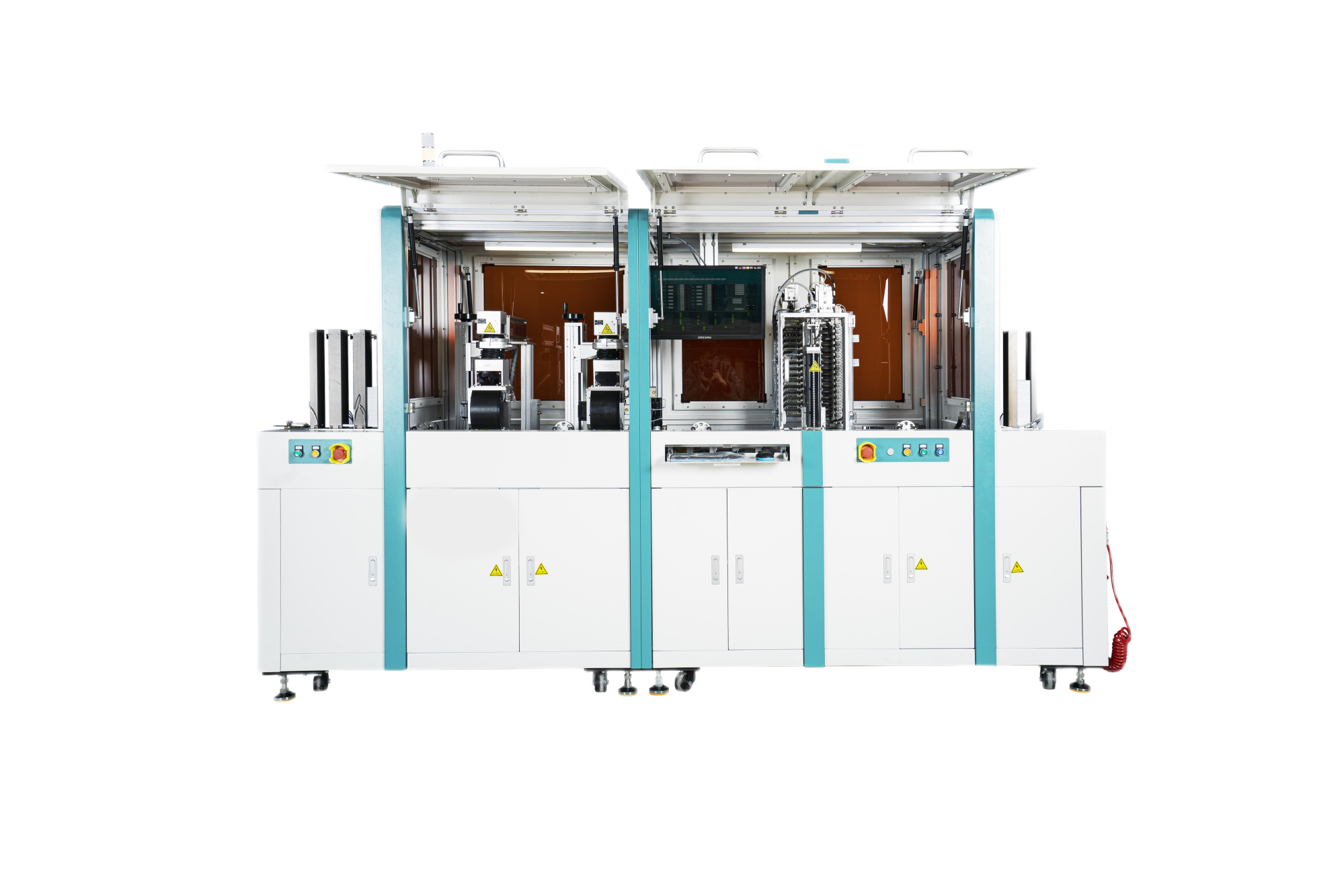
Figure: an automatic card personalization line, where encoding, printing, verification and sorting share one job record per card. Equipment: GSM Card Personalization Machine: Automatic End-to-End Encoding and Printing Line.
Engineering Advantages
✓ Rate Held at the Handoffs
Buffering is placed where variability is highest and removed where it is not, so the line keeps its qualified rate instead of averaging down to its worst interface.
✓ Read-Back Before Print
Encoding is verified immediately, so printing and personalization only ever consume cards with a confirmed data record.
✓ One Exception Path
Print and chip defects are classified against the same record, which means one quarantine pocket and one reprint workflow rather than parallel and inconsistent ones.
✓ Reconciliation by Report
Every card closes its record at sorting, so shift-end counts come from the line instead of from a manual comparison of station logs.
Technical Data
Station count, interfaces and throughput are configured per project. The figures above describe the typical production configuration and are qualified against your data format, card construction and site security requirements.
Where It Fits in the Production Chain
The useful way to specify this class of equipment is to name the handoff that will limit the line and to say what happens to a card that fails there. A line whose slowest point is encoding is a data problem; one whose slowest point is verification is an imaging problem; one whose slowest point is sorting is a logistics problem. Each has a different fix, and none of them is solved by buying a faster printer. Read alongside the module implanting and card recycling notes, personalization is where a manufactured card becomes a specific credential, and the only step where the data can be wrong in a way the physics cannot detect.
- Bank and transit card personalization bureaux
- SIM and GSM card data encoding with printed identity
- Loyalty and membership programmes with per-card printing
- In-house issuance where reconciliation must stay inside one system
Frequently Asked Questions
What actually limits the throughput of a personalization line?
The slowest handoff, plus the time lost at the interfaces around it. In most installations that is either encoding with read-back or optical verification, not printing. The line rate should be quoted for the qualified job mix rather than for a single station.
Why verify the chip immediately after encoding rather than at the end?
Because a card that fails read-back should never receive printed identity. Verifying at the source keeps rejects attributable to one station and stops a bad record from consuming print material and a sort slot.
How is a rejected card handled without breaking the count?
It is routed to a quarantine pocket and its record is closed as an exception rather than deleted. The job count then reconciles as encoded minus rejected equals shipped, which is auditable in a way that a manual count is not.
Next Step
More equipment in this range is listed on the ZOWINDA CardMachine product page, and related application notes appear in our Industry News section.
Related reading:
- Automatic Milling and Implanting Machine for Smart Card Modules
- Automated Card Sealing, Labeling and Sorting Machine for Card Fulfilment
- GSM Card Personalization Machine P8600 - SIM Card Data Encoding and Printing
- Smart Card Chip Recycling Machine CR3000 - Automatic IC Chip Recovery System
- ICC Backside Spot Pressure Tester - e-Passport Chip Module Adhesion Test
Ready to boost your production efficiency?
Contact us for a tailored solution and quotation on the GSM Card Personalization Machine: Automatic End-to-End Encoding and Printing Line.
Email: info@zowinda.com
WhatsApp: +86 186 2085 0485
 Automated Card Sealing, Labeli
 GSM Card Personalization Machi
 Automatic Milling and Implanti
 PT085 Passport Durability Test
Please contact us with your request
We are ready to answer your questions.