
PT085 Passport Durability Test System 2026 | ZOWINDA
Passport & Travel Document Testing
PT085 Passport Durability Tester: One Benchtop for Stamp, Pen Stress and Abrasion
Published: November 11, 2026 | ZOWINDA Application Engineering
A passport is judged not only by how it presents on the day it is issued, but by how it survives years of daily handling. Official stamps pressed into the data page, ballpoint pens dragged across laminated surfaces, zipped pockets, and rough tabletops all slowly wear the booklet until the machine-readable zone stops scanning or the cover starts to delaminate. The PT085 Passport Durability Test System is built to reproduce that lifetime of mechanical wear on a benchtop, in a few hours, against the international methods that issuing authorities, personalization bureaus and independent inspection labs actually cite. It is a passport durability tester that folds three distinct endurance disciplines - stamp imprint, pen stress and abrasion - into one compact unit, so a single operator can qualify a document construction without moving it between three separate rigs.
Why Combine Stamp, Pen Stress and Abrasion in One Machine
Mechanical durability testing has historically meant three separate pieces of equipment, each calibrated and trained on independently. A stamp imprint rig, a pen stress rig and an abrasion rig occupy floor space, each needs its own maintenance record, and each adds a station an operator must be qualified to run. The PT085 collapses that spread into a single benchtop footprint by sharing one motion platform, one control interface and one calibration chain across all three tests. For a document test lab that runs dozens of configurations a week, the saving is not only physical space but the far larger cost of keeping three instruments validated and three skill sets current.
Consolidation also makes the results comparable in a way separate rigs cannot guarantee. Because the same holder, the same force path and the same logging interface serve every test, a passport that passes stamping but fails abrading is judged on consistent geometry rather than on the quirks of three different machines. That consistency is exactly what an auditor or a customer qualification file expects to see, and it is difficult to reproduce when each test lives on its own bench with its own measurement chain.
The Three Core Tests, Explained
Stamp imprint test (ISO/IEC 18745 Clause 8.5): reproduces the repeated official stamping that data pages receive throughout a passport lifetime. A defined impression is applied with controlled force and cycle count so the laminate, the printed layer and the machine-readable zone can be inspected for cracking, ink bleed or loss of readability after repeated stamping.
Pen stress test (ISO/IEC 18745 Clause 8.11): applies a ballpoint pen pressure profile to the printed and laminated surfaces, simulating the handwriting and marking a passport endures. The test reveals whether surface print or the overlay lifts, pits or transfers under sustained point load.
Abrasion test (ISO/IEC 18745 Clause 8.12): rubs the document against a standardized abradant across a defined area and cycle count, standing in for pockets, bags and daily friction. It exposes weak overlays, poor lamination adhesion and fading long before a real passport would show the same damage in the field.
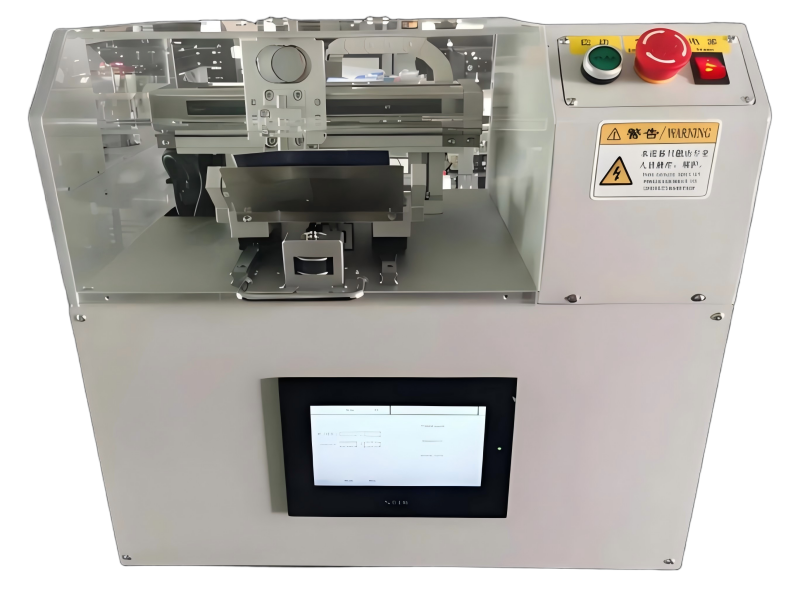
Figure: the PT085 passport durability tester performing a combined stamp, pen stress and abrasion sequence on a Machine Readable Passport. Equipment: PT085.
A Repeatable Test Cycle
- Mount the MRP in the holder. The Machine Readable Passport is clamped in the holder so every specimen is located against the same datum. A consistent mount is what makes results from one batch comparable to the next, and it is the step that removes operator-to-operator variation from the measurement.
- Select the test profile. Through the color touchscreen the operator chooses stamp imprint, pen stress or abrasion individually, or combines them into one sequence. Three ISO-preset trajectories are available and can be adjusted for custom severity.
- Set the parameters. Cycle count, frequency, test area, speed and force are entered on the editable interface. This is where a standard compliance run and a more severe research screening are separated by a few numbers rather than by a different machine.
- Run and log. The unit executes the profile and records the settings applied. Because the parameters are stored against the run, a repeat test months later can be reproduced exactly, which is what a qualification file requires.
- Inspect and report. After the cycle the document is removed and inspected for the failure modes each test is designed to expose, and the result is recorded against the specimen and the parameter set used.
A Repeatable Test Cycle
Three Tests, One Benchtop
Stamp imprint, pen stress and abrasion share one motion platform and one control interface, so a lab needs a single footprint, a single calibration chain and a single qualified operator instead of three.
ISO/ICAO Aligned
The tester is built around ISO/IEC 18745:2018 Clauses 8.5, 8.11 and 8.12 and ICAO Doc 9303 V3.2, so the profiles it runs are the ones authorities and inspection bodies already specify.
Editable Touchscreen Control
A color touchscreen presents three ISO-preset trajectories and lets operators adjust cycles, frequency, area, speed and force, making both standard compliance and custom stress screening straightforward.
Configurable Build
It is offered as a single test module or as an integrated 3-in-1 configuration, so a bureau can start with one discipline and expand without replacing the platform.
Beyond-Baseline Screening
Because parameters are fully adjustable, the same unit serves routine compliance checks and deeper research endurance profiles that probe a document construction past the ISO baseline.
Engineering Advantages
Standards references describe the test methods the PT085 is aligned with; final qualification is performed against the exact clause edition and specimen definition applicable to your document and market.
Technical Data
The passport durability tester earns its place wherever a document construction must be proven before it is issued at volume. A personalization bureau uses it to confirm that a new laminate or a new print process will still scan and still read after a simulated lifetime of stamps and friction. A manufacturer uses it to catch a weak overlay before a production lot ships. An inspection agency uses it to give an unbiased, standards-based verdict on a supplier claim. In every one of those settings the value is the same: a reproducible, documented endurance result that an auditor can read and trust, produced on one machine instead of three.
- Passport personalization bureaus qualifying every print and laminate run
- Government document test laboratories performing acceptance and audit testing
- Machine Readable Passport manufacturers running incoming and outgoing QC
- Independent inspection agencies validating supplier document constructions
- Research and development teams screening new booklet and data-page materials
Frequently Asked Questions
What standards does the PT085 support?
It is aligned with ISO/IEC 18745:2018 Clause 8.5 (stamp imprint), Clause 8.11 (pen stress) and Clause 8.12 (abrasion), and with ICAO Doc 9303 V3.2. Those are the methods most issuing authorities and inspection bodies cite, so the profiles it runs map directly onto standard qualification files.
Can the three tests be run as one combined sequence?
Yes. Each of stamp imprint, pen stress and abrasion can be selected on its own, or combined into a single sequence on the touchscreen. Combining them is useful when a document must be qualified against the full handling profile rather than against one isolated failure mode.
Does it only test passports?
It is purpose-built around Machine Readable Passport booklets, but any booklet-type or card-type travel or identity document with comparable laminate and print construction can be evaluated on the same platform. The holder and trajectories are what define the specimen, not the document name.
How are test parameters set and recorded?
Cycles, frequency, test area, speed and force are entered on the color touchscreen and stored with the run. Because the settings travel with the result, a test performed today can be reproduced exactly months later, which is what a qualification or audit record requires.
What utilities does the unit need?
It runs on a wide-range supply, AC 100-230 V at 50-60 Hz, and occupies a benchtop footprint of 550 x 370 x 550 mm at a net weight of 52 kg, so it fits a standard laboratory or bureau test bench without special infrastructure.
Related Equipment
More equipment in this range is listed on the ZOWINDA Passport Tester product page, and related application notes appear in our Industry News section.
Related equipment:
- PT086 Book Bend Stress Tester
- PT088 Passport Torsion Stress Tester
- PT095 Data Page & Cover Warpage Tester
Ready to qualify your passport construction?
Contact us for a tailored solution and quotation on the PT085 Passport Durability Test System.
Email: info@zowinda.com
WhatsApp: +86 186 2085 0485
 PT085 Passport Durability Test
 Smart Card Chip Recycling Mach
 GSM Card Personalization Machi
 Slot Milling Machine ZOWINDA30
Please contact us with your request
We are ready to answer your questions.