
GSM Card Personalization Machine P8600 - SIM Card Data Encoding and Printing
Smart Card Manufacturing Notes
GSM Card Personalization Machine P8600 - SIM Card Data Encoding and Printing
Published: November 10, 2026 | ZOWINDA Application Engineering
Personalization is the step where a blank card becomes a specific card: a subscriber identity, a payment application, an access credential. It is also the step where the value of the card jumps by an order of magnitude while the tolerance for error drops to zero, because a mis-personalized card is not a rework item, it is a liability. The P8600 GSM card personalization machine is built around that asymmetry: it moves cards quickly, but every function that touches data is designed to be verifiable, and every card that fails verification is rejected rather than corrected in place.
Why Data Integrity, Not Speed, Sets the Ceiling
Personalization throughput is usually quoted in cards per hour, and that number is real, but it is not the constraint that governs a personalization bureau. The constraint is the reconciliation rate: how many cards can be programmed, printed, verified and matched back to the job record per hour without a single unexplained card at the end. A line that programs three thousand cards an hour and leaves six cards unaccounted for is slower than a line that programs two thousand and leaves none, because six unexplained cards means a stop, an investigation, a re-run and an audit finding.
The second constraint is key handling. SIM and payment personalization depends on secret material, and the machine is where plaintext data meets card-bound keys. A modern platform treats the data path as part of the machine: the link to the key system is authenticated, the session is scoped to the current job, and the operator interface never exposes the material being written. That is a design decision with a visible consequence - the machine can be audited, which is the first thing a security review asks for and the last thing a retrofit can supply.
The Personalization Cycle
- Provision the job and the keys. The job carries the card range, the application profile and a reference to the key material. Keys are requested per job and are not resident on the machine between jobs.
- Feed, read and bind the card. Each card is identified before anything is written, so the physical card and the logical record are bound at this step. That binding is what makes later reconciliation possible at all.
- Program the card over the chosen interface. Data writing follows the card profile. Throughput here is a protocol property as much as a mechanical one: a well-tuned station spends its time inside the card rather than waiting for it.
- Print and verify in the same pass. Printed personalization data is verified against the job record inline, so a print defect is caught while the card is still on the transport instead of after packing.
- Reconcile, reject and report. Every card ends in exactly one state: good, rejected with a reason, or missing with an alarm. The job does not close until the count balances.
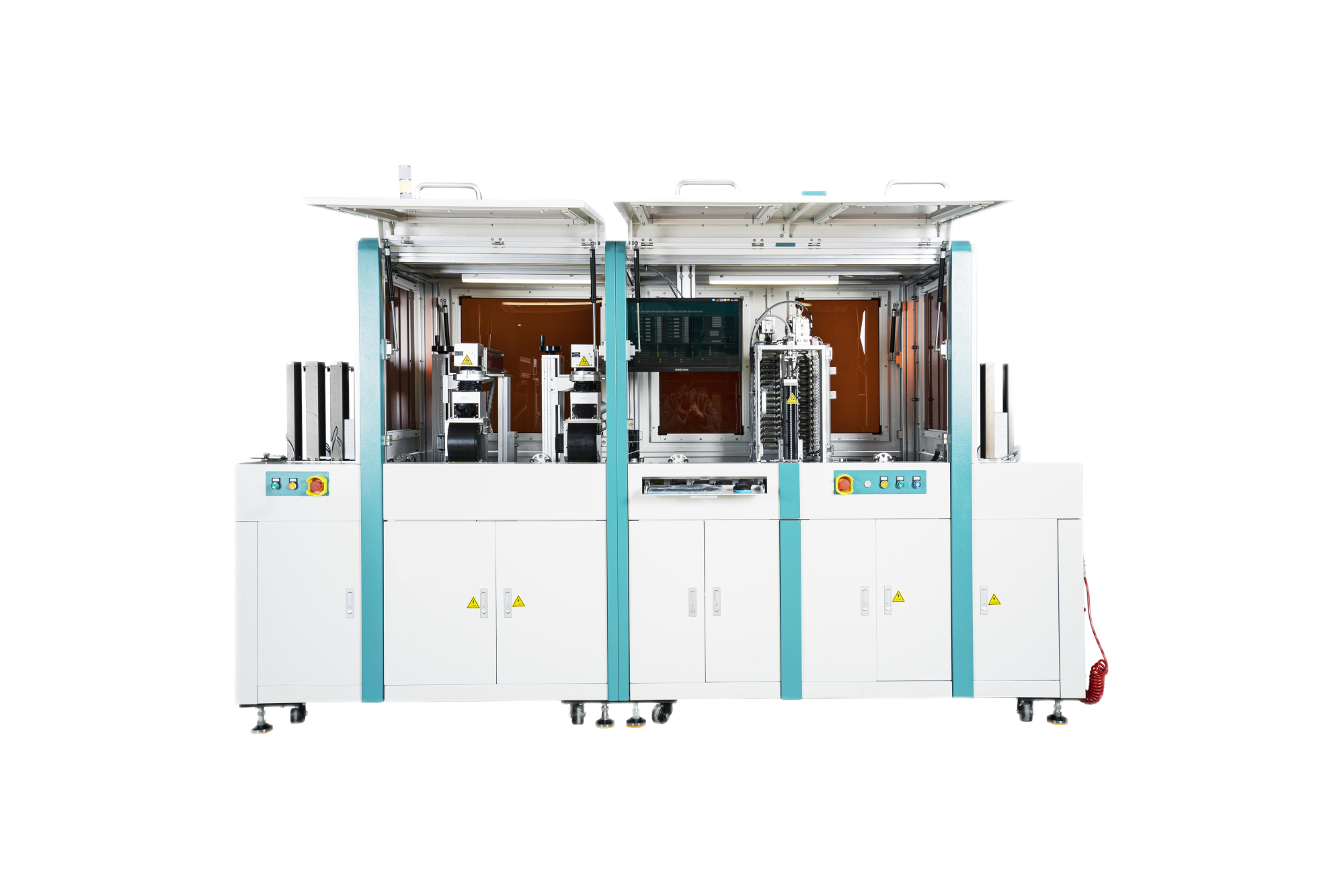
Figure: GSM / SIM card personalization station, programming and printing in a single card pass. Equipment: GSM Card Personalization Machine P8600 - SIM Card Data Encoding and Printing.
Engineering Advantages
✓ Integrated Data and Print Path
Programming, printing and verification happen in a single card pass, so the machine outputs a finished personalized card instead of an intermediate that still needs a second station and a second reconciliation.
✓ Job-Scoped Key Handling
Key material is requested per job and held only for that job, which keeps the operator surface free of secret data and makes the audit trail mean something.
✓ Inline Verification
Every card is read back and compared with its job record before it leaves the machine. A mismatch removes the card; it is never rewritten in place.
✓ Modular Perso Stations
Contact, contactless and print stations are modular, so one platform can be configured for SIM, payment or dual-interface documents without a platform replacement.
Technical Data
Throughput depends on the card profile, the application size and the print station fitted. Figures are typical for the production configuration and are confirmed against your job definition.
Applications
The pattern that matters in a personalization bureau is the exception, not the average. A run of five thousand cards produces its value in the four thousand nine hundred that pass and its risk in the handful that do not. A platform that makes exceptions visible at the moment they occur - and that closes every job with a balanced count - turns personalization from a machine that must be watched into a process that can be certified. That is also why the data path, not the transport, is where the engineering effort belongs: a card that moves quickly through a weak data chain is simply a faster way to create an unexplained card.
- SIM and USIM issuance for mobile operators
- Banking and payment card personalization
- Corporate identity and access credentials
- Transit and loyalty program cards
- Replacement and re-issue runs at bureau scale
Frequently Asked Questions
What does the GSM designation mean on this platform?
The name reflects the SIM card family the platform was originally specified against, where GSM was the network standard the issued cards served. The same stations program USIM, payment and dual-interface cards; the designation is a lineage marker rather than a limit on card types.
Can personalization run without a connection to the key system?
Not for production key material. Job keys are requested from the key system per job and are not persisted on the machine. Running from locally stored keys would defeat the purpose of the audit trail, so it is not offered as an option.
What happens to a card that fails verification?
It is marked, removed from the transport and logged with its failure reason, and it is not rewritten in place. Re-personalizing a card that already carries partial data is how a duplicate identity gets created; the correct handling is reject and reissue.
Next Step
More equipment in this range is listed on the ZOWINDA CardMachine product page, and related application notes appear in our Industry News section.
Related reading:
- Slot Milling Machine ZOWINDA3000 - 8500 UPH High-Speed Card Cavity Milling
- Smart Card Chip Recycling Machine CR3000 - Automatic IC Chip Recovery System
- Integrated Chip Placement and Wire Embedding/Welding System
- Auto Wire Embedding Machine (2-in-1 System)
- ICC Backside Spot Pressure Tester - e-Passport Chip Module Adhesion Test
Ready to boost your production efficiency?
Contact us for a tailored solution and quotation on the GSM Card Personalization Machine P8600 - SIM Card Data Encoding and Printing.
Email: info@zowinda.com
WhatsApp: +86 186 2085 0485
 Smart Card Chip Recycling Mach
 GSM Card Personalization Machi
 Slot Milling Machine ZOWINDA30
 Modules Laser Cutting Machine
Please contact us with your request
We are ready to answer your questions.