
Automatic Milling and Implanting Machine for Smart Card Modules
Smart Card Manufacturing Notes
Automatic Milling and Implanting Machine for Smart Card Modules
Published: November 11, 2026 | ZOWINDA Application Engineering
Ask a card factory where module placement goes wrong and the answer is rarely the placer. It is the transfer. A sheet is milled on one machine, stacked, moved, re-registered on a second machine and only then does a module drop into the cavity. Every one of those moves re-establishes a datum that the first machine had already established perfectly well, and each re-establishment contributes its own error. A combined milling and implanting machine exists to delete that chain: the cavity and the module are produced against the same reference, on the same sheet, without the sheet ever leaving the platform.
Why the Transfer Between Stations Costs More Than the Speed It Buys
The engineering case for splitting milling and implanting is specialisation: a milling spindle wants stiffness and debris extraction, a placer wants vision and a soft touchdown, and separate machines can each be optimised. The cost is the tolerance stack. Cavity position is measured from the sheet edge datum on the mill; module position is measured from the same edge on the placer, but the sheet has been unclamped, transported, possibly re-stacked and clamped again in between. Clamping force, sheet flatness after handling, and edge condition all change slightly, so the two machines are effectively working from two different datums that happen to share a name.
The visible symptom is a module that sits a little off-centre in its cavity, or a bond line that is thick on one side and starved on the other. Neither is a hard failure at the station. Both become failures later: a thickness reading that drifts toward the upper limit, a delamination result that scatters, a card that passes electrical test and fails a mechanical one. Combining the two operations does not make either one more accurate in isolation; it removes an entire category of error from the product, and it removes the work in process that used to sit between the stations waiting for a batch to complete.
How a Combined Cycle Runs
- Clamp the sheet once. The sheet is registered and held for the whole cycle. Because it is never released between milling and placement, the datum established at the start is the datum used for both operations.
- Mill the cavity and verify depth. The cavity is cut and its depth measured on the sheet. A drift is corrected before any module is placed, so a shallow cavity cannot silently propagate to finished cards.
- Dispense adhesive into the verified cavity. Adhesive volume is dosed into a cavity whose geometry is known, which is what makes the bond line predictable instead of a function of cavity depth variation.
- Place and bond the module. The module is placed against the same reference the cavity was cut from, so the fit is governed by machine geometry rather than by two independent alignments.
- Verify placement and hand off. Placement offset and bond condition are checked while the sheet is still on the platform, and a sheet leaves the machine ready for personalization instead of waiting for a second pass.
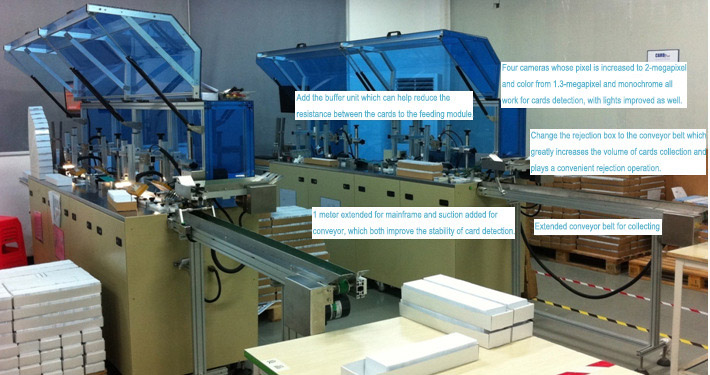
Figure: cavity milling and module implanting performed on one platform, so the cavity and the module share a single sheet datum. Equipment: Automatic Milling and Implanting Machine for Smart Card Modules.
Engineering Advantages
✓ Single-Datum Accuracy
Cavity and module are positioned from one registration, which removes the alignment mismatch that separate stations introduce on every sheet.
✓ No Inter-Station Buffer
Sheets do not queue between milling and implanting, so work in process drops and a defect is visible at the station that created it rather than two steps later.
✓ One Setup Per Product
Cavity program and placement program are changed together, which shortens changeover and removes the mismatch risk of updating one machine and forgetting the other.
✓ Debris and Bond in One Place
Milling debris is extracted before adhesive is dispensed on the same platform, so a contaminated cavity floor cannot reach the bonding step.
Technical Data
Accuracy and throughput figures are typical values for the production configuration. Final values are qualified against your laminate stack, module type and cavity drawing.
Where It Fits in the Production Chain
The economic argument is not that one machine is faster than two. It is that the pair of numbers which matter most in module assembly, cavity depth and placement offset, are measured against the same reference, so a drift shows up as a single trend instead of an argument between two stations about whose fault it is. Factories that run the combined cycle usually report the benefit in yield stability rather than in cards per hour, because the failures it removes were never visible at the station that caused them. Read together with the cavity milling and chip singulation notes, this is the step where the card body becomes a card.
- Cavity and module in one pass for dual-interface and contactless cards
- Rework of sheets rejected for off-centre or proud modules
- Pilot lines where floor space rules out two stations and a buffer
- Contract manufacturing with frequent product changeover
Frequently Asked Questions
Does combining milling and implanting reduce accuracy compared with separate machines?
Not in the way that matters. Each individual operation can be marginally less optimised, but the error that dominates module fit is the relative alignment between cavity and module, and that is strictly better when both are produced from one clamp. In practice combined machines hold the fit window more consistently across a shift.
Can a combined machine handle both contact and dual-interface cards?
Yes. The cavity program carries the depth and outline for the module type, so a dual-interface cavity with its deeper profile is a program change rather than a hardware change. The constraint is the module and inlay combination you qualify, not the platform.
What happens if a cavity is milled out of tolerance?
It is caught in cycle, before adhesive or module is committed. That is the main practical advantage over a two-station line, where the sheet has already left the mill and the defect is discovered on the placer or later at final test.
Next Step
More equipment in this range is listed on the ZOWINDA CardMachine product page, and related application notes appear in our Industry News section.
Related reading:
- GSM Card Personalization Machine: Automatic End-to-End Encoding and Printing Line
- Automated Card Sealing, Labeling and Sorting Machine for Card Fulfilment
- Slot Milling Machine ZOWINDA3000 - High-Speed Card Cavity Milling
- Automatic IC Module Implanting Machine
- Modules Laser Cutting Machine - Smart Card Module Chip Singulation System
Ready to boost your production efficiency?
Contact us for a tailored solution and quotation on the Automatic Milling and Implanting Machine for Smart Card Modules.
Email: info@zowinda.com
WhatsApp: +86 186 2085 0485
 Automated Card Sealing, Labeli
 GSM Card Personalization Machi
 Automatic Milling and Implanti
 PT085 Passport Durability Test
Please contact us with your request
We are ready to answer your questions.