
Modules Laser Cutting Machine - Smart Card Module Chip Singulation System
Modules Laser Cutting Machine - Smart Card Module Chip Singulation System: Engineering Notes from the Test Floor
Published: November 09, 2026 | ZOWINDA Application Engineering
Between the chip assembly line and the card embedding machine, every smart card module passes through one finishing step that decides the quality of its edges: singulation. Modules are produced on carrier strips - dozens of identical units joined by webs of material - and separating them is a cutting problem. Mechanical punch tooling does the job, but it deforms the surrounding carrier, leaves burrs along the cut wall and stores mechanical stress in the module frame. A laser cuts without contact: the beam defines the edge, the material ablates, and the module leaves the strip with clean walls and no mechanical memory of being cut. For a part that will next be picked by vacuum and bonded into a passport data page, that difference shows up directly in the placement statistics.
Why Singulation Quality Matters
The module leaves the strip and immediately enters a placement machine that gripped it by vacuum, transferred it, and presented it to the bonding head. Every irregularity on the cut wall interferes with that choreography. A burr breaks the vacuum seal and the pick fails; a deformed edge tilts the module in the gripper and the bond lands off-centre; a mechanically stressed frame can carry microcracks that surface later as field failures. Singulation sits upstream of all of it, which is why edge quality is measured not as a cosmetic property but as a placement yield and long-term reliability driver.
The second argument for laser singulation is stability over volume. Punch tooling wears: the burr grows, the edge geometry drifts, and a production line that qualified its modules in January is shipping different edges in June. A laser has no tool to wear - the edge is defined by the beam path and the energy settings, both of which are files and setpoints. The edge geometry produced at strip one million is the edge geometry produced at strip one, and a new module layout is a pattern import, not a tooling order with its lead time and its requalification.
How Laser Singulation Runs
- Load the module carrier strip onto the transport. Strips are registered by their datum holes, so the cutting path lands on the module cavity regardless of strip camber or transport accumulation error.
- Import the cutting pattern for the strip layout. The pattern is a file matched to the module layout - cavity outline, web positions, corner radii. Changing module size or layout is a file change, not a tool change.
- Set focus and energy for the material and thickness. Ablation parameters are chosen to cut cleanly without heat creep into the surrounding material, protecting the encapsulated chip from thermal stress.
- Run the cut path per module cavity. The beam traces each cavity outline while extraction removes ablation products. Strips advance continuously through the registration check and the cut field.
- Verify edge quality and release modules onward. Sampled modules are inspected for cut-wall quality; clean-walled modules are presented to inspection and placement in the downstream cell.
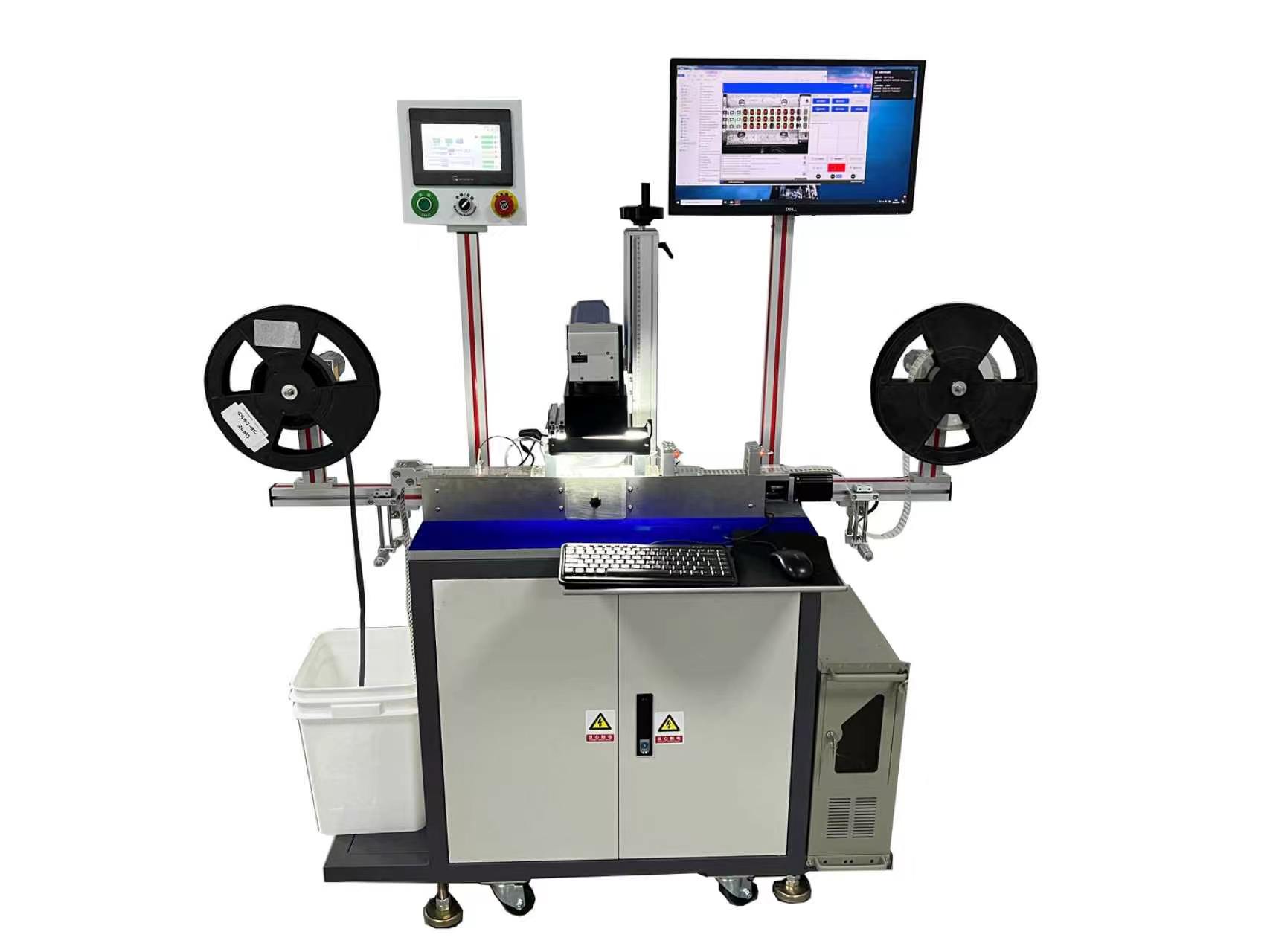
Figure: modules laser cutting machine singulating chip modules from a punched carrier strip. Equipment: Modules Laser Cutting Machine - Smart Card Module Chip Singulation System.
Engineering Advantages
✓ Non-Contact Cutting
No tool touches the module, so there is no burr to break a vacuum pick and no mechanical stress stored in the module frame - the edge is as clean at the last strip as at the first.
✓ Toolless Pattern Changes
Module layouts are files. A layout change or a new module size is imported and cut, with no tooling order, no regrinding and no requalification of worn punches.
✓ Constant Edge Geometry
Cut geometry depends on stable setpoints rather than on tool wear, which keeps downstream placement and bonding statistics flat over the life of the programme.
✓ Clean, Integrated Process
Extraction removes ablation products at the source; no coolant, no slugs and no deburring step are added to the line.
Technical Data
Laser parameters, strip formats and line integration are matched to the module carrier construction and the downstream placement equipment in your production cell. ZOWINDA specifies the configuration against your strip drawings.
From Singulation to a Qualified Module
Singulation is the first link in the chain that ends with a qualified passport. The clean-walled module picks reliably, bonds centred, and the finished data page then faces the mechanical tests that decide whether the whole construction ships: the backside spot pressure test that loads the module joint, and the peel and flexion tests that qualify the laminate around it. A production chain that begins with a stressed, burred module ends with unexplained scatter in exactly those tests - scatter that gets attributed to lamination or adhesive when its origin was the cut. Starting the chain with a clean, unstressed edge is the cheapest reliability decision on the line.
- Module production cells feeding card and inlay embedding lines
- ePassport module production for data page assembly
- Layout changeovers and short-run module variants
- Placement yield improvement programmes
Frequently Asked Questions
Laser cutting or mechanical punching - which is right for us?
Punching is fast and proven for stable, high-volume layouts where edge deformation is acceptable. Laser cutting wins wherever edge quality drives placement yield, where layouts change, or where the programme cannot afford tool wear drift between requalification runs. Many lines run lasers for passport-grade modules and punches for less demanding formats.
Does the laser damage the chip inside the module?
The chip sits encapsulated under the module surface, and the cut is parameterised to ablate the carrier material without heating the region beyond its limits. Focus position, energy and path speed are the control variables, and they are set against the carrier thickness rather than against the chip.
Can one machine handle different module sizes?
Yes. The cutting path is a file, so different cavity layouts are handled as different patterns on the same machine, selected per strip type at the transport.
Next Step
More equipment in this range is listed on the ZOWINDA CardMachine product page, and related application notes appear in our Industry News section.
Related reading:
- ICC Backside Spot Pressure Tester - e-Passport Chip Module Adhesion Test
- PT074 MRP Holder for Passport | 10-Station Stationary Fixture for ePassport Testing
- Integrated Chip Placement and Wire Embedding/Welding System
- Integrated Inlay Manufacturing System
- Three Wheel Tester for ICC Card Mechanical Reliability
Ready to boost your production efficiency?
Contact us for a tailored solution and quotation on the Modules Laser Cutting Machine - Smart Card Module Chip Singulation System.
Email: info@zowinda.com
WhatsApp: +86 186 2085 0485
 Modules Laser Cutting Machine
 PT074 MRP Holder for Passport
 ICC Backside Spot Pressure Tes
 PT093 Peel Strength Tester - P
Please contact us with your request
We are ready to answer your questions.