
Automatic IC Module Implanting Machine
Automatic IC Module Implanting Machine: Engineering Notes from the Production Floor
Published: November 02, 2026 | ZOWINDA Application Engineering
Contact cards still carry the largest installed base in banking, SIM and healthcare applications, and almost every field failure traces back to the module joint. An automatic IC module implanting machine turns that joint from a manual craft into a measured process: cavity depth, module seating force, heat-stake profile and contact resistance are all controlled and recorded.
What "Implanting" Actually Involves
A contact card is not a chip glued onto plastic. The card body is milled to a controlled cavity, the module is seated into that cavity, and the module legs are heat-staked into the body so the joint survives bending and torsion. If the cavity is too deep the module sits below the surface and the contact pattern wears unevenly; if it is too shallow the card cannot reach ISO thickness after lamination.
An implanting machine therefore owns three variables at once: cavity geometry, seating force and stake energy. Automating them together is what separates a card that passes a bending test from one that fails in the field after a few thousand insertions.
Process Sequence
- Card body infeed. Card bodies are fed from a magazine or a linked personalization line, with orientation verified before milling.
- Cavity preparation. The cavity is milled or finished to the module footprint with depth monitored against the card body thickness.
- Module seating. The module is placed with controlled force so the adhesive is spread evenly and no air pocket forms under the contact plate.
- Heat staking. Staking pins form the mechanical lock that carries bending load, keeping the electrical joint out of stress.
- Electrical verification. Contact resistance and continuity are measured per card, and rejects are diverted with a reason code for traceability.
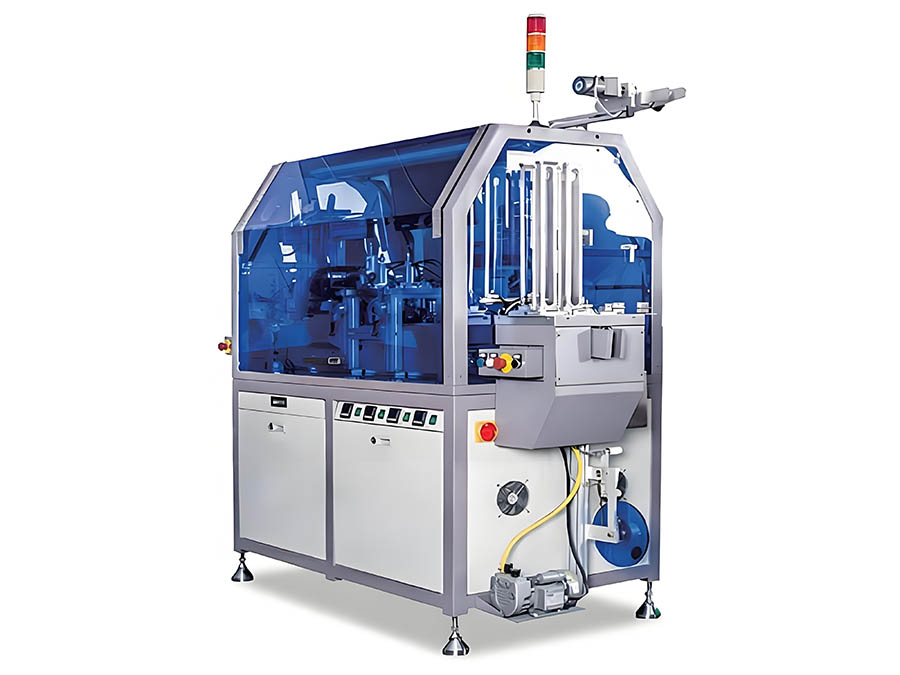
Figure: automatic IC module implanting machine for contact smart cards. Equipment: Automatic IC Module Implanting Machine.
Key Advantages
✓ Cavity Depth Control
Depth is monitored against the actual card body rather than a nominal value, which keeps contact height inside the ISO window.
✓ Programmable Stake Profile
Stake temperature, time and force are stored per product, so a module joint behaves the same on Monday morning as it did during qualification.
✓ 100 Percent Electrical Test
Every card is measured before it leaves the station, so a drifting bond shows up as a trend instead of a customer complaint.
✓ Line Integration
Standard interfaces allow the machine to sit inside a milling, personalization and sorting line instead of running as an island.
Technical Data
Configuration is quoted per project. Card body material, module supplier and required throughput all change the station layout, so ZOWINDA specifies the machine against your BOM.
Typical Applications
The machine is usually placed directly after cavity milling and before personalization, so a defective module is caught before the card carries personalized data. That ordering matters: reworking a personalized card is far more expensive than rejecting a blank one.
- Banking and payment contact cards
- SIM and telecom card production
- Healthcare and insurance cards
- Government and campus identification cards
Frequently Asked Questions
Does the machine mill the cavity as well?
It can be supplied as an implanting station or combined with cavity milling, depending on whether the line already has a milling step.
How is traceability handled?
Card-level test results can be exported to the line control system, so a rejected joint is linked to its batch, module lot and stake recipe.
What drives module cost most?
Module yield at the joint. Reducing implant rejects usually pays back faster than negotiating module price, because each rejected card also wastes a body and a lamination cycle.
Next Step
More equipment in this range is listed on the ZOWINDA CardMachine product page, and related application notes appear in our Industry News section.
Ready to boost your production efficiency?
Contact us for a tailored solution and quotation on the Automatic IC Module Implanting Machine.
Email: info@zowinda.com
WhatsApp: +86 186 2085 0485
 Key Injection and Audit Trail:
 Dual-Interface Bridge: Making
 Laser Cutting or Die Cutting:
 Reel-to-Reel or Sheet-to-Sheet
Please contact us with your request
We are ready to answer your questions.