
Auto Patch Pick and Place Machine for Smart Card Production
Auto Patch Pick and Place Machine for Smart Card Production: Engineering Notes from the Production Floor
Published: November 05, 2026 | ZOWINDA Application Engineering
A patch is a small carrier - a strap with a chip position, or a coupling patch - that sits on the antenna and defines where the module will eventually live. Placing it is a sub-millimetre operation performed at line speed on a sheet that is already laminated and already valuable. Three things decide quality: alignment relative to the antenna, contact force during seating, and adhesive behaviour in the cure that follows. A machine that controls all three repeats placement across a whole shift; one that controls none of them produces a sheet that reads well on the bench and fails at the edge of reader range.
What the Patch Has to Do
Electrically the patch couples the chip to the antenna. Its position sets the overlap area with the antenna ends, and overlap is capacitance and coupling: too little and read range collapses at the low end of the reader field, too much and resonance shifts below the window the card is specified to. Because the antenna was embedded at a fixed pitch, patch placement is the last opportunity to correct a small electrical error - or to add a large one.
Mechanically the patch has to survive lamination and, on a dual-interface product, the cavity milling that follows. A patch seated with too little force sits on a cushion of adhesive and lifts during lamination; one seated with too much force squeezes adhesive out and starves the bond. Both look identical in a functional read test. They differ only in a bend or heat-cycle test, which is exactly the test a customer runs and a plant often does not.
Placement Sequence
- Sheet presentation. The laminated sheet is located on the table and referenced, so placement coordinates are expressed against the antenna pattern rather than against a panel edge.
- Vision alignment. Fiducials or antenna features are located and the whole placement map is corrected for the true position of the sheet in front of the head.
- Patch feed. Patches arrive on tape and are indexed to the pick position, with splice and empty-pocket handling so a gap in the reel does not silently become a missing placement.
- Pick and seat. A vacuum nozzle picks the patch, transfers it and seats it with programmed force and dwell, which is what fixes the adhesive bondline thickness under the part.
- Verification and record. Each placement is checked and logged, so a finished sheet can be traced back to the nozzle, the force recipe and the tape lot that produced it.

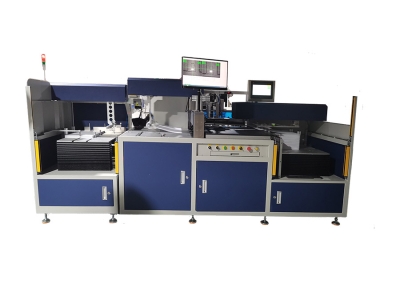
Figure: auto patch pick and place head seating a strap onto an inlay sheet under vision alignment. Equipment: Auto Patch Pick and Place Machine for Smart Card Production.
Key Advantages
✓ Vision-Corrected Placement
Alignment follows the pattern on the sheet, so the tolerance chain starts at the antenna instead of at a panel edge that lamination has already moved.
✓ Force-Controlled Seating
Programmed force and dwell define the adhesive bondline; neither a floating patch nor a starved joint is left to operator feel.
✓ Tape Handling Without Stops
Splice detection and empty-pocket logic keep the machine running through a reel change instead of producing a run of unpatched positions.
✓ Position-Level Traceability
Every placement is recorded, which turns a downstream failure into a specific nozzle, force recipe and tape lot rather than a whole-batch suspicion.
Technical Data
Placement tolerance and force windows are agreed against your antenna design, patch footprint and lamination recipe. ZOWINDA configures vision recipes, nozzles and force profiles for the patch family you run.
Where It Fits
Placement sits between embedding and lamination on a contactless line, and ahead of the milling station on a dual-interface product. The distinction matters because the tolerance budget differs: a patch that only has to couple to the antenna absorbs more positional error than a patch that must also line up with a cavity milled later. Running the machine with a per-product force and alignment recipe, rather than one global setting, is what lets a single station serve both product families without trading yield on either.
- Contactless inlay production, before lamination
- Dual-interface sheets, before cavity milling
- Rework of unpatched positions on a suspect sheet
- Pilot builds of a new antenna and patch combination
Frequently Asked Questions
How accurate does patch placement have to be?
Accurate enough that overlap with the antenna ends stays inside the coupling window your design assumes, and on a dual-interface product accurate enough that the milled cavity still lands on the patch. Both limits are electrical, not cosmetic, so they come from your design and your cavity drawing rather than from a machine datasheet.
Are patch placement and chip attach the same step?
No. Patching places a carrier on the antenna at sheet level. Chip attach or module implanting puts the die or module in place, often after the cavity has been milled. On a dual-interface product the two steps are separated by lamination and milling, which is why patch accuracy is specified with the cavity in mind.
What happens when the tape runs out mid-sheet?
The machine detects the splice or the empty pocket and treats it as a defined event: affected positions are flagged and the sheet is completed, so unpatched units are known rather than silently missing. Those positions can then be reworked or scrapped per unit instead of per sheet.
Next Step
More equipment in this range is listed on the ZOWINDA CardMachine product page, and related application notes appear in our Industry News section.
Related reading:
- Automatic IC Module Implanting Machine
- Integrated Chip Placement and Wire Embedding/Welding System
- ICC Backside Spot Pressure Tester for Smart Card Quality Control
Ready to boost your production efficiency?
Contact us for a tailored solution and quotation on the Auto Patch Pick and Place Machine for Smart Card Production.
Email: info@zowinda.com
WhatsApp: +86 186 2085 0485
 Auto Patch Pick and Place Mach
 Auto Sheet Trimming Machine fo
 High-Speed RFID Card Productio
 Automatic IC Module Testing Ma
Please contact us with your request
We are ready to answer your questions.