
Auto Sheet Trimming Machine for Inlay Edge Finishing
Auto Sheet Trimming Machine for Inlay Edge Finishing: Engineering Notes from the Production Floor
Published: November 05, 2026 | ZOWINDA Application Engineering
Lamination leaves a panel that is deliberately oversized. After the press the overlay sheets overhang the core, resin has flowed past the edge, and the panel has the right thickness but not the right outline. Trimming is the station that turns that panel into a referenced blank: an outline square to the datum within a tolerance the punching and milling stations can rely on. It looks like a cutting operation and behaves like a metrology one, because every downstream registration starts from the edge this machine produces.
Why the Trimmed Edge Is a Process Variable
Downstream stations find their position in one of two ways: from the sheet edge, or from fiducials printed or embedded on the sheet. Both degrade when the edge is not where the machine assumes it is. A panel trimmed 0.3 mm out of square moves every cavity on the outer row of the layout; a burr left on the edge holds the sheet off the punching die by its own thickness; and a trim that tears overlay away from core creates a delamination start point that appears as a failed bend test months later, long after the cutting tool was changed.
Edge quality also governs handling. Trimming generates dust and static, and a sheet carrying a raised burr does not stack flat - which shows up as a double-sheet feed at the next station rather than as a cutting defect. That is why a production trimming machine is specified on edge finish and repeatability rather than on cutting speed alone, and why dust extraction and the referencing system matter as much as the blade path.
Trimming Sequence
- Sheet loading and referencing. The laminated panel is located against a mechanical datum or by fiducials, so the cut is defined relative to the pattern inside the sheet rather than to its rough physical edge.
- Recipe selection. Sheet outline, trim allowance and cut path come from a stored recipe matched to the layout, so a change of multi-up arrangement does not mean re-teaching the machine.
- Alignment check. The machine confirms the sheet is presented square within tolerance before cutting. A sheet out of position is stopped instead of being trimmed badly and passed on.
- Trimming. The edge is cut in a single controlled pass. Feed rate and blade condition are what keep the cut face clean instead of smeared, chipped or torn.
- Edge conditioning and unload. Dust and static are extracted at the cutting point, the edge is inspected, and the sheet is stacked flat for the operation that follows.

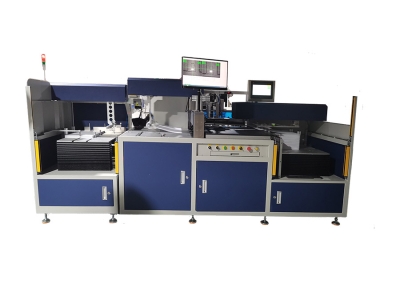
Figure: auto sheet trimming machine finishing the edge of a laminated inlay panel before punching. Equipment: Auto Sheet Trimming Machine for Inlay Edge Finishing.
Key Advantages
✓ Reference-Based Cutting
The cut follows the pattern, not the rough panel edge, so sheet-to-sheet variation in lamination overhang never propagates into the outline tolerance.
✓ Clean Cut Face
Controlled feed and a guided blade path keep the cut face square and free of the smearing that traps dust and starts delamination.
✓ Dust and Static Control
Extraction at the cutting point keeps the sheet clean, which matters because one particle under the next die becomes a cracked antenna.
✓ Layout Recipes
Outline, allowance and path are stored per product; a multi-up change is a recipe selection with a tooling check, not a setup from scratch.
Technical Data
Outline tolerance, burr limits and accepted materials are agreed against your drawing and the specification of the punching or milling station downstream. ZOWINDA sets tooling and cut parameters to that drawing before shipment.
Where It Sits in the Line
The machine belongs immediately after the press, ahead of any operation that registers on the sheet. On a line running several layouts it also acts as the gate that keeps an out-of-square panel away from a die that would otherwise turn it into unusable units. In plants that buy laminated sheets, the same machine doubles as an incoming inspection tool: trimming a sample reveals both the dimensional overhang a supplier is delivering and the edge condition of their laminate, which predicts field delamination far better than a visual check on an untrimmed panel.
- Directly after lamination and before punching or milling
- Incoming inspection of bought-in laminated sheets
- Trimming of patched sheets before cavity work
- Edge re-finishing after a laminate or overlay film change
Frequently Asked Questions
Why not die-cut the sheet directly and skip trimming?
Die cutting registers on the edge or on fiducials, and a laminated panel provides neither reliably until it has been squared. Trimming first makes the registration reference real, which is why the punching station can hold tolerance run after run. Skipping it transfers the whole panel variation into every unit on the sheet.
What burr level is acceptable?
That limit comes from the next operation rather than from the trimming machine. A station that stacks sheets flat and feeds them under a die tolerates less burr than one handling sheets singly. Give ZOWINDA the downstream specification and cut parameters plus blade condition are set to meet it.
Does it handle PC and PET-G as well as PVC?
Yes, with cut parameters matched to the material. Polycarbonate is harder and more notch-sensitive, PET-G is softer and more prone to smearing at the cut face, and PVC sits between the two. Each material carries its own recipe, which is the reason the recipe table exists.
Next Step
More equipment in this range is listed on the ZOWINDA CardMachine product page, and related application notes appear in our Industry News section.
Related reading:
- Auto Wire Embedding Machine (2-in-1 System)
- Smart Card Cavity Milling Machine
- Integrated Inlay Manufacturing System
Ready to boost your production efficiency?
Contact us for a tailored solution and quotation on the Auto Sheet Trimming Machine for Inlay Edge Finishing.
Email: info@zowinda.com
WhatsApp: +86 186 2085 0485
 Auto Patch Pick and Place Mach
 Auto Sheet Trimming Machine fo
 High-Speed RFID Card Productio
 Automatic IC Module Testing Ma
Please contact us with your request
We are ready to answer your questions.