
Automatic IC Module Testing Machine for Smart Card Production
Automatic IC Module Testing Machine for Smart Card Production: Engineering Notes from the Production Floor
Published: November 04, 2026 | ZOWINDA Application Engineering
The module is the most expensive component on a contact or dual-interface card, and it is implanted into a body that has already consumed lamination, printing and cavity milling. That order of operations decides the economics: a defective module caught at final card test costs the whole card, while the same module caught before implanting costs a module. An automatic module testing machine moves the electrical decision upstream, so every module that enters a cavity has already been proven to answer, to hold contact and to meet its electrical limits.
What Has to Be Proven Before Implanting
A contact module is a small PCB carrying a die, bonded out to six or eight contact pads. Most failures introduced between wafer and tape reel are invisible to the eye: a marginal bond wire, an encapsulation void, a contact plating that will not wipe clean in a reader. They surface later as a card that answers intermittently, or one that works in a warm office and fails in a cold terminal - which is precisely the failure a customer reports and a plant cannot reproduce.
Module testing also poses a different mechanical problem from card testing. The module is presented on tape or in a tray, its contacts are small and closely spaced, and the test has to keep pace with the implanting head. An automatic station handles presentation, probe contact and electrical evaluation in a single cycle, and its verdict is used to decide whether that module is implanted at all.
Test Sequence
- Module presentation. Modules arrive on tape or in a tray and are indexed to the test position without manual handling.
- Probe contact. Spring probes land on the module contact pads at controlled force, so the test does not damage the plating it is meant to evaluate.
- Activation. The module is powered and reset; its answer-to-reset is read to confirm the die, the bond wires and the interface are intact.
- Electrical checks. Supply current, contact continuity and the specified parametric limits are verified in the same cycle.
- Sorting and record. Pass or fail is applied, a failed module is marked or diverted, and the result is logged against the reel or batch.
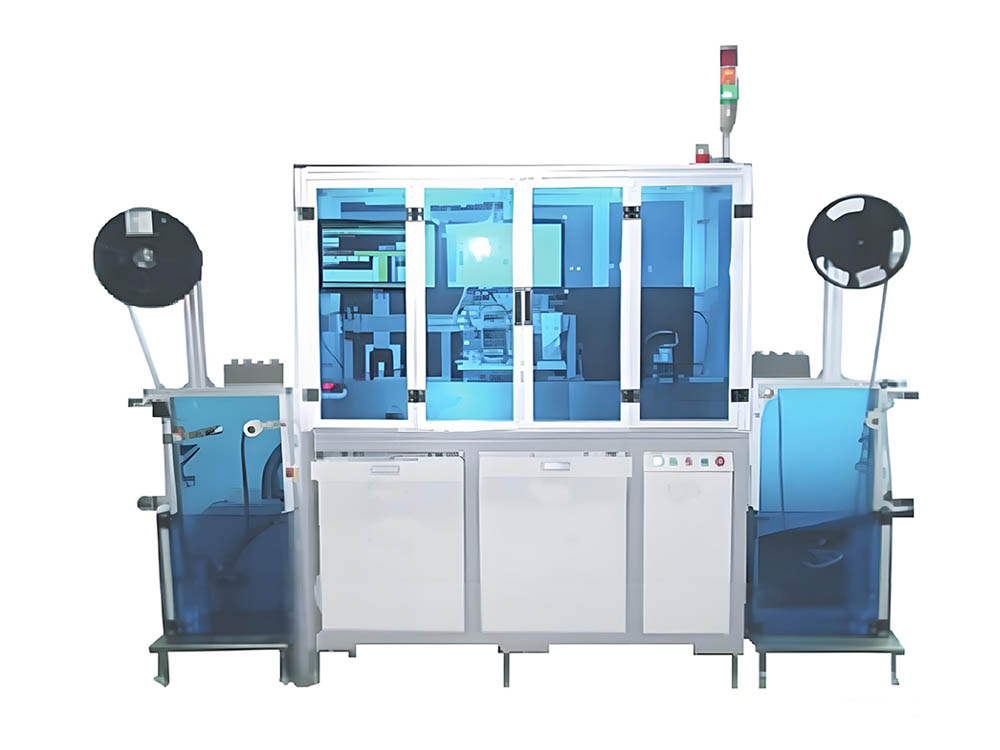
Figure: automatic IC module test station probing contact modules on tape before implantation. Equipment: Automatic IC Module Testing Machine for Smart Card Production.
Key Advantages
✓ Upstream Economics
Rejecting a module costs a module. The identical defect found at final card test costs a laminated, printed, milled and personalized card.
✓ Controlled Probe Force
Spring-loaded contact at a set landing force protects the gold plating, so the test does not create the contact resistance problem it exists to catch.
✓ Protocol-Level Verification
Reading the ATR proves die, bond wires and interface all work, not merely that two contacts happen to be shorted together by the probe.
✓ Reel-Level Traceability
Results per reel and per position let a suspect batch be isolated before it has been dispersed across an entire production run.
Technical Data
Test coverage and parametric limits are set from the module datasheet and from your card specification. ZOWINDA configures probe cards and recipes for the module family you implant.
Where It Fits in the Line
The station sits between module receipt and the implanting machine, and it pays for itself fastest where modules come from more than one supplier or where the implanting line runs at volume. On a dual-interface card it also protects the inlay: an implanting head that seats a marginal module still consumes the antenna underneath it. Plants that already test finished cards electrically will recognise the pattern - the same defect, caught two process steps earlier, for a fraction of the cost.
- Incoming inspection of contact and dual-interface modules
- Pre-implant gating on high-volume lines
- Supplier qualification across multiple module sources
- Rework isolation when a module batch is suspect
Frequently Asked Questions
Does it replace final card electrical test?
No, and it should not. Module test proves the module; final card test proves the card, including cavity geometry, implanting force and antenna connection on a dual-interface product. The two catch different failure modes, and the module test exists to stop bad parts early rather than to shorten the final gate.
Can it handle dual-interface modules?
Dual-interface modules are tested on their contact interface, which is the path that carries power and data in a contact session. Contactless performance of the finished card is verified at card level and with resonance frequency testing.
What happens to failed modules?
They are marked or diverted at the station and logged by reel, so the pattern - a whole reel, a run of positions, a single supplier batch - stays visible and can be fed back to the module supplier.
Next Step
More equipment in this range is listed on the ZOWINDA CardMachine product page, and related application notes appear in our Industry News section.
Related reading:
- Automatic IC Module Implanting Machine
- Integrated Chip Placement and Wire Embedding/Welding System
- Smart Card Cavity Milling Machine
Ready to boost your production efficiency?
Contact us for a tailored solution and quotation on the Automatic IC Module Testing Machine for Smart Card Production.
Email: info@zowinda.com
WhatsApp: +86 186 2085 0485
 Automatic IC Module Testing Ma
 Automatic Frequency Test Machi
 Three Wheel Tester for ICC Car
 Auto Wire Embedding Machine (2
Please contact us with your request
We are ready to answer your questions.