
Smart Card Cavity Milling Machine: High-Precision CNC Cavity Machining for IC Chip Embedding
Smart Card Cavity Milling Machine: High-Precision CNC Cavity Machining for IC Chip Embedding: Engineering Notes from the Production Floor
Published: November 02, 2026 | ZOWINDA Application Engineering
Every contact card begins with a hole that has to be exactly right. The cavity milled into the card body sets the module height, the flatness of the card surface and the strength of the joint that will later carry bending load. A CNC cavity milling machine is judged on three things: depth repeatability, edge quality and how clean it keeps the work area while running at production speed.
Why Cavity Quality Decides Card Quality
A cavity that is a few hundredths of a millimetre too shallow lifts the module above the card surface. The card then fails thickness measurement, and the contact plate wears unevenly because it carries the reader force on a smaller area. Too deep, and the adhesive cannot bridge the gap, leaving a void that opens under thermal cycling.
Edge quality matters just as much. A ragged cavity edge creates a stress riser in the card body, and that is exactly where a bending test will eventually crack the laminate. Controlled feed rate, sharp tooling and effective dust extraction are therefore not cosmetic details - they are the difference between a cavity and a defect.
Station Workflow
- Body loading. Card bodies are loaded from a magazine with thickness measured on entry, so the control can compensate per body rather than per batch.
- Reference measurement. The surface is probed before cutting; the machining depth is referenced to the measured surface, not to a nominal zero.
- CNC cavity milling. The cavity is cut in passes with feed and spindle speed tuned to the body material, keeping heat input low.
- Edge finishing and cleaning. A finishing pass cleans the cavity wall and extraction removes chips so no debris is trapped under the module.
- Inspection and sorting. Depth, position and visual condition are checked, and out-of-window bodies are separated before implanting.
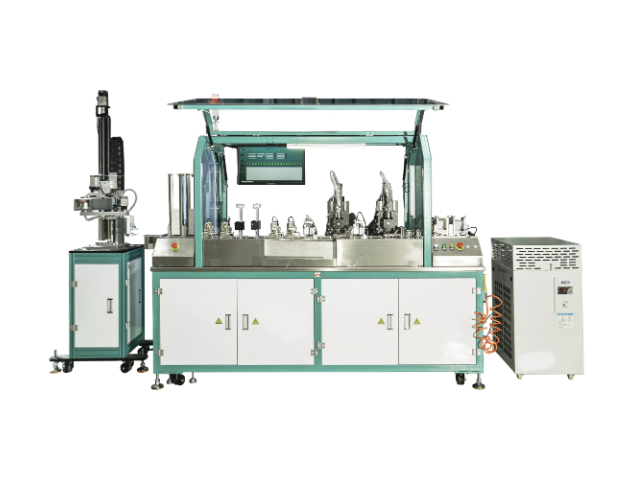
Figure: CNC cavity milling station for smart card bodies. Equipment: Smart Card Cavity Milling Machine: High-Precision CNC Cavity Machining for IC Chip Embedding.
Key Advantages
✓ Depth Referenced to the Body
Each card is measured before cutting, so variation in laminate thickness is compensated instead of accumulated.
✓ Clean Cavity Walls
Tuned feed rate and a finishing pass leave an edge that will not initiate a crack during bending or torsion testing.
✓ Dust Extraction
Chips are pulled away at the cut, protecting both the cavity and the motion system over long runs.
✓ Tool Life Monitoring
Cutting counts per tool are tracked, so a worn tool is changed on schedule rather than discovered through scrap.
Technical Data
Specifications are quoted per configuration. Cavity geometry, body material and throughput target determine spindle choice and tooling, so ZOWINDA confirms values against your card design.
Where It Is Used
The machine is normally the first process step in a contact-card line, feeding the implanting station directly. Running both steps on linked equipment means the cavity and the module are measured against the same card, which removes a whole class of tolerance arguments between departments.
- Contact and dual-interface card bodies
- SIM and micro-module card production
- Chip embedding lines ahead of implanting
- Card reworking and cavity correction
Frequently Asked Questions
Can one machine handle several cavity sizes?
Yes. Cavity geometry is stored as a recipe, so switching between 6-pin and 8-pin modules, or between standard and custom formats, is a tooling and program change rather than a rebuild.
How is tool wear handled?
Cut counts per tool are logged and the operator is prompted to change tooling before edge quality degrades, which keeps scrap predictable.
Does milling weaken the card?
A correctly sized cavity with a clean edge does not. The weakness comes from oversize cavities and ragged edges, which is why depth referencing and finishing passes are part of the process.
Next Step
More equipment in this range is listed on the ZOWINDA CardMachine product page, and related application notes appear in our Industry News section.
Ready to boost your production efficiency?
Contact us for a tailored solution and quotation on the Smart Card Cavity Milling Machine: High-Precision CNC Cavity Machining for IC Chip Embedding.
Email: info@zowinda.com
WhatsApp: +86 186 2085 0485
 Smart Card Cavity Milling Mach
 Automatic IC Module Implanting
 Integrated Inlay Manufacturing
 Intelligent Envelope Sorting S
Please contact us with your request
We are ready to answer your questions.