
MRP Holder for Passport Testing Guide 2026 | ZOWINDA
Passport & Travel Document Testing
The MRP Holder That Decides Whether Your Passport Test Is Repeatable
Published: November 23, 2026 | ZOWINDA Application Engineering
Two laboratories can run the same passport durability test, on the same tester model, from the same written procedure, and still disagree by a margin wide enough to flip a pass or fail. The difference is rarely the machine. It is the fixture. Before a single force profile is applied, the Machine Readable Passport has to be located against a reference surface, held flat without being crushed, kept square to the motion axis, and left undisturbed long enough for the measurement chain to settle. ISO/IEC 18745 treats that preparation as part of the method rather than as an afterthought, which is why the PT074 MRP holder for passport exists as a dedicated instrument instead of a bench improvisation. This article explains what an ePassport test fixture actually controls, where holders drift out of tolerance, and how to match a positioning fixture to the test methods a passport programme is audited against.
Fixturing Is the First Error Source in Passport Testing
Every mechanical measurement on a passport booklet is a chain of small tolerances, and the fixture sits at the head of that chain. If the booklet is presented half a degree out of square, the stress introduced by a bend, torsion or peel test is no longer applied along the axis the method describes. If the data page is allowed to bow, the effective bending radius changes and a laminated overlay that should have survived the cycle count delaminates early. If the document is clamped with uneven pressure, the chip module and its antenna carry pre-load before the test even begins, and any RF read failure later in the sequence is attributed to the document rather than to the setup.
This is why ISO/IEC 18745 spends clauses on specimen preparation. Clauses 7.4 and 8.1 through 8.4 set out how a document must be conditioned, oriented and held before test methods are applied, and Clause 8.13 covers the general test-setup requirements that keep one laboratory comparable with another. ICAO Doc 9303 V3.2 adds the document-side geometry that the fixture has to respect: cover dimensions, data page position, and the physical envelope of the booklet. A positioning fixture turns those requirements into repeatable geometry. Without one, the requirements are met differently by every operator on every shift, and the resulting test report is only reproducible by the person who produced it.
What an ePassport Test Fixture Actually Controls
A holder looks like a passive piece of workshop furniture. In practice it fixes four variables that otherwise move freely between runs.
Position and orientation
The slot sets the booklet against a datum so that the spine, the fore edge and the data page sit in the same relationship to the tester every time. This is what allows a force applied at the cover to be an actual peel or bend at a defined location rather than an approximate one.
Flatness under its own weight
A personalised booklet does not sit perfectly flat. Covers warp slightly after lamination, and a data page that has absorbed ambient humidity will bow. A holder that supports the document along its full length removes that variation, so every specimen enters the test with the same starting geometry instead of the same nominal geometry.
Clamping without pre-stress
Holding a document still and clamping it hard are different objectives. Excessive clamping introduces compression into the cover stack, changes the local stiffness the test is trying to measure, and in the case of a chip module can transfer load directly into the interconnection. A well-designed fixture restrains position while leaving the tested region free to respond.
Batch identity and traceability
Multi-station holders keep specimens separated and identifiable. Ten booklets staged in ten labelled slots cannot be confused mid-sequence, which matters when a lab is running several document constructions or several print runs against the same procedure.
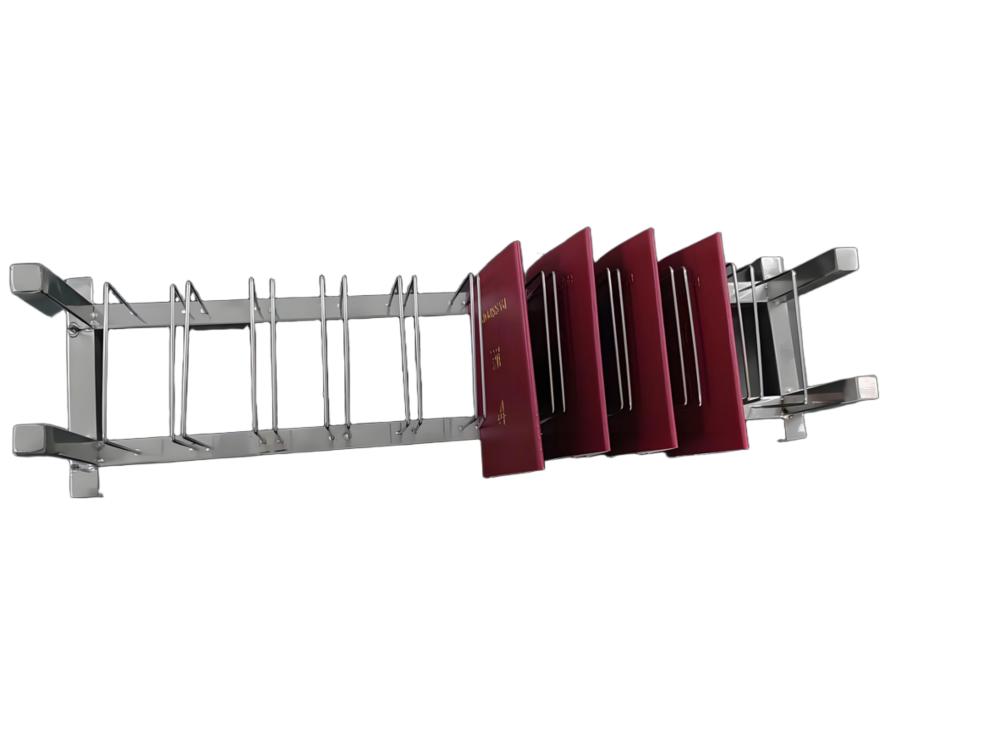
Figure: the PT074 MRP holder for passport staging ten ePassport booklets in independent stationary slots ahead of a durability test sequence. Equipment: PT074.
Why Ten Stations Changes Laboratory Throughput
Passport durability work is inherently serial and slow. A bend, torsion or abrasion profile runs for hundreds or thousands of cycles, and the interval between tests is dominated by setup rather than by the test itself. A single-specimen holder forces the operator to interrupt the tester to swap documents, which is exactly when a specimen gets dropped, mislabelled or re-oriented slightly differently from the batch before it.
Ten independent slots change the rhythm of the work. Documents are staged once, verified once, and then moved through the test sequence without repeated handling at the machine. The practical benefit is not just speed: staged specimens sit in the same ambient conditions for the same length of time, so conditioning drift between the first and last document in a batch is minimised. For a laboratory preparing golden samples for calibration, that consistency is worth more than the time saved.
The holder also makes an honest throughput calculation possible. Instead of quoting a cycle time per test, a lab can quote a cycle time per batch of ten prepared specimens, which is the number a bureau planning an acceptance campaign actually needs.
Where Holders Drift Out of Tolerance
Positioning fixtures fail quietly. There is no alarm when a slot has worn a fraction of a millimetre wider, or when the reference face has picked up a film of adhesive residue from a previous batch. The test still runs, the report still issues, and the drift only surfaces months later as an unexplained disagreement between two laboratories. The failure modes worth watching are predictable.
Slot wear from repeated insertion. Every document slid into a slot removes a small amount of material at the entry edge. Over thousands of cycles the slot loses its grip on position, and specimens begin to sit with a slight angular freedom. A periodic go/no-go check with a reference booklet catches this before it reaches a test report.
Surface contamination. Adhesive transfer from cover overlays, ink from freshly personalised data pages, and ordinary dust all build up on the reference face. A contaminated datum is no longer a datum. Wiping the reference surfaces on a defined schedule, with a solvent that does not attack the fixture material, is part of instrument care rather than housekeeping.
Deformation under load. A holder that is rigid on the bench can still flex when a test applies force through a document seated in it. This is why fixture mass and material matter: a lightweight polymer body is convenient to move but has to be stiff enough that the load path runs into the tester frame and not into the fixture.
Electrostatic build-up. Dry laboratory air plus polymer fixtures plus repeated handling is a recipe for charge accumulating on the document. Because an ePassport is an RF device, that charge can influence a read attempt in ways that look like a chip fault. Grounding practice at the staging bench belongs in the same procedure as the fixture itself.
Matching the Fixture to the Test Method
A positioning holder is not a substitute for a test-specific fixture, and confusing the two is a common source of bad data. The holder prepares and stages; the tester applies the method. In a passport programme the two are used together, which is why the PT074 is normally specified alongside the mechanical testers rather than in place of them:
For book bend and spine flexing work, the specimen has to be presented so the bend axis falls on the intended crease line. A staged, square booklet is what makes that repeatable.
For torsion testing, the two ends of the booklet are loaded in opposite directions. If the document is not seated symmetrically, one corner takes more of the applied angle and the failure appears in the wrong place.
For warpage and flatness assessment, the holder is the reference plane. A warped holder produces a warped verdict, and the error is systematic rather than random, which makes it hard to spot in repeat data.
For peel and adhesion work, the fixture has to restrain the cover or the data page without reinforcing the very bond the test is trying to measure.
For contactless read checks after mechanical testing, the holder sets the working distance between the document antenna and the reader. Moving a booklet a few millimetres closer to or further from the reader changes coupling, and a marginal document can pass or fail on that distance alone.
Technical Data
Standards references describe the positioning and preparation requirements the PT074 is designed to support. Final conformity is assessed against the exact clause edition and specimen definition that applies to your document and issuing authority.
Where a Positioning Fixture Belongs
The holder earns its place wherever a passport result has to survive being questioned.
- Government document laboratories performing acceptance and audit testing across batches
- Personalization bureaus staging freshly printed and laminated booklets for inspection
- Passport manufacturers running incoming and outgoing quality control sampling
- Independent inspection agencies comparing supplier document constructions on equal terms
- Calibration and training benches that need a stable home for golden-sample documents
None of these settings is glamorous, and that is the point. A fixture is the part of the test system that nobody photographs until a result is challenged. When it is right, a laboratory can hand an auditor a report that another laboratory can reproduce. When it is improvised, every result is a private arrangement between one operator and one bench.
Frequently Asked Questions
What is an MRP holder used for?
It positions Machine Readable Passport booklets for durability and inspection work. The holder keeps each document flat, square and stationary against a reference datum so that a test method is applied to the same geometry on every specimen, which is the precondition for comparable results between batches and between laboratories.
Which standards does the PT074 support?
It is designed around the positioning and preparation requirements referenced in ISO/IEC 18745:2018 (Clauses 7.4, 8.1, 8.2, 8.3, 8.4 and 8.13) and the document geometry defined in ICAO Doc 9303 V3.2. It prepares specimens for test methods; it does not itself apply a durability method.
Why ten stations instead of one?
Durability work is dominated by setup time rather than test time. Ten independent slots let a laboratory stage a batch once, keep every specimen under the same conditioning for the same duration, and move documents through the sequence without repeated handling at the machine.
Does the holder fit other travel documents?
It is built around the MRP booklet envelope. Booklet-type travel and identity documents of comparable dimensions and cover stiffness can be staged on the same fixture, but the specimen definition in your test procedure should always be confirmed before the result is treated as a compliant one.
Is it portable enough for a shared test bench?
At 470 x 135 x 150 mm and 2 kg it can be lifted by one person, so it can be shared between stations or moved into a conditioning room. Because the reference surfaces carry the accuracy, it should be handled as an instrument rather than as a tray, and re-checked with a reference booklet after any move.
Related Equipment
Full specifications, drawings and lead times for the PT074 MRP holder for passport are listed on its product page, and it can be specified together with any tester in this range.
The PT074 is listed with the rest of the range on the ZOWINDA Passport Tester product page, and related application notes appear in our Industry News section.
Testers commonly paired with this fixture:
- PT086 Book Bend Stress Tester
- PT088 Passport Torsion Stress Tester
- PT095 Data Page & Cover Warpage Tester
Ready to make your passport results reproducible?
Tell us your document construction and audit clause, and we will recommend the fixture and tester combination that fits.
Email: info@zowinda.com
WhatsApp: +86 186 2085 0485
 MRP Holder for Passport Testin
 Card Warpage After Lamination:
 Inlay Storage and Shelf Life:
 Dust, Static and Debris: Clean
Please contact us with your request
We are ready to answer your questions.