
Card Warpage After Lamination: Cooling, CTE and the Flatness Spec
Smart Card Manufacturing Notes
Card Warpage After Lamination: Cooling, CTE and the Flatness Spec
Published: November 23, 2026 | ZOWINDA Application Engineering
A laminated card that leaves the press flat and arrives at personalisation bowed has not changed shape by accident. It has relaxed into the stress field that was built into it, and the press cycle simply decided when the relaxation would happen. Warpage is one of the few defects in card manufacturing that is fully visible on a bench with a steel rule, which makes it easy to measure and easy to dismiss. It is also a defect with three separate causes that are usually confused with each other: thermal expansion mismatch between the layers, cooling that is uneven in time or in space, and moisture that leaves the stack asymmetrically.
Why a Flat Stack Comes Out Bent
Start with the materials. The cores used for cards have very different thermal expansion: PVC in the range of 60 to 80 parts per million per kelvin, PET and PET-G nearer 20 to 30, polycarbonate around 65. Bond two of these together and heat them, and one layer wants to be longer than the other; bond them while hot and cool them together, and the difference has to go somewhere. In a symmetric stack the mismatch is largely balanced and the card stays flat. In a real card the stack is rarely symmetric: an overlay on one face only, a printed design on the other, a cavity milled out of one side, a module that occupies volume on one face and not the other. The bending moment follows the asymmetry, and the card curls toward the stiffer, less expansive side.
Then add the thermal path. Thermoplastic cores soften near their glass transition, PVC around 72 to 80 degrees Celsius, and a laminated stack effectively sets its shape as it cools through that region. Cooling fast through the transition freezes in whatever gradient exists at that moment; cooling slowly gives the polymer time to relax and lets the layers find a compromise. This is why two presses running the same temperature and pressure can produce different flatness: one cools in the platens under pressure, the other opens hot and cools in a stack on a trolley, where the outer cards see room air and the inner cards see insulation made of other cards.
The third cause is moisture, and it is the one that makes warpage appear after inspection. Water absorbed in a polymer lowers its glass transition and swells it, and the two faces of a card do not dry or absorb at the same rate. A stack that was flat when it left the line at mid-afternoon can bow overnight as the cavity side dries differently from the overlay side. This is the same physics that makes an inlay curl before lamination, applied to a finished card, and it explains the classic complaint that flatness measured at the end of the shift does not match flatness measured at personalisation three days later.
The consequence is not cosmetic. A bowed card changes the geometry of everything downstream: contact plates sit at an angle to the reader, so contact force becomes uneven and fretting wear accelerates on one side; embossing and indent printing lose registration because the card is no longer a flat reference plane; sorting and stacking machines jam on the bow rather than on the thickness; and a card that is flat in a temperate warehouse can bow in a hot vehicle and then be rejected by a terminal. Any flatness specification that does not state the conditioning state is therefore only half a specification.
Five Ways to Take Warpage Out of the Process
- Balance the stack before you tune the press. Match overlay thickness on both faces wherever the design allows, keep printed coverage symmetrical, and treat a single-sided overlay as a known trade-off with a known consequence rather than as a neutral choice.
- Equalise the platens, then measure them. A press that is 3 degrees Celsius cooler on one side produces cards that bow consistently toward that side. Survey platen uniformity with a contact probe or thermal film, not by reading the controller.
- Stage the cooling instead of racing it. Hold pressure while the stack passes through the transition, then cool in a constrained flat stack. A controlled ramp costs seconds and buys flatness that no downstream straightening can reproduce.
- Condition before you judge. Measure after 24 hours at 23 degrees Celsius and 50 percent relative humidity, supported flat, or the number you record describes the room and the hour rather than the card.
- Feed the result back to the incoming material. If flatness drifts when the core supplier changes, the issue may be moisture content or expansion coefficient rather than the press. Record core lot against flatness and the correlation usually appears within a month.
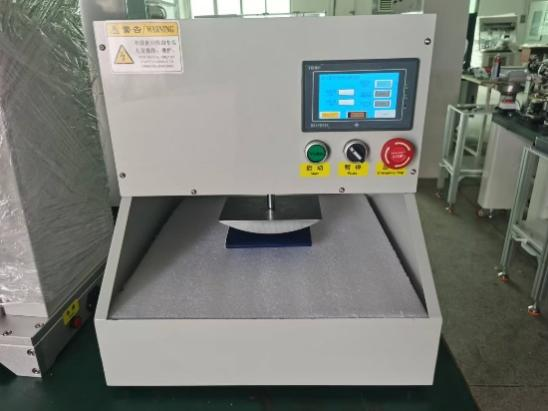
Warpage measurement is simple in principle and easy to get wrong in practice: the result depends on conditioning, support and where the gauge touches the surface. Equipment: PT095 Data Page and Cover Warpage Tester.
What Warpage Does Downstream
✓ Contact geometry
A bowed card tilts the contact plate in the reader, so normal force concentrates on one edge. Wear accelerates there, resistance drift appears early, and the failure is attributed to plating rather than to flatness.
✓ Personalisation registration
Embossing and indent printing use the card edge or a reference mark as the datum. A bowed card is a curved datum, and the character position error grows with distance from the reference.
✓ Machine handling
Vacuum pickups, friction feeders and stackers are set for a nominal thickness. A 2 millimetre bow defeats the vacuum seal or lifts the leading edge, and the jam looks like a mechanical fault.
✓ Field complaints that never reproduce
A card that bows in a warm car and flattens on a desk passes every test in the plant. This is why conditioning states belong in the specification and in the complaint investigation.
Reference Flatness and Process Values
Flatness figures are construction dependent and the values above describe a typical PVC and PET-G card body. Passport data pages, polycarbonate constructions and cards with a milled cavity behave differently, so qualify limits on the actual build and record the conditioning state with every measurement.
Where Flatness Pays for Itself
Flatness is one of the few card properties that can be measured with a rule and still be ignored for years. The cases below are the ones where the cost of ignoring it is easiest to quantify.
- Dual-interface cards whose contact resistance drifts on one edge only, cured by correcting bow rather than by changing plating.
- Embossing lines that lose character registration after a core supplier change with no change to the machine.
- Sorting and stacking reject rates that rise in dry weather and fall in the monsoon.
- Passport data pages that fail a cover flatness check after shipping but passed at the plant.
- Customer complaints about cards that will not enter a terminal, where the returned card measures flat at room temperature.
Frequently Asked Questions
Can we flatten bowed cards after lamination?
You can reduce bow by re-heating the stack above the glass transition and cooling it under constraint, but you are adding a second thermal cycle to a card that already carries stress, and you are doing it after the cavity and the module have been created. It is a recovery action for a non-critical batch, not a process step.
Is a thicker core the answer to warpage?
No. A thicker core raises bending stiffness, so the same stress produces less visible bow, which looks like an improvement while the stress remains. It also costs material and can worsen contact force tolerance. Fix the asymmetry and the thermal path first.
Why does flatness differ between two plants making the same card?
Almost always because of cooling and conditioning rather than materials. Press dwell, platen uniformity, whether the stack cools under constraint, and how long cards rest before measurement vary more between sites than the bill of materials does.
Next Step
More equipment in this range is listed on the ZOWINDA CardMachine product page, and related application notes appear in our Industry News section.
Related reading:
- Dust, Static and Debris: Cleanliness Between Milling and Embedding
- Inlay Storage and Shelf Life: Moisture Moves the Lamination Window
- Lamination Pad Wear: Pressure Uniformity and Yield
- Card Body Thermal Budget: PVC, PET-G and PC Lamination
- Contact Plate Life: Wear, Fretting and Resistance Drift
Ready to boost your production efficiency?
Contact us for a tailored solution and quotation on inlay production, card testing and personalisation equipment.
Email: info@zowinda.com
WhatsApp: +86 186 2085 0485
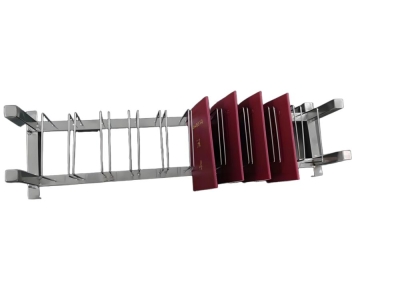 MRP Holder for Passport Testin
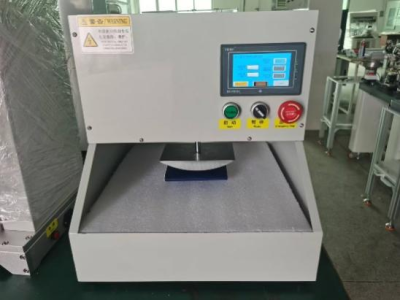 Card Warpage After Lamination:
 Inlay Storage and Shelf Life:
 Dust, Static and Debris: Clean
Please contact us with your request
We are ready to answer your questions.