
Inlay Storage and Shelf Life: Moisture Moves the Lamination Window
Smart Card Manufacturing Notes
Inlay Storage and Shelf Life: Moisture Moves the Lamination Window
Published: November 23, 2026 | ZOWINDA Application Engineering
Every incoming inspection of an inlay looks at the same things: antenna geometry, chip bond, resonant frequency, read range on a reference reader. Almost none of them look at the state the material is in after a week in a warehouse, a month on a shelf, or a weekend in an opened bag. Yet the press does not care where an inlay came from, only what it contains when it enters the cycle, and the one variable that drifts silently through storage is water. Two reels with identical date codes and different storage histories will laminate differently, register differently and read differently, and the difference will be blamed on the press recipe.
Moisture Is the Slowest Variable in the Process
Polyethylene terephthalate and its glycol-modified relatives are hygroscopic. At 23 degrees Celsius and 50 percent relative humidity, a PET film settles at roughly 0.2 to 0.4 percent moisture by weight, and above 80 percent relative humidity it can approach 0.6 to 0.8 percent. That sounds small until you convert it: water in a polymer acts as a plasticiser, so the glass transition temperature of PET, near 78 degrees Celsius when dry, can fall by 10 to 20 degrees when wet. The film that was dimensionally stable on the shelf becomes a film that softens earlier in the press, flows more, and relaxes the very stresses the lamination recipe was designed around.
What the water does inside the press matters more than what it does at room temperature. A press cycle heats a stack quickly and under pressure, and any moisture in the films, the adhesive or the printed antenna layer has nowhere to go until the stack is opened. It becomes steam at the interface, and the interface is exactly where adhesion is supposed to develop. The visible results are blisters and haze; the invisible results are a bond that is locally unbonded, a resonant frequency shifted a few hundred kilohertz because the dielectric stack changed, and an antenna whose silver tracks sat under a water-rich adhesive film during cure.
The inlay makes this worse than a plain sheet because it is an asymmetric laminate. Printed antenna on one face, chip bonded on the other, adhesive layers of different thickness, sometimes a ferrite or a spacer sheet: a stack of materials with different moisture expansion coefficients and different moduli, bonded to each other while they contain different amounts of water. Moisture leaves such a stack unevenly and slowly, so the inlay curls. Curl is the most useful early warning available, because it is measurable with a ruler on a flat plate, and because a curled inlay is already a registration problem before it reaches the press. A 0.5 millimetre bow across a 300 millimetre sheet is small; multiplied through a sheet-to-sheet lamination and a die-cutting step, it becomes the offset that consumes the antenna-to-body tolerance chain.
Shelf life is therefore not a property of a product, it is a history of a package. The same inlay stored sealed with desiccant, opened for an hour and resealed behaves nothing like one left open beside a plating line for a week. This is why a shelf life printed on a label is a weak control, and why the strong controls are the ones that record state: humidity indicator cards inside sealed bags, opening and resealing logs, first-in-first-out rotation with real dates, and a conditioning step before the press that is written into the work instruction rather than left to the operator.
Five Storage and Conditioning Rules
- Define the receiving state, not just the specification. Ask for a moisture content range and a sealed package with desiccant and a humidity indicator card, and record the indicator reading at goods-in. An incoming inspection that checks frequency but not moisture will accept material that cannot be laminated.
- Condition before the press, by a written table. Drying at 40 to 45 degrees Celsius for four to twelve hours, depending on film thickness and stack, brings most PET inlays into a safe window without thermal damage. Write the table by thickness and verify it with your own blister rate, not with the dryer display.
- Avoid over-drying as deliberately as under-drying. PET dried hard becomes brittle and electrostatically active, and a very dry inlay curls the other way. Both extremes hurt registration and both raise particle attraction at exactly the moment the cavity is about to be covered.
- Control condensation when material moves. Material brought from a cold store into a warm room collects water on the surface, and that water goes straight into the press. Allow sealed packs to equilibrate to room temperature before opening, which is a rule about patience, not about equipment.
- Rotate stock with dates a human can read. First-in-first-out fails quietly when labels are batch codes only. A visible received date, a re-seal date and a maximum open-bag life convert a vague instruction into a decision an operator can make at the machine.
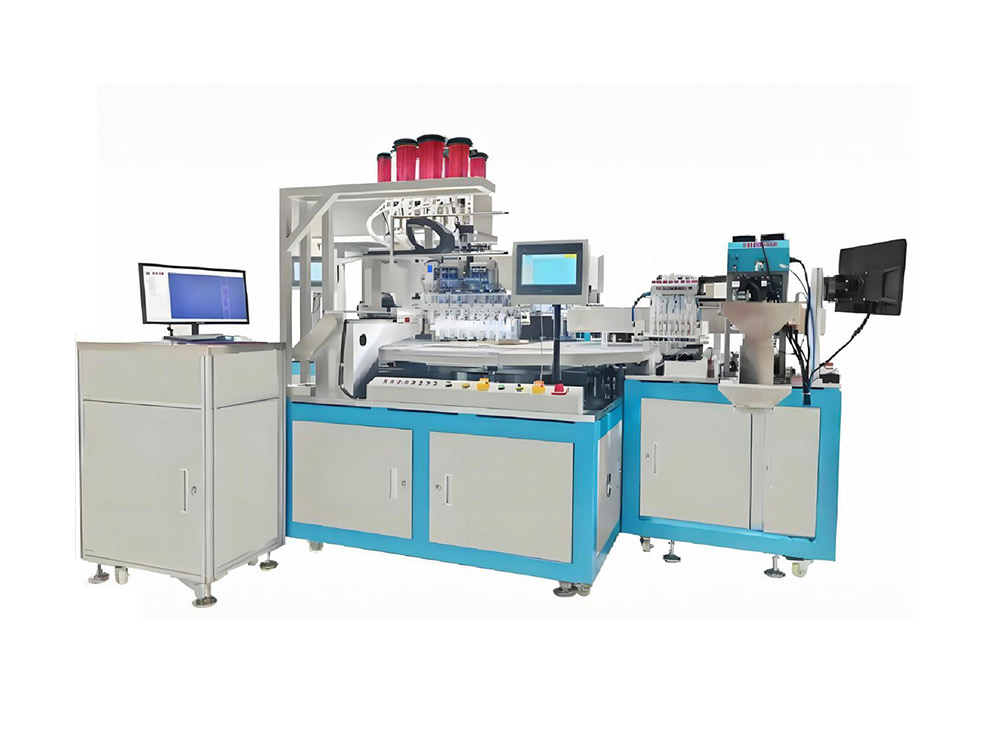
Inlay production ends with a reel and a bag, not with a finished card. What happens between that bag and the press decides how much of the manufactured precision survives. Equipment: Integrated Inlay Manufacturing System.
Why the Failure Looks Like a Press Problem
✓ Hygroscopic cores
PET and PET-G absorb water from the air and plasticise as they do. The press recipe that worked on dry material over-cures or mis-registers on wet material, with no change to any setpoint.
✓ Curl as an early indicator
Moisture leaves an asymmetric stack unevenly, so curl appears before any electrical symptom. Measuring bow after 24 hours of equilibration is the cheapest moisture test available.
✓ Desiccant discipline
A desiccant sachet saturates and then stops working while looking intact. Indicator cards and a defined replace-on-open policy are what make the bag a barrier rather than decoration.
✓ The cost of over-drying
Brittle film, higher static, reverse curl and cracked antenna tracks are all consequences of drying past the window. The target is a range, not a minimum.
Reference Storage and Conditioning Values
These figures are typical for PET and PET-G inlay constructions and should be treated as starting conditions. Thicker stacks, ferrite layers and water-based adhesives all move the window, so verify by blister rate, registration offset and frequency on your own lamination trial.
What Good Storage Buys You
The value of storage control shows up as stability rather than as improvement. Processes that were previously described as temperamental become predictable, and the daily argument about whether the press or the material caused a bad shift ends because the material state is a recorded number instead of an assumption.
- Blister and haze rates that stop tracking the weather outside the plant.
- Registration offsets on sheet-to-sheet lamination that shrink once wet material is excluded.
- A resonant frequency distribution that stays inside its window instead of drifting by shift.
- Fewer curl-related jams at the die cutter and at the embedding station.
- Incoming inspection that can reject a reel on evidence rather than on suspicion.
Frequently Asked Questions
Can we dry an inlay after it has already curled?
You can dry it, but you cannot uncurl it reliably. Drying removes the water and reverses part of the bow, yet the adhesive interfaces have already seen the strain, and the antenna may carry micro-damage at the chip bond. Treat curl as evidence of a moisture excursion and qualify the reel on electrical and peel results before releasing it to a customer order.
Is vacuum storage better than desiccant bags?
Vacuum removes air but not absorbed water, and it does nothing about the pressure that a soft bag applies to a reel. A sealed bag with desiccant plus a humidity indicator card is cheap, inspectable and adequate for normal inlay shelf lives. Vacuum is worth considering only for long-term storage of high-value material.
Why does the same inlay laminate well in one plant and badly in another?
Because the press is not the only difference. Ambient humidity, warehouse temperature, how long bags stay open, and whether material is conditioned before use vary far more between plants than press setpoints do. Moving a process between sites without moving its storage rules moves only half the process.
Next Step
More equipment in this range is listed on the ZOWINDA CardMachine product page, and related application notes appear in our Industry News section.
Related reading:
- Dust, Static and Debris: Cleanliness Between Milling and Embedding
- Card Warpage After Lamination: Cooling, CTE and the Flatness Spec
- Card Body Thermal Budget: PVC, PET-G and PC Lamination
- RFID in Wet Environments: Dielectric Loading and Detuning
- Inlay-to-Body Registration: The Real Tolerance Chain
Ready to boost your production efficiency?
Contact us for a tailored solution and quotation on inlay production, card testing and personalisation equipment.
Email: info@zowinda.com
WhatsApp: +86 186 2085 0485
 MRP Holder for Passport Testin
 Card Warpage After Lamination:
 Inlay Storage and Shelf Life:
 Dust, Static and Debris: Clean
Please contact us with your request
We are ready to answer your questions.