
Card Body Thermal Budget: PVC, PET-G and Polycarbonate Lamination Windows
Smart Card Manufacturing Notes
Card Body Thermal Budget: PVC, PET-G and Polycarbonate Lamination Windows
Published: November 14, 2026 | ZOWINDA Application Engineering
Lamination is the only step in card production where the entire card body is heated past its design limits on purpose. PVC, PET-G and polycarbonate do not spend that thermal budget the same way, and a recipe copied from a PVC line is the most common root cause of warped polycarbonate sheets and dull PVC surfaces alike.
Three Plastics, Three Definitions of Too Hot
PVC is the easiest material to laminate and the easiest to damage. Its glass transition sits near 80 degrees Celsius and softening begins well before a careless operator would notice. The working window for lamination is typically 110 to 130 degrees Celsius with cycle times of 8 to 20 minutes depending on sheet thickness and press construction. Above the window, the surface takes on an orange peel texture, the print layer of pre-collated sheets can offset onto the carrier foil, and cavities milled before lamination close up as the body relaxes. The margin between fully bonded and visibly damaged is narrow, which is why PVC lines run conservative recipes and accept slightly longer cycles.
PET-G occupies the middle ground. Its glass transition is comparable to PVC, roughly 75 to 85 degrees Celsius, but its melt behaviour is broader and it tolerates higher process temperatures without the surface defects that end a PVC run. Converters typically laminate PET-G at 120 to 150 degrees Celsius. The material rewards that extra heat: interlayer adhesion is stronger, and the sheet accepts post-lamination heat steps such as hot foil stamping with more margin. The trade-off is that PET-G is hygroscopic. Sheets that absorbed ambient moisture during storage blister during lamination, so conditioning and sealed storage matter more than they ever did on a PVC line.
Polycarbonate moves the entire conversation. With a glass transition near 145 degrees Celsius, it is laminated at 180 to 200 degrees Celsius under higher pressure, and it expects it: laser personalisation, a requirement on most government programmes, only works on a body that survives localised temperatures far above anything PVC can see. But PC is also the least forgiving of process shortcuts. Insufficient pressure shows up as microvoids between layers that appear only after lamination, and asymmetric cooling shows up as bow. A PC sheet that leaves the press flat but bows a millimetre after a day at room temperature was cooled unequally through its thickness, not laminated badly.
The design consequence is that the thermal budget belongs to the card body, not to the press. A dual-interface stack that adds a 0.2 millimetre ferrite sheet, a module cavity and a thicker milled region changes heat flow through the sheet, so the same recipe that centred a plain card can push an edge region out of its window. Qualify recipes per stack, not per material.
How to Find and Hold the Window
- Start from the material datasheet, then throw half of it away. Vicat and glass transition figures describe bulk behaviour at slow heating rates. A press ramp of a few degrees per minute with pressure applied throughout behaves differently. Use the datasheet to rule out impossible recipes, not to pick the final one.
- Run a temperature ladder with destructive checks. Laminate trial sheets at five set points across the expected window. For each, peel-test interlayer adhesion, check cavity dimensions, and inspect the surface under raking light for orange peel. The window is the range where all three pass, and it is usually narrower than the ladder suggests.
- Instrument the stack, not the platen. A thermocouple in a sacrificial sheet at the milled region and at the plain edge reveals how much colder the thick region runs. On dual-interface stacks the difference routinely reaches 10 degrees Celsius, which is most of a PVC window.
- Control cooling as a process parameter. Warpage in PC and curl in PET-G are cooling asymmetries, not lamination errors. Record top and bottom platen temperatures at the moment pressure releases and trend them. Symmetric release is what keeps a sheet flat after 24 hours.
- Re-qualify on every stack and material change. A new overlay, a new ferrite sheet, a new adhesive lot each changes heat flow and bond behaviour. Treat the recipe as part of the bill of materials, and re-run the ladder whenever a component of the stack changes.
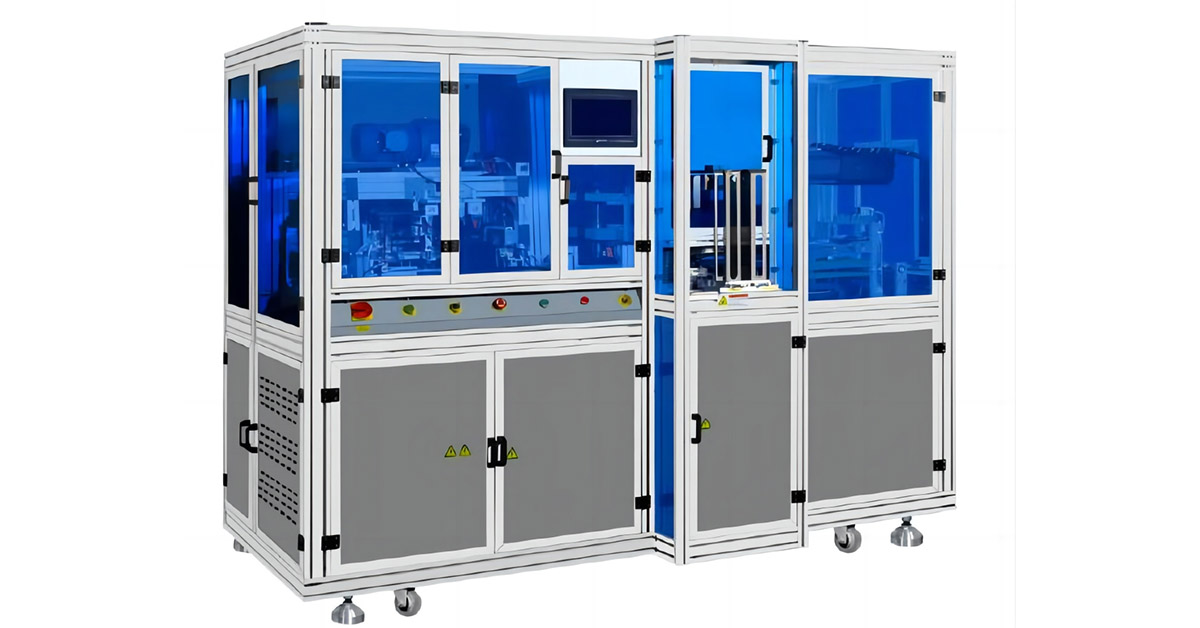
Lamination temperature, dwell and pressure are one budget, spent differently by each card body. Equipment: Automatic Sheet Collating and Overlay Laminating Machine.
Rules That Prevent the Expensive Mistakes
✓ Never carry recipes across materials
A PVC recipe on PC leaves unbonded layers; a PC recipe on PVC destroys the sheet. The press can do both, which is exactly why recipes must be locked to the stack they were qualified on.
✓ Budget the whole lifecycle, not just lamination
Hot foil stamping, embossing and laser personalisation each add thermal events after the press. A body chosen with no margin for them forces rework at the end of the line, where scrap is most expensive.
✓ Treat moisture as a temperature problem
PET-G and PC absorb water; water flashes to steam at lamination temperature and shows up as blisters. Sealed storage and conditioning near room humidity cost less than one blistered batch.
✓ Judge flatness after 24 hours, not at the press
Residual stress relaxes as the sheet returns to room temperature. Accept sheets on a flatness check the next day and you will never chase a warp that came from release temperature asymmetry.
Reference Lamination Windows
Typical reference windows for financial and government card formats. Exact set points depend on sheet build-up, press construction and overlay chemistry, and must be established by a ladder trial on your own stack.
Where the Thermal Budget Decides the Product
The same budget logic governs any laminated structure where plastics, adhesives and electronics share one press cycle:
- Contactless payment cards in PVC or PET-G with pre-laminated inlays
- Polycarbonate government and ePassport data pages with laser personalisation requirements
- Dual-interface cards where ferrite and module change heat flow through the stack
- Multi-application cards with milled cavities laminated before and after implanting
- Any line running mixed materials, where recipe mix-ups are the dominant scrap cause
Frequently Asked Questions
Can the same press run PVC and polycarbonate on the same shift?
Yes, with recipe discipline. The press hardware is identical; what must change is set points, pressure profile and often the carrier foils. Physically separating the recipes, by dedicated recipe files and changeover checklists, prevents the classic mistake of running a PVC sheet on a PC cycle.
Why do polycarbonate cards bow after lamination even when the press says the cycle was correct?
Because the cycle is only half the story. Bow almost always comes from asymmetric cooling through the thickness: one face solidifies earlier, locks in a length difference and the sheet curves. Fix the release temperature symmetry and the flatness of the stack-up before touching the lamination set points.
Does a thicker card need a longer lamination cycle?
Longer, yes, and hotter at the core. Heat has to conduct through the stack, so a milled or multi-layer sheet reaches bonding temperature later than a plain one. Instrumenting a sacrificial sheet is the only reliable way to know when the middle of the stack has actually seen the window.
Next Step
More equipment in this range is listed on the ZOWINDA CardMachine product page, and related application notes appear in our Industry News section.
Related reading:
- Gold Bump Flip-Chip or Wire Bonding: Choosing the Module Interconnect
- Reel-to-Reel or Sheet-to-Sheet: Matching Inlay Architecture to Volume
- Inlay Sheet Yield Maths: Where a Two Percent Layout Change Pays
- Integrated Inlay Manufacturing System
Ready to boost your production efficiency?
Contact us for a tailored solution and quotation on inlay production, card testing and personalisation equipment.
Email: info@zowinda.com
WhatsApp: +86 186 2085 0485
 Reel-to-Reel or Sheet-to-Sheet
 Gold Bump Flip-Chip or Wire Bo
 Card Body Thermal Budget: PVC,
 Isotropic Conductive Adhesive
Please contact us with your request
We are ready to answer your questions.