
Key Injection and Audit Trail: The Part of Personalisation That Gets Audited
Smart Card Manufacturing Notes
Key Injection and Audit Trail: The Part of Personalisation That Gets Audited
Published: November 16, 2026 | ZOWINDA Application Engineering
Ask a production manager what a personalisation line makes and the answer is cards. Ask an auditor the same question and the answer is records. Both are correct, and the gap between them is where most serious personalisation incidents begin, because a card whose key is unknown is worse than a card that failed, and a rejected card that was never counted is a key in the wild.
Personalisation Produces Two Products: the Card and the Record
Personalisation writes two kinds of data. The visible kind, printed or embossed on the surface, and the invisible kind, loaded into the chip: file structure, application data and cryptographic keys. The invisible kind is the reason the process is controlled. A card with wrong printed data is a customer complaint. A card with a key that cannot be traced back to its derivation record is a security event, because nobody can say which other cards share the exposure.
Key injection normally works by diversification rather than by storing one key per card in advance. A master key lives inside a hardware security module, and each card receives a unique key derived from that master plus card-specific data, commonly the serial number or the primary account number. The card therefore holds a key that exists nowhere else, and the issuer can regenerate it later because the derivation inputs and the master are both known. This is elegant and it moves the entire security burden onto two things: protecting the master, and recording the derivation inputs for every card without exception.
The protection part is procedural as much as technical. A key ceremony loads master keys into the HSM under dual control, meaning no single person ever holds a complete key component, and the ceremony is witnessed and recorded. From that point the master must never exist in clear outside the module. That rules out a surprising number of everyday practices: exporting a key to a text file for a test, loading keys through a vendor tool that displays them, keeping a copy in a spreadsheet so a line can be restarted quickly. Each of those turns an HSM from a security boundary into decoration.
The recording part is where production reality bites. Every card must be bound to the data used to derive its key, at the moment of personalisation, in a record that cannot be silently edited afterwards. In practice this means the personalisation system writes a line per card containing the serial, the derivation inputs or their reference, the operator, the timestamp and the session identifier of the HSM interaction. When a card is later reported as compromised and the question is how many others are affected, that record is the only way to answer in hours instead of weeks.
How to Build a Key Flow That Survives an Audit
- Write the key hierarchy down before writing any code. Decide how many levels exist, what derives what, and which data is an input to derivation. A hierarchy that exists only in the head of the engineer who built it cannot be audited, and cannot be handed over when that engineer leaves.
- Dual control the ceremony and record it as evidence. Two authorised people, split components, a witnessed log with names, times and component identifiers. The record is the deliverable, not the ceremony. If the only proof a ceremony happened is that everyone remembers it, it did not happen.
- Bind every card to its derivation data at the moment of writing. The link between card and key inputs must be created by the system that personalises the card, not reconstructed afterwards from a batch list. Reconstruction is where off-by-one errors live, and an off-by-one error in a derivation index is a wrong key on a live card.
- Reconcile every shift, not every month. Cards issued must equal cards good plus cards rejected plus cards destroyed, counted per job. A break of one card is a signal; a break discovered at month end is an investigation. Reconciliation is cheap while the shift is still running and expensive once the bins have been emptied.
- Destroy personalised rejects under witness and keep the record. A rejected card that already received keys is key material, not scrap plastic. It must be accounted, destroyed to a defined standard and the destruction witnessed and logged, then the log retained for as long as the card could have been in the field.
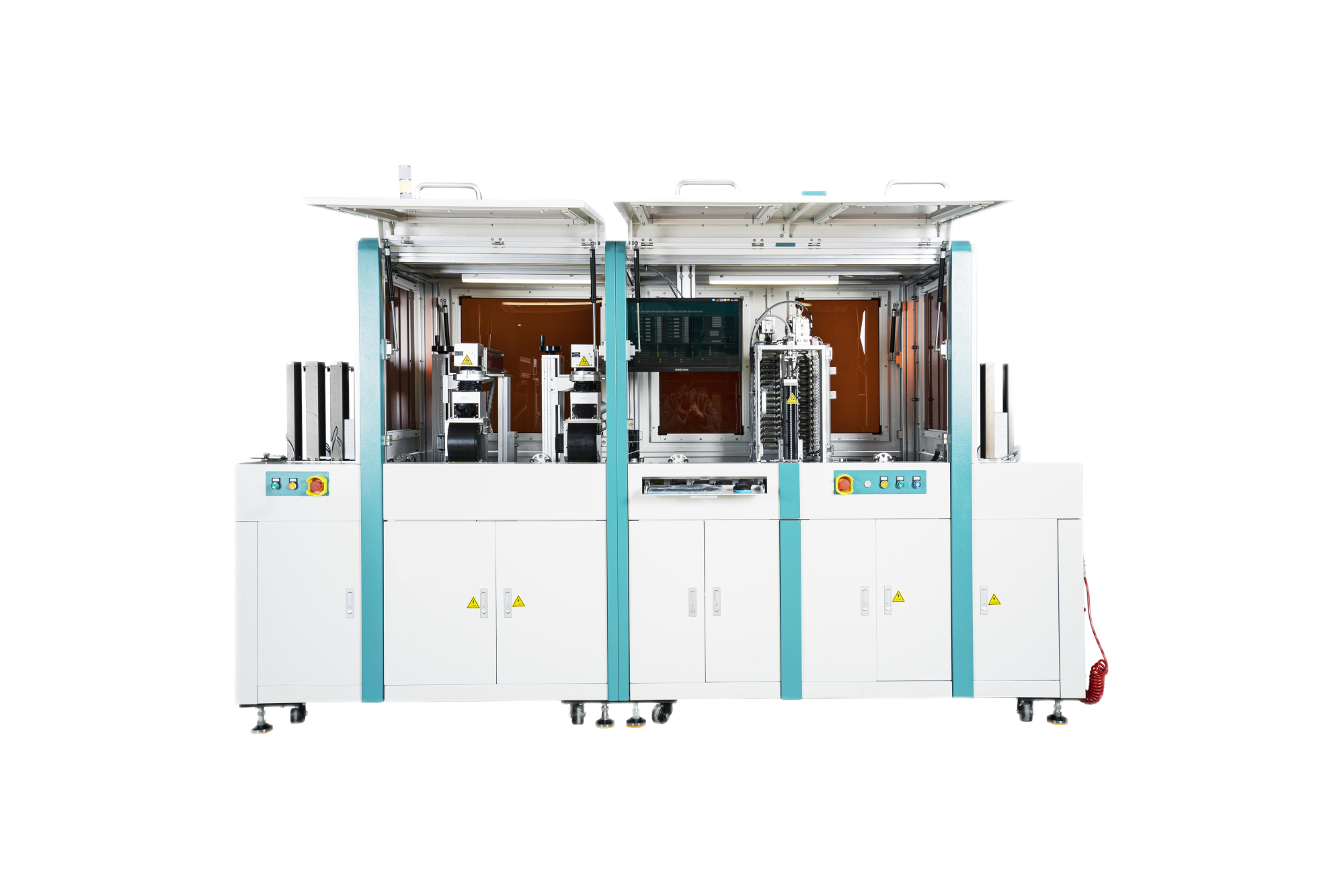
Encoding, printing and key loading in one pass: the record has to be written at the same moment as the card. Equipment: GSM Card Personalisation Machine P8600.
Rules That Protect the Record
✓ Keys never leave the module in clear
Every legitimate key operation happens inside the security module or inside the chip. Any workflow step that shows a key, exports a key or logs a key is a defect in the workflow, not a convenience.
✓ The audit trail is a product of the process
If the record is generated after the fact by a reporting tool, it is a summary and not evidence. It has to be written by the same system that wrote the card, in the same transaction.
✓ Treat rejects as key material
Counting rejects as production loss understates them. Each reject carries a key that was derived and must be traceable, which makes the reject bin a controlled area rather than a bin.
✓ Decide retention by card life, not by policy comfort
Records must outlast the card. A retention period shorter than the longest possible field life of the product means the last years of a card population have no traceable key history at all.
Reference Values for Key Management
Typical practice for payment, identity and closed-loop card programmes. Exact requirements are set by the scheme, the issuer and local regulation, and should be confirmed against the applicable security requirements before a line is commissioned.
Where the Same Logic Applies
The pattern of a derived secret plus a mandatory record appears in every product that carries credentials:
- Payment and transit cards with scheme-mandated key hierarchies
- SIM and eSIM profiles where keys are loaded under operator control
- Government identity documents combining a chip, a printed portrait and a serial
- Access control and campus cards where a leaked master compromises a whole site
- Any issuance line running multiple jobs per shift, where reconciliation is the only early warning
Frequently Asked Questions
Is a hardware security module mandatory for every card programme?
For scheme payment cards it is effectively mandatory because the scheme says so. For closed-loop and private systems it is not always required by a standard, but the alternative is storing master keys on a personalisation PC, which converts every backup, every remote support session and every stolen disk into a key exposure. The module is cheaper than the incident.
How long should personalisation records be kept?
At least as long as any card from that job can still be in use, plus the dispute and investigation window that follows. For a card with a ten year field life, a seven year retention policy guarantees that the last three years of cards cannot be traced, which is exactly the period when a slow key compromise would surface.
Can a card be re-personalised if key injection failed?
A card that failed before any key was written can usually be reworked if the failure was in printing. A card that received keys and then failed verification cannot be treated as blank, because the chip now holds a key, possibly a wrong one, and possibly inside a file structure that is half written. Mark it, count it and destroy it.
Next Step
More equipment in this range is listed on the ZOWINDA CardMachine product page, and related application notes appear in our Industry News section.
Related reading:
- Laser Cutting or Die Cutting: How the Cavity Edge Decides Card Reliability
- Dual-Interface Bridge: Making the Contact and Contactless Paths Agree
- GSM Card Personalization Machine P8600 - SIM Card Data Encoding and Printing
- Card Body Thermal Budget: PVC, PET-G and Polycarbonate Lamination Windows
Ready to boost your production efficiency?
Contact us for a tailored solution and quotation on inlay production, card testing and personalisation equipment.
Email: info@zowinda.com
WhatsApp: +86 186 2085 0485
 Key Injection and Audit Trail:
 Dual-Interface Bridge: Making
 Laser Cutting or Die Cutting:
 Reel-to-Reel or Sheet-to-Sheet
Please contact us with your request
We are ready to answer your questions.