
PT088 Passport Torsion Stress Tester for Booklet Fatigue
PT088 Passport Torsion Stress Tester for Booklet Fatigue: Engineering Notes from the Test Floor
Published: November 06, 2026 | ZOWINDA Application Engineering
Bend a booklet and the load runs across the spine. Twist it and the load runs diagonally, from one corner to the opposite corner, with the spine as the only restraint. That diagonal path is the one that finds the defects neither bending nor flexing can reach: a data page inlay that is well bonded but poorly placed, a chip module that survives compression but not shear, a spine that holds under bending and opens under torsion. Torsion is the third axis of passport mechanical durability, and it is the one most often skipped.
What Torsion Loads That Bending Does Not
Hold a booklet by one cover and rotate the other about the long axis. The covers separate at the fore-edge, the spine becomes a torsional spring, and the data page - rigid because of its inlay and its chip - resists the twist while the cover around it follows. The result is shear at the cover-to-data-page interface and out-of-plane bending in the antenna plane, which is a stress state no pure bending test produces. Antenna wire laid in a flat spiral is strong in tension along its length and weak against out-of-plane displacement, so torsion is precisely the load that lifts turns off the substrate.
Torsion also reaches the chip module differently. A bend compresses the module into its cavity; a twist rocks it, loading the adhesive in shear on one side and peel on the other. A module that passes a bend test at 20,000 cycles can lift a corner after a few thousand twists - and a lifted corner reads fine on a bench and fails in a pocket. That asymmetry is the reason the three mechanical tests are complementary rather than redundant.
Running a Torsion Test
- Clamp both covers, not the data page. The clamps hold the covers so the booklet itself transmits the torque. Clamping the data page directly changes the load path and stops testing the construction.
- Set twist angle per direction. Torsion is bidirectional: a booklet twisted one way and the other sees two different strain distributions. Both directions are part of the recipe.
- Set cycle count and hold time. A short hold at full twist separates creep from fatigue. Without it, a slow adhesive and a weak adhesive look the same.
- Inspect the fore-edge and spine at intervals. Separation at the fore-edge, whitening along the spine and a rocking chip module are the visible signatures. Photographing at fixed intervals makes the progression comparable.
- Verify electrically after each pull. Resonance shift is the earliest torsion symptom, because a turn that has lifted changes inductance before it changes anything visible.
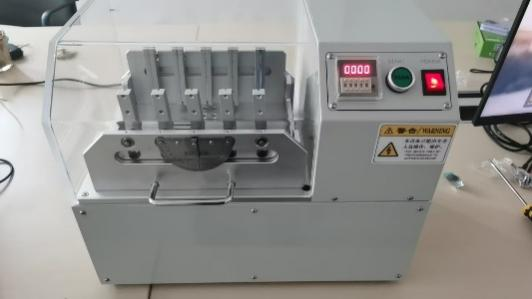
Figure: PT088 passport torsion stress tester with opposed rotating clamps and programmable twist angle. Equipment: PT088 Passport Torsion Stress Tester for Booklet Fatigue.
Engineering Advantages
✓ Opposed Rotating Clamps
Torque is applied by rotating both covers in opposition, which keeps the booklet centred and repeats the same strain path cycle after cycle.
✓ Bidirectional Twist
Both rotational directions are programmable, so the asymmetries that a one-way fixture hides are loaded as well.
✓ Angle-Controlled Severity
Twist angle is the severity parameter, stored per recipe, so a screening run and a qualification run are the same fixture at different settings.
✓ Built for Comparison
Repeatable clamping and counted cycles let two booklet constructions be compared directly, which is what a supplier decision actually needs.
Technical Data
Twist angle, cycle count, hold time and acceptance criteria follow the durability clause of your programme and the construction being qualified. ZOWINDA specifies clamps and the recipe range against the format and thickness you supply.
Where Torsion Testing Earns Its Place
The classic case is a module that tests clean and fails in service. Bend and flex both pass, the module sits flat, the adhesive looks adequate - and then a torsion run lifts a corner in a few thousand cycles and the read range drops to the edge of the reader tolerance. The same logic applies to inlay placement. A spiral that is centred on the data page sees a symmetric strain field under torsion; one that is offset sees a gradient, and the turns nearest the spine carry more of the twist. Neither defect is expensive to fix once it is known, and both are invisible until a torsion test is run.
- Qualifying a chip module adhesive that passed bend but failed in the field
- Checking an inlay layout change before tooling commitment
- Comparing booklet constructions at equal cost
- Investigating returns that read on the bench but fail in use
Frequently Asked Questions
Does a torsion test replace the bend and flexing tests?
No - the three load different failure modes. Bending about the spine shears the data page against the cover, flexing accumulates fatigue in the hinge, and torsion loads the antenna plane out of plane and rocks the chip module. A durability programme that skips torsion tends to discover it as a field failure.
Why clamp the covers instead of the data page?
Because the construction has to carry the torque. Clamping the rigid data page bypasses the cover-to-page bond and the spine, which are the two elements the test is meant to load.
Can torsion be run on the same fixture as bending?
The clamps differ because the motion differs, but the controller and recipe storage are the same family. ZOWINDA specifies the clamp set for the load type and the booklet format, so a lab running all three tests keeps one operating language.
Next Step
More equipment in this range is listed on the ZOWINDA CardMachine product page, and related application notes appear in our Industry News section.
Related reading:
- PT086 Book Bend Stress Tester for ePassport Back-Pocket Durability
- PT087 Dynamic Flexison Tester for Passport Bending Fatigue
- ICC Backside Spot Pressure Tester for Smart Card Quality Control
Ready to boost your production efficiency?
Contact us for a tailored solution and quotation on the PT088 Passport Torsion Stress Tester for Booklet Fatigue.
Email: info@zowinda.com
WhatsApp: +86 186 2085 0485
 PT088 Passport Torsion Stress
 PT087 Dynamic Flexison Tester
 PT086 Book Bend Stress Tester
 Auto Patch Pick and Place Mach
Please contact us with your request
We are ready to answer your questions.