
Smart Card Types and How They Work Guide 2026 | Zowinda
Smart Card Types and How They Work Guide 2026 | Zowinda
A smart card is a pocket-sized plastic card with an embedded integrated circuit that stores and processes data. If you have ever used a chip bank card, a transit pass, an employee badge, or a SIM card, you have used one. This guide explains the main smart card types, shows how smart cards work at the chip level, and connects the theory to the machines that build them. Whether you are an engineer, a buyer, or a curious reader, you will leave with a clear mental model of contact, contactless, and dual-interface technology.
What Is a Smart Card
At its core, a smart card is a secure microcontroller or memory chip laminated inside a PVC, PET-G, or PC card body. The chip talks to a reader through either metal contact pads (contact cards) or a radio antenna (contactless cards). The card body carries printed artwork, a magnetic stripe, or an adhesive layer, but the intelligence lives in the silicon. Because the chip can encrypt, authenticate, and store credentials, smart cards are trusted for payments, identity, access control, and mobile connectivity.
The global standard family behind most cards is ISO/IEC 7816 for contact cards and ISO/IEC 14443 for contactless cards. Understanding these two standards is the fastest way to understand every smart card type on the market today.
Main Types of Smart Cards
Smart cards are classified by how they communicate and by how much processing power the chip has. The four groups below cover almost every real-world deployment.
Contact Smart Cards
Contact cards expose a row of gold contact pads (usually eight) on the surface. When inserted into a reader, the pads touch spring pins that power the chip and carry data over ISO/IEC 7816. These cards are extremely reliable and resist eavesdropping because the link is physical. EMV payment cards, SIM cards, and many government ID cards are contact cards.
Contactless Smart Cards
Contactless cards hide a thin antenna coil and an RFID or NFC chip inside the body. They power up inductively when brought near a reader operating at 13.56 MHz (HF) and exchange data by radio. No insertion is needed; a tap is enough. Transit tickets, office badges, and tap-to-pay bank cards are contactless. The heart of these cards is the All-in-One RFID Inlay, which bonds the antenna and chip into a single module before lamination.
Dual-Interface and Hybrid Cards
Dual-interface cards carry both contact pads and a contactless antenna wired to the same secure chip, so one credential works in both old and new readers. Hybrid cards pack two separate chips (one contact, one contactless) in one body. Dual-interface is now the default for modern payment and ID programs because it maximizes acceptance.
Memory Cards vs Microprocessor Cards
Memory cards only store data in fixed sectors and may have simple logic protection. Microprocessor cards run an operating system on the chip, execute cryptographic commands, and isolate applications. High-security use cases such as banking and e-passports always use microprocessor cards.
How Contact and Contactless Cards Work
A contact card works like a tiny computer plugged into a socket. The reader supplies 5V (or 3V/1.8V) power through the VCC pad, a clock through CLK, and a reset through RST. The chip wakes up, runs its OS, and answers APDU commands over the I/O pad. Authentication and transaction data are encrypted inside the chip, so the reader never sees the secret key.
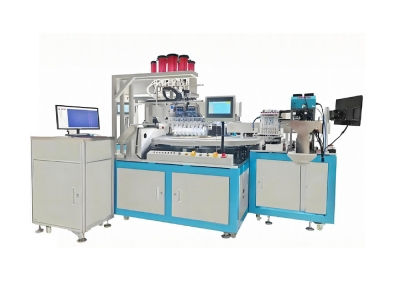
A contactless card works by inductive coupling. The reader's coil creates a 13.56 MHz magnetic field; the card's antenna harvests energy and the chip boots. Data moves by load modulation on the same carrier. The chip inside a modern inlay is attached with conductive bumps by an RFID Automatic Flip Chip System in microseconds, which is why flip-chip bonding is the dominant method for contactless inlays. Range is a few centimeters, which keeps the link private and hard to skim from a distance.
How Smart Cards Are Manufactured
Building a card is a precision production line. It starts with printed PVC, PET-G, or PC sheets. An inlay or a contact module is placed, then chips are bonded with equipment such as the RFID Automatic Flip Chip System. Sheets are laminated, milled to carve the contact cavity by a Smart Card Slot Milling Machine, and personalized with printing and encoding. Every finished card must survive bending, temperature, and abrasion tests on an ICC Three Wheel Tester before shipment. The full line spans lamination, collating and overlay, cavity milling, antenna embedding, personalization, and final testing and sorting.
How to Choose the Right Smart Card
Pick the interface first: choose contact for fixed readers, contactless for speed and hygiene, or dual-interface for maximum compatibility. Then match the chip: memory cards for loyalty and ticketing, microprocessor cards for payments and identity. Finally match the material and durability to the environment, and validate a sample on the same reader model your users will have. A short checklist: interface, chip class, operating standard, material grade, and tested durability. If you need help specifying a line, our team can share a production spec sheet.
| Card Type | Interface | Standard | Typical Use | Security |
|---|---|---|---|---|
| Contact | Metal pads | ISO/IEC 7816 | Bank EMV, SIM, eID | High (physical link) |
| Contactless | 13.56 MHz RFID/NFC | ISO/IEC 14443 | Transit, badges, tap pay | High (short range) |
| Dual-Interface | Pads + antenna | 7816 + 14443 | Modern payment / ID | High (both) |
| Memory | Either | Vendor | Loyalty, ticketing | Medium |
| Microprocessor | Either | Java Card / OS | Banking, e-passport | Very high |
Frequently Asked Questions
What is the difference between a smart card and a magnetic stripe card?
A magnetic stripe card only holds static data that anyone can read with a swipe. A smart card has a chip that computes and protects secrets, so cloned stripes are useless against a chip. That is why banks migrated to chip cards.
Is NFC the same as a contactless smart card?
NFC is the short-range radio technology (ISO/IEC 14443 based) that contactless smart cards use. A contactless card is the physical card; NFC is the protocol. Phones use NFC to emulate cards, and cards use NFC to talk to readers.
Can one smart card do both contact and contactless?
Yes. A dual-interface card wires both the contact pads and the contactless antenna to the same secure microcontroller. One credential works in legacy inserted readers and modern tap readers.
How long does a smart card last?
Contact cards are rated for tens of thousands of insertions; contactless cards have no moving wear and last for the life of the chip, typically five to ten years. Durability depends on material grade and lamination quality, which is why production lines include wheel and pressure testing.
What machines build a smart card?
A line includes an inlay bonder, a flip-chip system, a laminator, a cavity milling machine, an antenna embedding machine, a personalization printer, and a reliability tester such as a three-wheel tester. ZOWINDA supplies each station and can scope a complete line for your volume.
Get a Smart Card Production Spec Checklist
Need help specifying the right card type or production line for your project? Email our team at info@zowinda.com or message us on WhatsApp at +86 186 2085 0485 for a free spec checklist and a quote. Explore our RFID Inlay, Flip Chip System, and Three Wheel Tester to see the equipment behind every reliable smart card.
 Smart Card Types and How They
 RFID Inlay vs Label vs Hard Ta
NFC Forum Tag Types 1 to 5: Ho
Centralized Bureau Issuance vs
RFID Inlay vs Label vs Hard Ta
NFC Forum Tag Types 1 to 5: Ho
Centralized Bureau Issuance vs
Please contact us with your request
We are ready to answer your questions.