
Dual Lane Sliding Shoe Sorter: How Twin-Lane Architecture Doubles Parcel Throughput
Dual Lane Sliding Shoe Sorter: How Twin-Lane Architecture Doubles Parcel Throughput Without Doubling Floor Space
Published: 2026-08-07 | Zowinda Technology | Parcel & Logistics Automation
As e-commerce parcel volumes keep climbing, single-lane sorters increasingly become the choke point of an entire distribution centre. The dual lane sliding shoe sorter answers this by running two independent sorting lanes on one shared frame - delivering close to twice the throughput while occupying only marginally more floor area. This article explains the mechanics, the throughput maths, the integration requirements and the ROI logic behind twin-lane shoe sorting.
Why Sliding Shoe Technology Still Leads High-Volume Parcel Sorting
Sliding shoe sorters divert items using low-friction shoes that travel across the conveying surface, gently pushing the parcel sideways onto a take-away chute. Unlike pop-up wheel or tilt-tray designs, the shoe never lifts or drops the item - it guides it. That single mechanical difference is why shoe sorters remain the default choice for mixed parcel streams containing polybags, cartons, padded mailers and irregular shapes.
Three properties keep this technology dominant in high-volume operations. First, gentle handling: the divert is a lateral glide rather than an impact, which matters for fragile goods and thin polybags. Second, wide product tolerance: the same machine sorts a 30 g envelope and a 30 kg carton without changeover. Third, sustained accuracy at speed: shoe divert timing is controlled electronically per shoe, so accuracy does not degrade as belt speed rises.
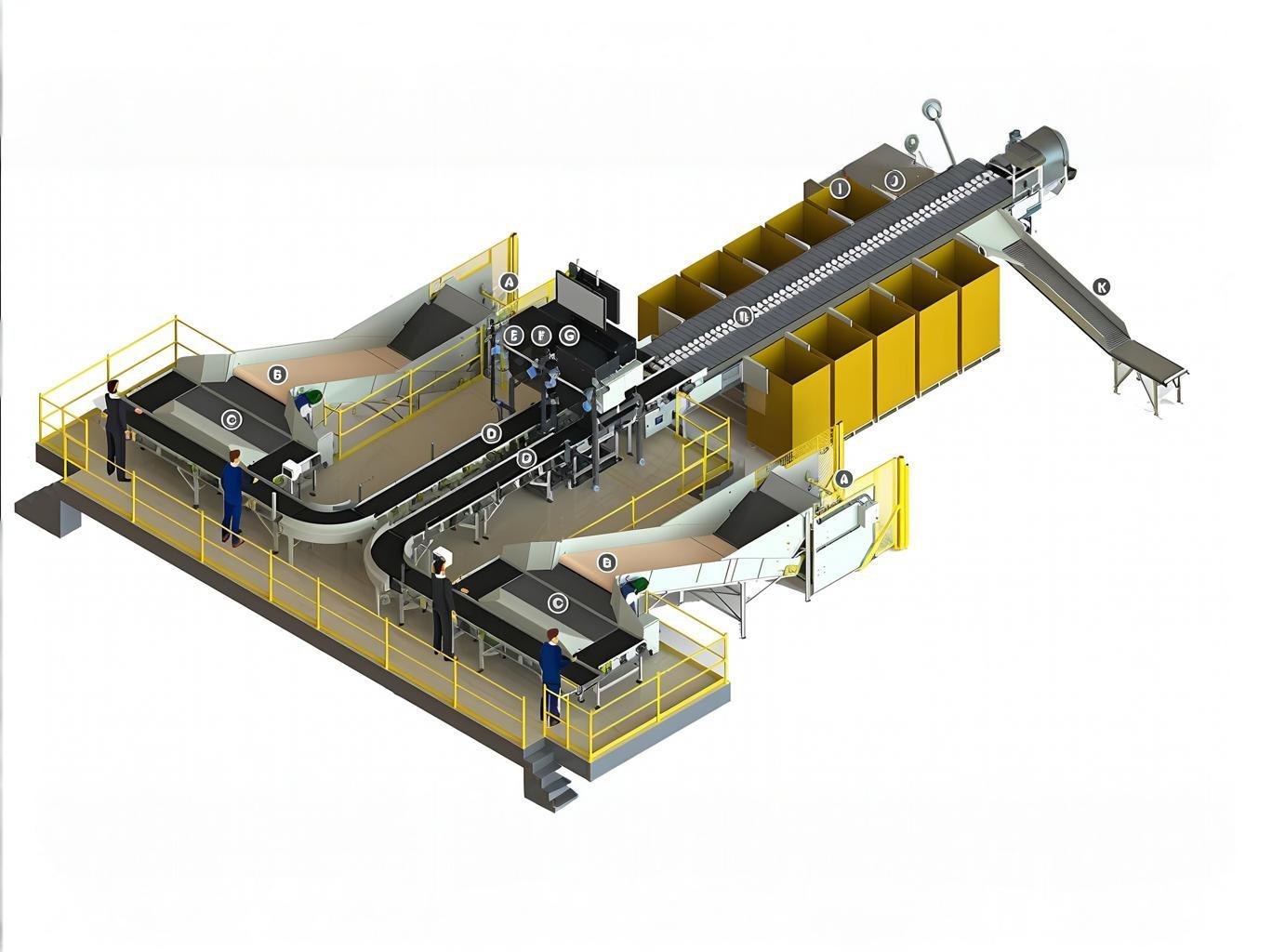
Dual lane sliding shoe sorter - two independent sorting lanes sharing a single drive frame.
The Dual Lane Concept Explained
A conventional shoe sorter carries one product stream down the centre of the slat bed. A dual lane sorter divides that same bed into two parallel logical lanes, each with its own induction point, its own scanning tunnel and its own divert logic. The shoes are addressed individually, so lane A can divert left while lane B simultaneously travels straight - on the same physical slat.
The practical consequence is significant. Instead of building a second sorter line - with its own drive, controls, mezzanine and maintenance envelope - the operator gets a second stream from one asset. Capital cost per sorted parcel drops sharply, and so does the square-metre cost that dominates urban distribution centre economics.
Independent Lane Logic
Each lane runs its own barcode read, destination lookup and divert command, so a no-read on one lane never stalls the other.
Shared Mechanical Frame
One drive unit, one slat bed, one lubrication and tensioning regime - roughly half the maintenance burden of two separate sorters.
Balanced Induction
Upstream singulation feeds both lanes from a common merge, automatically levelling load so neither lane starves or saturates.
Scalable Chute Count
Divert destinations can be assigned to either lane or shared, letting planners tune chute allocation to real destination volumes.
Throughput Mathematics: What Twin Lanes Actually Deliver
Throughput on a shoe sorter is governed by belt speed, minimum item pitch and induction efficiency. Adding a second lane does not simply double the figure - induction and downstream chute capacity impose real limits. In practice, a well-balanced dual lane installation delivers roughly 1.7x to 1.9x the sustained rate of an equivalent single lane machine, and the gap narrows further as parcel mix becomes more uniform.
Figures are indicative and depend on parcel mix, chute count, induction design and site conditions. Zowinda provides a site-specific throughput study before final specification.

Shoe divert detail - each shoe is addressed individually, enabling independent per-lane divert decisions.
Integration Requirements: Getting the Surrounding System Right
A sorter never underperforms in isolation. When a dual lane machine fails to hit its rated figure, the cause is almost always upstream or downstream. The following checklist covers the areas that determine whether the installed rate matches the specified rate.
Upstream: Singulation and Induction
- Singulation quality - side-by-side parcels are the single largest cause of missorts. A dedicated singulator or bulk flow feeder is strongly recommended above 6,000 pph.
- Gap control - the induction conveyor must present a consistent minimum gap so the control system can allocate shoes cleanly.
- Lane balancing - a merge that feeds both lanes evenly is essential; a static 50/50 split will underperform against dynamic load levelling.
Scanning and Data
- Multi-sided scanning tunnel - top plus four-side read covers labels on any face and cuts no-read rates below 0.5%.
- Dimensioning and weighing (DWS) - integrating DWS at induction gives billing-grade data and enables volumetric chute allocation.
- WCS latency - the destination lookup must return within the induction-to-divert travel window, typically well under 200 ms.
Downstream: Chutes and Take-Away
- Chute capacity - an undersized chute backs up and forces recirculation, wiping out the twin-lane advantage.
- Full-chute sensing - automatic re-routing to an overflow destination prevents jams during peak surges.
- Ergonomic offload - chute height and angle directly affect the number of operators required per shift.
Return on Investment: Where the Savings Come From
The business case for a dual lane sorter rests on four measurable effects. Labour is the largest: manual parcel sorting typically achieves 300 to 500 items per operator hour, so a 12,000 pph machine displaces a substantial headcount at peak. Accuracy is the second: every missort generates a re-handling cost plus a potential service failure with the end customer.
The third effect is floor space. In a metropolitan distribution centre, an additional single lane sorter line consumes a footprint that a dual lane machine largely avoids. The fourth is maintenance: one frame, one drive and one spare parts inventory instead of two. Taken together, most high-volume operators model payback in the range of 12 to 30 months, with peak-season capacity headroom as an unquantified bonus.

Take-away chutes - correct chute sizing and full-chute sensing are critical to sustaining rated throughput.
Frequently Asked Questions
How much floor space does a dual lane sorter need compared with two single lane sorters?
Because both lanes share one slat bed and drive frame, a dual lane machine typically occupies close to the footprint of a single sorter plus a modest allowance for the second induction and additional chutes - substantially less than two independent lines.
Can the two lanes handle different product types simultaneously?
Yes. Each lane has independent scanning and divert logic, so one lane can be dedicated to small polybags and envelopes while the other handles cartons, with different divert timing profiles per lane.
What happens if one lane needs maintenance?
Because the lanes share a mechanical frame, most drive-level maintenance requires stopping the machine. However, lane-specific items such as induction conveyors, scanners and chutes can generally be serviced while the other lane continues operating.
What sorting accuracy is realistic in production?
With proper singulation, a multi-sided scanning tunnel and correctly sized chutes, above 99.9% is routinely achieved. Accuracy problems in the field almost always trace back to singulation or scanning rather than the sorter itself.
Does the system integrate with our existing WMS?
Yes. The sorter control system exposes standard industrial interfaces and is normally driven by a WCS layer that communicates with the customer WMS or ERP. Zowinda supports integration during commissioning.
Related Equipment & Reading
Ready to Double Your Parcel Sorting Capacity?
Talk to our engineering team for a tailored throughput study, layout drawing and quotation.
Email: info@zowinda.com
WhatsApp: +86 186 2085 0485
 RFID Inlay vs Label vs Hard Ta
NFC Forum Tag Types 1 to 5: Ho
Centralized Bureau Issuance vs
Edge-to-Edge Printing vs Borde
RFID Inlay vs Label vs Hard Ta
NFC Forum Tag Types 1 to 5: Ho
Centralized Bureau Issuance vs
Edge-to-Edge Printing vs Borde
Please contact us with your request
We are ready to answer your questions.