
Automatic Sheet Collating and Overlay Laminating Machine | CCD-Aligned 900 UPH Card Sheet Production
Automatic Sheet Collating and Overlay Laminating Machine: CCD-Guided Precision for Modern Card Sheet Production
Published: August 05, 2026 | ZOWINDA Industry News
Sheet collating is the quiet bottleneck of every card factory. A misalignment of just 0.2 mm at the collating stage becomes a rejected batch after lamination, milling and personalization. ZOWINDA's Automatic Sheet Collating and Overlay Laminating Machine attacks that problem at the source, combining UVW correction platforms with CCD vision alignment to hold collating accuracy at 0.1 mm while running up to 900 sheets per hour.
Why Sheet Collating Accuracy Decides Your Final Yield
In PVC card manufacturing, a finished card is the sum of three to five stacked layers: core sheets, printed inlay layers and transparent overlays. Every one of those layers must be registered against the same reference before heat lamination fuses them permanently. Once the press closes, misregistration cannot be corrected - the sheet is scrap.
Traditional manual or semi-automatic collating relies on mechanical pin registration and operator judgement. It works acceptably for short runs, but drift accumulates: sheets expand slightly with humidity, feeder stacks settle, and pin holes wear. On a 2,000-sheet order, the last 300 sheets frequently register worse than the first 300, and the defect only surfaces after milling exposes an off-centre chip cavity.
The Automatic Sheet Collating and Overlay Laminating Machine removes operator dependence entirely. Three independent feeding frames, each with its own gear-motor lifting platform and UVW correction stage, prepare every layer to the same digital reference. A CCD vision system then reads the printed colour code on each sheet and applies a real-time positional offset before the layer is placed. Registration quality no longer degrades across the run.
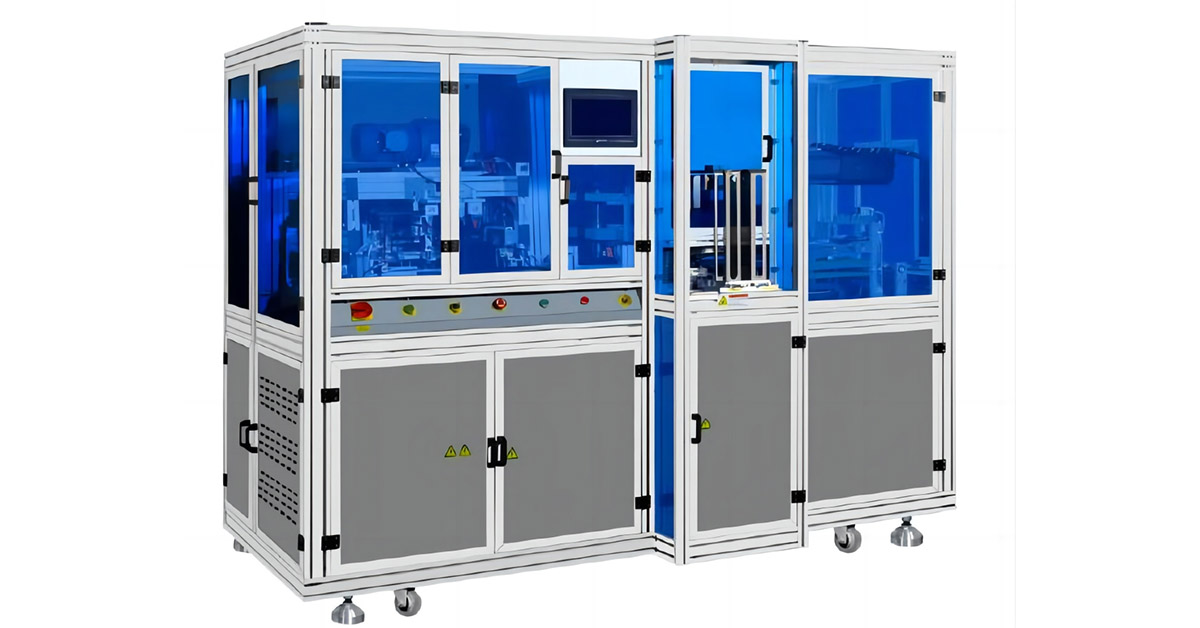
ZOWINDA Automatic Sheet Collating and Overlay Laminating Machine - integrated loading, UVW correction, CCD alignment, ultrasonic welding and overlay lamination in a single line.
Core Technologies Built Into the Machine
Seven engineering subsystems work in sequence. Each one closes a specific failure mode that card producers know well.
Automatic PVC Sheet Loading
Three automatic collating feeding frames, each with a gear-motor controlled lifting platform. A cylinder-fixed structure positions each sheet before separation, eliminating double-feed and skewed pick-up.
UVW Correction Platform
Every feeding frame is paired with a UVW stage using cross rollers and stepper motors for independent X and Y correction. Each PVC sheet is squared to the machine reference before it ever reaches the collating table.
CCD Vision Colour-Code Alignment
The CCD system locates the printed colour code on the incoming sheet, compares it to the preset deviation value, and corrects position in real time - the key to holding 0.1 mm accuracy across long runs.
Vacuum Transfer Moving Arm
A high-precision linear module with lifting air cylinder and vacuum suction board moves material from feeder to correction platform to collating platform without mechanical grippers marking the surface.
Servo Feeding Clamps A / B / C
Clamp A moves material between collating positions, Clamp B delivers aligned stacks to dust removal, Clamp C transfers to the overlay laminating platform. Servo control keeps handoff timing repeatable.
Ultrasonic Spot Welding
An ultrasonic head beneath the third collating platform spot-welds the stack once the final sheet lands. The layers are locked in register before any downstream transport can disturb them.
Dust Cleaning Before Lamination
An integrated dust removal stage cleans both faces prior to overlay lamination. Trapped particles are one of the most common causes of visible bubbles and delamination in finished cards.
Overlay Laminating and Cutting
Overlay film is applied and the collated assembly is trimmed in-line, delivering a press-ready package that feeds directly into the lamination cycle.
Technical Specifications
Configuration below reflects the standard production build. Feeding frame count, sheet size window and film handling can be customized for specific card formats.
Where This Machine Delivers the Strongest Return
The economic case is straightforward: the machine converts a variable, operator-dependent process into a repeatable one. For factories running multi-layer cards at volume, the saved scrap typically dominates the saved labour.
- Banking and payment card production - dual-interface cards demand precise inlay-to-overlay registration so that later cavity milling does not cut into the antenna.
- National ID and government credential programs - security printing layers must align exactly or holographic and guilloche features break visually.
- Transit and access control cards - high-volume, low-margin work where a one-percent yield improvement changes the economics of the whole contract.
- Membership and loyalty card converters - frequent design changeovers benefit from digital parameter recall rather than mechanical re-tooling.
- Contract card bureaus - job-shop environments where the same line must handle many customers, formats and layer counts within a single shift.
Integrating Collating Into a Complete Production Line
Sheet collating rarely operates alone. In a fully configured ZOWINDA line it sits between printing and lamination, feeding directly into hydraulic or continuous laminating presses, then onward to punching, milling, module implanting and personalization. Because the collated stack leaves the machine ultrasonically welded and trimmed, downstream handling is simplified and buffer inventory can be reduced.
Manufacturers planning capacity expansion should size the collating stage against their lamination cycle time rather than against nameplate throughput. A press cycle of four minutes per book with a 900 UPH collator generally supports single-shift operation with comfortable margin; two-shift operations usually justify a second collating station or an expanded feeding frame configuration.
ZOWINDA supplies the machine with installation support, operator training and a spare parts package covering vacuum components, suction boards and ultrasonic consumables. Remote diagnostics are available for customers who require rapid fault resolution without on-site engineer travel.
Operating Practices That Protect Collating Accuracy
Buying a CCD-aligned collator raises the ceiling on achievable accuracy, but day-to-day practice determines whether a factory actually reaches it. The following disciplines separate plants that hold 0.1 mm in month twelve from those that quietly drift back to 0.3 mm within a quarter.
Condition the substrate before it reaches the feeder
PVC and PET sheets absorb moisture and change dimension. Stock should be acclimatised in the production hall for at least twenty-four hours in its sealed packaging, then unwrapped only as it is loaded. A sheet that has expanded 0.15 percent across a 500 mm span has already consumed the entire registration budget before the CCD system sees it.
Validate the colour code print quality, not just its position
The CCD system reads a printed reference mark. If the mark is printed with inconsistent density, a worn plate or excessive dot gain, detection confidence falls and the machine either slows down or applies a noisy correction. Treat the registration mark as a controlled print element with its own inspection tolerance.
Keep vacuum performance on a maintenance schedule
Suction boards and vacuum lines lose performance gradually. A partially blocked board still picks sheets but releases them a few milliseconds late, which shows up as a directional bias in the collating result. Measuring vacuum pressure weekly is far cheaper than diagnosing intermittent registration drift after the fact.
Record parameters per card format, not per shift
Deviation values, feeder timing and welding energy should be stored as named recipes tied to a card format and substrate combination. Factories that rely on operators re-dialling settings each changeover accumulate small differences that make yield comparisons between runs meaningless.
Audit the first and last twenty sheets of every run
Registration problems are usually progressive rather than sudden. Pulling a sample at the start and end of each order and measuring against the same datum turns a hidden trend into a visible one, which is what allows corrective maintenance to be scheduled rather than triggered by a scrapped batch.
Related ZOWINDA Equipment
The machines below are the stations most often specified alongside this equipment in a complete card production line.
- Auto Glue Tape Lamination Machine - the natural downstream station once collated stacks are welded and trimmed.
- Card Punching and Sorting Machine - converts laminated sheets into sorted individual cards at up to 20,000 pcs per hour.
- Auto Contactless Card Inlay Line - produces the RFID inlay layers that the collating stage registers against overlays.
Frequently Asked Questions
What collating accuracy can the machine actually hold in production?
The specified figure is 0.1 mm, achieved through UVW correction platforms combined with CCD colour-code alignment. Sustaining it depends on substrate conditioning and print quality of the registration mark; factories that control both routinely hold the specification across full production runs rather than only on sample sheets.
How many layers and feeding frames can be handled?
The standard build uses three automatic collating feeding frames, which covers the common core-plus-inlay-plus-overlay structure. The feeding frame count is expandable, so cards requiring four or five stacked layers can be accommodated by specifying additional stations at the configuration stage.
Which substrates are compatible?
PVC, PET, PETG and comparable card substrates are supported. Because the transfer system uses vacuum suction rather than mechanical grippers, surface-sensitive printed and pre-laminated materials can be handled without edge marking.
Why is ultrasonic spot welding needed before lamination?
Once layers are aligned, any subsequent transport can disturb them. The ultrasonic head under the third collating platform tacks the stack together so registration achieved by the CCD system survives the move to dust removal, overlay lamination and the press.
What throughput should be assumed when planning capacity?
Up to 900 sheets per hour. In practice the collating stage should be sized against lamination cycle time rather than nameplate speed; a four-minute press cycle is typically well served by a single collator on one shift, while two-shift operations often justify a second station or expanded feeding frames.
Ready to Upgrade Your Card Production Line?
Talk to a ZOWINDA engineer for a tailored configuration, throughput study and quotation for your factory.
Email: [email protected]
WhatsApp: +86 186 2085 0485
 In-Mold Foil Decoration vs Pos
Friction Feeder vs Vacuum Feed
Laser Die-Cutting vs Mechanica
Smart Card Overlaminate and En
In-Mold Foil Decoration vs Pos
Friction Feeder vs Vacuum Feed
Laser Die-Cutting vs Mechanica
Smart Card Overlaminate and En
Please contact us with your request
We are ready to answer your questions.