
Automatic 3D Curved Antenna Embedding Machine: Precision RFID Antenna Production for Complex Geometries
Automatic 3D Curved Antenna Embedding Machine: Precision RFID Antenna Production for Complex Geometries
Published: July 10, 2026 · Category: Industry News
As RFID applications expand beyond flat cards into curved wearables, spherical tags and conformal packaging, manufacturers face a new challenge: embedding conductive antennas accurately across non-planar surfaces. The Automatic 3D Curved Antenna Embedding Machine solves this by combining multi-axis robotic positioning with real-time vision feedback, enabling precise wire embedding on virtually any substrate geometry at production throughput.
The Geometry Challenge in Modern RFID Production
Traditional antenna embedders assume a flat substrate moving through a linear station. But next-generation RFID products demand antennas that follow compound curves, recessed pockets and freeform contours. Manual or semi-automatic approaches cannot hold tolerance across these shapes at volume. Zowinda's 3D platform replaces fixed tool paths with adaptive robotic motion: each antenna path is computed from a 3D model of the target part, then executed with closed-loop vision correction. This eliminates the geometry barrier between prototype-scale curved RFID parts and mass production.
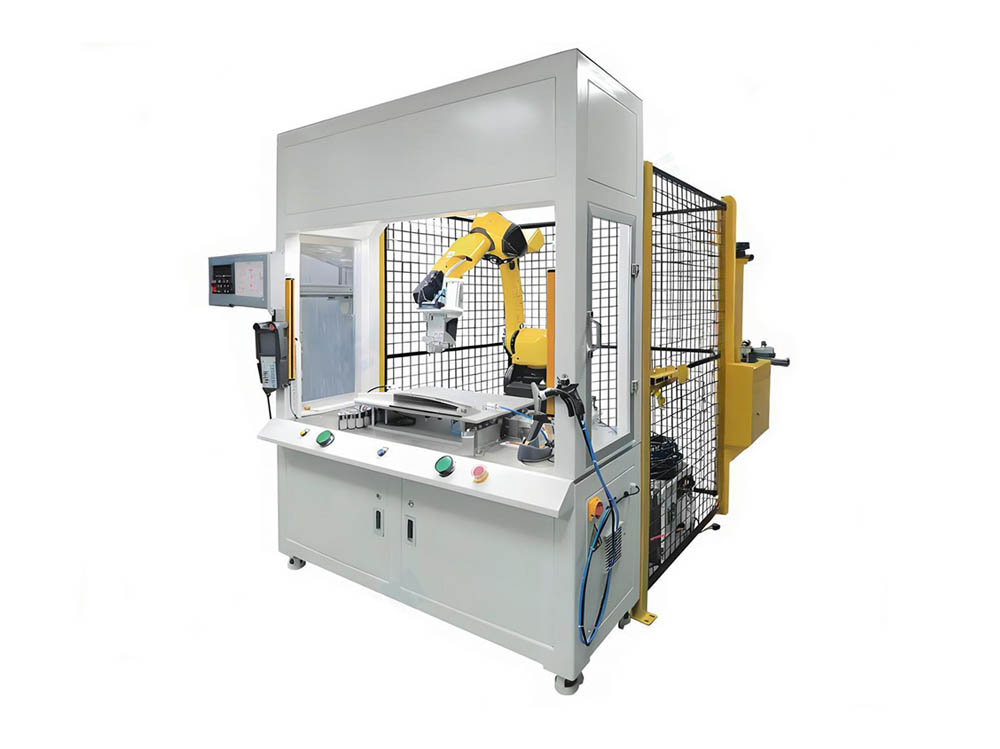
Zowinda Automatic 3D Curved Antenna Embedding Machine — robotic wire placement for non-planar RFID substrates.
Core Capabilities
Six engineered capabilities make this machine a production-floor workhorse:
Multi-Axis Robotic Head
5+ degrees of freedom position the embedding nozzle along any trajectory, following complex 3D antenna patterns on curved substrates.
Real-Time Surface Mapping
Structured-light scanning maps each substrate before embedding, compensating for part-to-part geometric variation.
Vision-Guided Placement
High-resolution cameras track wire position relative to substrate features, holding accuracy within +/-0.15 mm even on curved surfaces.
Adaptive Tension Control
Closed-loop servo tension adjusts dynamically as the nozzle follows curves, preventing sag, lift-off or over-compression.
Batch Programming
Import CAD/STL models of new product designs; the system auto-generates embedding paths without manual teaching.
Industry 4.0 Ready
OPC-UA and MQTT interfaces stream quality metrics, cycle counts and OEE data to MES and cloud dashboards.
Technical Specifications
Applications Driving Demand
The machine targets RFID tag converters producing wearable payment bands, automotive key-fob housings, smart-jewelry pendants and IoT sensor modules where the antenna must follow a non-flat form factor. It also serves manufacturers of smart-card modules requiring precise antenna alignment within recessed card-body cavities.
Ready to Boost Your Production Efficiency?
Contact us for a tailored solution and quotation.
Email: [email protected]
WhatsApp: +86 186 2085 0485
 Automatic 3D Curved Antenna Em
 Automatic Module Testing Machi
 Auto Envelope Sealing and Labe
 Automated Card Sealing Labelin
Please contact us with your request
We are ready to answer your questions.