
RFID Label Converting and Finishing Equipment: From Inlay to Finished Smart Label
RFID Label Converting and Finishing Equipment: From Inlay to Finished Smart Label
Published: 2026-08-17
Converting is the bridge between a bare RFID inlay and a market-ready smart label. A well-tuned converting line laminates, die-cuts, and slits thousands of labels per hour while keeping antenna alignment and read performance intact. This guide walks through the core stations, the parameters that matter, and the QC gates that separate a profitable line from a scrap-heavy one.
Why Converting Quality Drives Tag Yield
An inlay is fragile: the etched or printed antenna and the flip-chip or wire-bonded IC are exposed until encapsulated. The converting stage buries them between face and liner stocks, and any mis-registration of even 0.3 mm can short an antenna or shield the chip. Modern servo-driven laminators hold web registration to ±0.15 mm, which is the single biggest lever on first-pass yield for HF and UHF label programs.

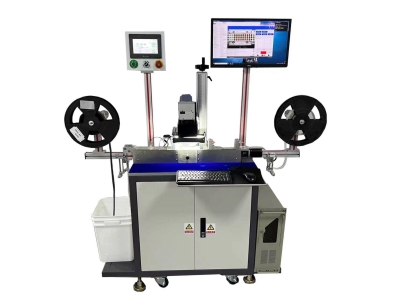
A servo-registered RFID label converting line laminating face stock over pre-webded inlays.
Core Converting Stations
Precision Lamination
Two- or three-ply lamination bonds face stock, adhesive, and liner around the inlay web at controlled tension (typically 2–8 N) to prevent antenna skew.
Rotary Die-Cutting
High-speed rotary dies cut label outlines and perforations at up to 60 m/min, with adjustable anvil gap to manage wear and burr formation.
Slitting & Rewind
Slitters separate multi-up webs into finished rolls with edge trim removal and tension-balanced rewind for clean downstream printing.
Inline Vision QC
Camera stations flag missing ICs, antenna breaks, and registration drift, ejecting bad labels before they reach the rewinder.
Representative Specifications
Ready to upgrade your production line?
Contact us for a tailored solution and quotation
Email: info@zowinda.com
WhatsApp: +86 186 2085 0485
 Smart Card Module Laser Cuttin
Smart Card Module Laser Cuttin
Smart Card Module Laser Cuttin
 NFC Operating Modes Explained:
Smart Card Data Encoding Forma
NFC Operating Modes Explained:
Smart Card Data Encoding Forma
Please contact us with your request
We are ready to answer your questions.