
Wire Embedding vs. Flip-Chip Mounting for RFID Inlays: A Manufacturing Trade-off Analysis
Wire Embedding vs. Flip-Chip Mounting for RFID Inlays: A Manufacturing Trade-off Analysis
Publish Date: 2026-08-14
The RFID inlay—antenna plus chip—is the heart of every contactless product. Two processes dominate its manufacture: wire embedding, where a thin aluminum wire is stitched into a substrate to form the antenna, and flip-chip mounting, where a bare chip is bonded directly onto a printed antenna. Both produce working inlays, but their economics and failure modes differ sharply. This analysis helps line planners pick the right process.
Wire Embedding: Mature and High-Volume
Wire embedding uses an ultrasonic or thermal head to press an aluminum wire into a pre-glued substrate, creating the antenna coil in seconds. It is the workhorse of high-volume HF and some UHF inlays because the wire is cheap, the process is robust, and yields are consistently above 99%. The downside is a relatively thick profile and limited freedom in antenna geometry compared to printing.
Flip-Chip Mounting: Precise and Compact
Flip-chip bonds a bumped silicon die directly onto a screen- or inkjet-printed antenna. This enables ultra-thin, flexible inlays and supports exotic antenna shapes for specialized read patterns. Setup is faster for short runs, but die handling, placement accuracy, and bump reliability make per-unit cost higher and yield more sensitive to contamination.
How to Decide
For millions of identical tags (transit, luggage, retail EAS), wire embedding's low material cost and bulletproof yield win. For thin form factors, specialized antenna designs, or lower-volume niche products, flip-chip's flexibility justifies the premium. Many manufacturers run both, routing each SKU to the process that optimizes its cost-performance curve.

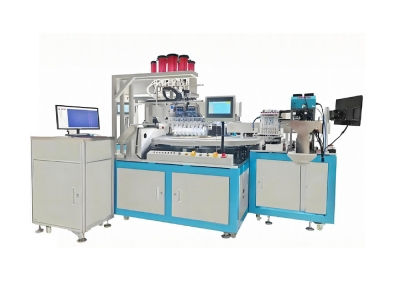
RFID inlay production showing wire-embedded antenna coil and flip-chip die bonding.
Key Advantages
✔ Low Material Cost
Wire embedding uses inexpensive aluminum wire at scale.
✔ Consistent Yield
Embedding routinely exceeds 99% in mature lines.
✔ Thin Form Factor
Flip-chip enables ultra-flexible, low-profile inlays.
✔ Design Freedom
Printed antennas support custom read patterns.
Technical Parameters
Ready to Upgrade Your Production Line?
Contact us for a tailored solution and quotation.
Email: info@zowinda.com
WhatsApp: +86 186 2085 0485
 NFC Operating Modes Explained:
Smart Card Data Encoding Forma
UHF RFID vs BLE for Asset Trac
NFC Operating Modes Explained:
Smart Card Data Encoding Forma
UHF RFID vs BLE for Asset Trac
 Smart Card Types and How They
Please contact us with your request
We are ready to answer your questions.