
Smart Card Production Line Layout: Material Flow and Throughput Optimization
Smart Card Production Line Layout: Material Flow and Throughput Optimization
Publish date: 2026-09-13
A card line is a chain of stations - print, laminate, mill, embed, personalise, inspect, package - and its real capacity is set by how they are arranged and fed, not by the fastest machine in it. Bottlenecks, buffer sizes and material handling decide whether a line runs at nameplate speed or stalls in queues. This guide looks at how to lay out a card line and balance flow so throughput matches the slowest, not the average, station.
The Line Is Only as Fast as Its Slowest Station
Every card line has one station that sets the pace - often lamination, with its fixed heat-and-pressure dwell, or personalisation, with its per-card write and print time. The theoretical capacity of the whole line equals that station's rate, no matter how many faster machines sit upstream and downstream. Adding speed elsewhere just builds queues at the bottleneck. The first job of any layout review is to find that constraint and stop optimising around it; everything else is either feeding it or absorbing its output.
Balancing Stations Around the Bottleneck
Once the pace-setter is known, the layout should let every other station keep up without overbuilding. That means matching cycle times so upstream does not flood the floor with work-in-process, and giving the bottleneck a small, deliberate buffer so a brief stop elsewhere does not immediately stall it. Over-buffering hides problems and ties up capital in half-made cards; under-buffering lets a five-minute stop cascade into a line-wide halt. The balance is a designed buffer at the constraint, not piles everywhere.
- Identify the single pace-setting station first.
- Match neighbour cycle times so WIP does not pile upstream.
- Place a deliberate buffer at the bottleneck, not everywhere.
✔ Bottleneck
The station that sets real line rate; protect it.
✔ Buffer
Small planned WIP at the constraint absorbs micro-stops.
✔ Balance
Neighbour rates matched so flow stays continuous.
Material Handling and the Hidden Stops
Between stations, cards move on stacks, magazines, conveyors or robots, and most unplanned stops live in that handling, not in the presses. A misaligned loader, a jammed magazine or a manual offload step silently eats more uptime than a slow laminator. Good layouts minimise hand-offs, keep orientation consistent so each station receives the card the same way, and automate the transfers that humans currently bridge. Every manual touch between machines is a place the line can pause without anyone noticing until WIP runs dry.
- Minimise hand-offs; each one is a place to jam or wait.
- Keep card orientation consistent into every station.
- Automate the transfers humans currently bridge by hand.

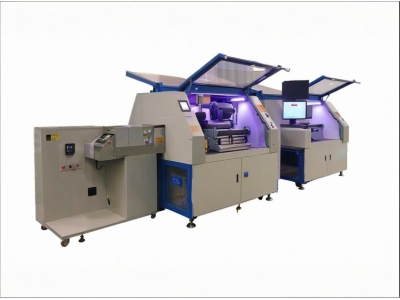
Card line layout where balanced stations, planned buffers and automated handling keep material flowing to the bottleneck.
Measuring Throughput Honestly
Nameplate speed on a brochure is not throughput. Real output is the bottleneck rate times its uptime, less the yield lost to handling and defects. The honest metrics are overall equipment effectiveness - availability, performance, quality - watched per station, because a line average hides a starving mill behind a fast printer. Layout decisions should be justified by moving these numbers, not by buying a faster machine that the constraint will never let run.
- Throughput = bottleneck rate x its real uptime, minus scrap.
- Track OEE per station; a line average hides a starving mill.
- Justify layout changes by moving the numbers, not by spec sheets.
Selection Quick Reference
A card line's capacity is a flow problem before it is a machine problem. Find the one station that sets the pace, balance the neighbours around it with a deliberate buffer, strip the hand-offs that hide stops, and measure throughput by the constraint's uptime rather than the brochure. Do that and the line runs at the speed its slowest station can truly sustain - which is the only speed that ships cards.
Ready to improve your production efficiency?
Contact us for a tailored solution and quotation.
Email: info@zowinda.com
WhatsApp: +86 186 2085 0485
 How Smart Cards Are Made: Proc
Smart Card Production Line Lay
RFID Inlay Encoding Calibratio
Sustainable Smart Card Manufac
How Smart Cards Are Made: Proc
Smart Card Production Line Lay
RFID Inlay Encoding Calibratio
Sustainable Smart Card Manufac
Please contact us with your request
We are ready to answer your questions.