
RFID Inlay Encoding Calibration: Write Power, Sensitivity and Yield Tuning
RFID Inlay Encoding Calibration: Write Power, Sensitivity and Yield Tuning
Publish date: 2026-09-13
An RFID inlay leaves the antenna press tuned, but it is not useful until it carries the right data written at the right power. Encoding is where read range and yield are actually won or lost: too little power and tags fail to write, too much and you stress the chip or trip adjacent tags. This guide covers how to calibrate write power, read sensitivity and the station settings that turn a roll of inlays into a batch of reliably encoded tags.
Encoding Is Where Yield Is Decided
Antenna printing and chip bonding make the inlay; encoding makes it a product. At the encode station each tag must receive its unique EPC, user memory and any password, and it must do so with a write success rate high enough that the line is not drowning in rejects. Because the tag is passive, the station's write power, antenna position and timing decide whether the chip gets enough energy to flip its memory. Get these wrong and you ship blank or half-written tags; get them right and yield climbs with almost no hardware change.
Calibrating Write Power
Write power is the first dial. Too low and the chip never reaches its write threshold, so the encoder reports a timeout and the tag is rejected. Too high and you waste energy, risk over-stressing the die, and can couple into neighbouring tags on a tightly spaced web, causing cross-talk writes. The calibration target is the minimum power that writes the worst-case tag on the roll at the line speed you run - measured, not guessed. A good station sweeps power at commissioning and re-checks it when the inlay batch or line speed changes.
- Find the minimum power that writes the weakest tag at speed.
- Avoid excess power that stresses the die or writes adjacent tags.
- Re-calibrate when batch or line speed changes, not just at install.
✔ Write power
Sweep to the minimum that yields 100% at line speed.
✔ Read sensitivity
Confirm the tag reads back before and after write.
✔ Yield tuning
Tighten timing and antenna placement to cut rejects.
Read Sensitivity and the Pre-Write Check
Before writing, a well-tuned line reads each tag to confirm it is present and healthy - a pre-write inventory that catches a dead inlay before you waste a write cycle on it. After writing, it reads the tag back to verify the EPC actually landed. The read sensitivity of the verify antenna must be high enough to catch a marginally coupled tag, because a tag that verifies poorly will also read poorly in the field. The two checks bracket the write and turn invisible failures into counted rejects.
- Pre-write read: skip dead inlays before spending a write cycle.
- Post-write verify: confirm the EPC landed, not just that power fired.
- Tune verify antenna so a poor read predicts a poor field read.

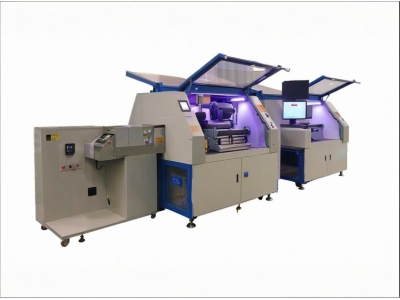
Inlay encoding station with pre-write and post-write verification antennas bracketing the write power calibration.
Yield Tuning: Timing, Placement and Web Tension
Once power and sensitivity are set, yield is mostly a mechanical and timing problem. The tag must sit in the field long enough at line speed to complete the write, so encoder dwell time and web tension matter; a tag that slips or bounces misses its window. Antenna placement relative to the tag must be consistent roll to roll, or the effective power at the chip drifts. Small timing and registration fixes - a faster encoder clock, a steadier web, a repositioned antenna - often recover more yield than any power change.
- Dwell time: enough field exposure at the line speed you run.
- Web tension: steady so the tag does not slip out of its write window.
- Antenna placement: consistent roll to roll for stable chip power.
Selection Quick Reference
Encoding calibration is mostly measurement, not force. Sweep write power to the true minimum that yields at speed, bracket every write with a pre-read and a post-verify, and treat lingering rejects as timing and placement problems before reaching for more power. Do that and the roll of inlays becomes a batch of reliably encoded, field-ready tags with yield that holds batch after batch.
Ready to improve your production efficiency?
Contact us for a tailored solution and quotation.
Email: info@zowinda.com
WhatsApp: +86 186 2085 0485
 How Smart Cards Are Made: Proc
Smart Card Production Line Lay
RFID Inlay Encoding Calibratio
Sustainable Smart Card Manufac
How Smart Cards Are Made: Proc
Smart Card Production Line Lay
RFID Inlay Encoding Calibratio
Sustainable Smart Card Manufac
Please contact us with your request
We are ready to answer your questions.