
How to Choose a Card Sorting and Kitting System for High-Volume Smart Card Production
How to Choose a Card Sorting and Kitting System for High-Volume Smart Card Production
Published: 2026-08-01 | Zowinda Production Equipment Buyer's Guide
After smart cards are personalized, encoded, and printed, the final production stage is sorting and kitting -- organizing finished cards into customer-specified batches, inserting them into carriers or envelopes, and preparing shipments. For facilities producing millions of cards annually, the choice between manual sorting, semi-automatic stackers, and fully automated sorting-and-kitting lines directly impacts labor costs, error rates, and delivery turnaround times. This guide breaks down the decision framework for 2026.
Understanding the Sorting and Kitting Process Chain
A complete post-personalization sorting line typically handles these operations in sequence:
- Input Stacking: Cards from the personalization machine output hopper are collated into a single feed stream at 200-800 cards/minute.
- Reading/Verification: Each card's visible data (name, number, barcode) and/or chip data is read by OCR cameras and/or smart card readers to determine its sort destination bin.
- Sorting Distribution: Based on the read data, a mechanical diverter routes each card to one of N output bins (typically 8-24 bins on production equipment).
- Counting and Batch Management: Each bin counts accumulated cards and signals when the target batch size is reached.
- Kitting/Insertion (optional): Cards are automatically inserted into letter carriers, welcome packets, or PIN mailers.
- Output Stacking and Packaging: Sorted/kit batches are stacked, banded, and labeled for shipment.

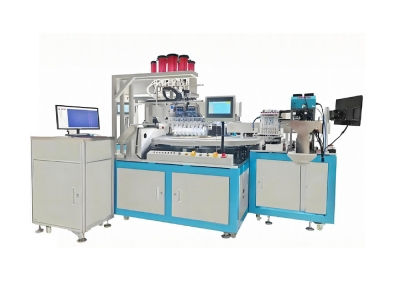
Figure 2: Multi-bin automatic card sorting system with integrated labeling
Throughput Tiers: Matching Equipment to Your Volume
Key Features to Evaluate
Sort Speed
Measure in cards-per-minute (CPM). Entry-level: 200 CPM. Production-grade: 600-1000 CPM. Higher speed reduces bottleneck risk downstream of fast personalizers.
Bin Count Flexibility
More bins equals fewer sort passes for complex batch configurations. Look for modular bin expansion (add bins as order complexity grows).
Read Technology
OCR camera (reads printed text), barcode scanner (1D/2D), magnetic stripe reader, and/or smart card contact/RFID reader. Multi-read capability adds versatility.
Error Handling
Jam detection, misread recovery, reject bin for unreadable cards, and audit trail logging. Error rate below 0.01% is achievable with quality equipment.
ROI Calculation Framework
To justify automated sorting investment, calculate:
Labor Savings = (Manual sort hours/card x Annual volume x Labor rate) minus (Equipment cost / Depreciation years plus Maintenance cost)
For a facility processing 3 million cards/year with $15/hr labor cost, switching from manual sorting (0.003 hr/card) to an auto-sorter typically achieves payback in 14-24 months depending on equipment tier selected.
Integration with Upstream Equipment
The sorting system should be physically and logically compatible with your existing personalization line. Key integration points include:
- Feed compatibility: Accepts output stack format from your specific personalizer model(s).
- Data handoff: Receives sort-key data from the personalization host system via file transfer or direct API.
- Line balance: Sorter throughput should exceed or match the combined output rate of upstream personalizers (avoid creating a new bottleneck).
- Footprint: Verify available floor space matches the sorter dimensions plus operator access clearance.
Need Help Sizing Your Sorting Line?
Share your production volume, card types, and sorting requirements. Our engineers will recommend the optimal configuration with a detailed quote.
Email: [email protected]
WhatsApp: +86 186 2085 0485
 RFID vs NFC Smart Cards: Compl
 Statistical Process Control fo
Hydraulic vs Servo-Electric La
Smart Card Module Embedding: C
Statistical Process Control fo
Hydraulic vs Servo-Electric La
Smart Card Module Embedding: C
Please contact us with your request
We are ready to answer your questions.