
ICC Backside Spot Pressure Tester: Precision QC for Smart Card Delamination Detection
ICC Backside Spot Pressure Tester: Precision Quality Control Equipment for Smart Card Manufacturing
Published: July 17, 2026 | Category: Smart Card Testing & Quality Assurance
Quality control is the backbone of smart card manufacturing. Whether producing bank cards, SIM cards, identity credentials, or access control cards, every unit must withstand mechanical stresses encountered throughout its lifecycle -- from daily wallet friction to industrial reader insertion cycles. The ICC (Integrated Circuit Card) Backside Spot Pressure Tester provides manufacturers with a specialized instrument to verify the structural integrity and delamination resistance of card assemblies under precisely controlled point-load conditions.
Understanding Spot Pressure Testing for Smart Cards
Smart cards are multi-layer laminates consisting of PVC or PET core materials, an embedded IC module (with contacts exposed on the surface for contact cards, or fully encapsulated for contactless), magnetic stripes, signature panels, and decorative overlay films. During lamination, these layers are fused under heat and pressure. However, microscopic voids, uneven adhesive distribution, or improper lamination parameter settings can create weak interfaces between layers.
The backside spot pressure test simulates concentrated force applied to specific points on the card surface -- particularly around the ICC module area where stress concentration is highest. By applying calibrated pressure and observing whether delamination, bubbling, or layer separation occurs, QC engineers identify latent manufacturing defects that would cause field failures after the card reaches end users.
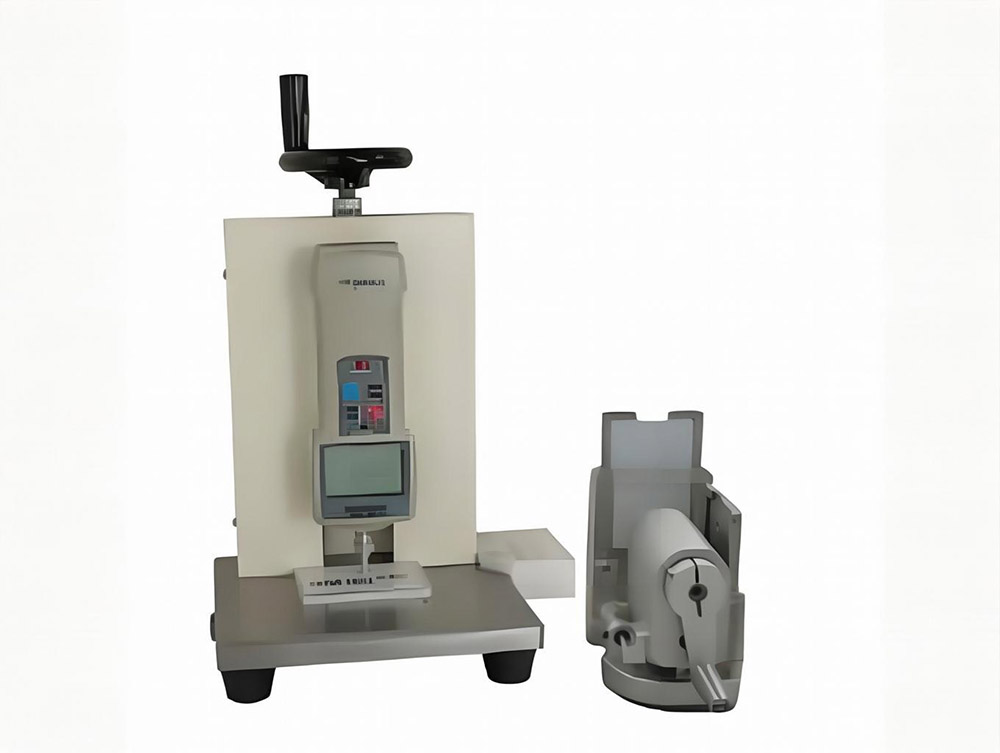
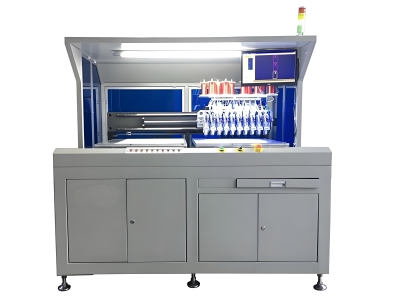
Figure 1: ICC Backside Spot Pressure Tester applying controlled point-load pressure for delamination detection on smart card samples
Core Functions of the ICC Backside Spot Pressure Tester
Precise Force Application
The tester uses a motorized actuator with a calibrated load cell to apply forces ranging from 50N to 500N (configurable) with +/- 1% accuracy. The pressure head diameter matches ISO/IEC 7816 and EMVCo specifications for standardized testing compliance.
Multi-Point Testing Capability
Programmable test sequences apply pressure at user-defined positions: center of ICC module, four corners of the card body, along magnetic stripe path, and any custom coordinates specified by the operator.
Dwell Time Control
Force can be sustained for configurable durations (1 second to 300 seconds) to differentiate between instantaneous failure modes and time-dependent creep-induced delamination. This is essential for cards destined for tropical climate deployment.
Automated Pass/Fail Judgment
An integrated visual inspection camera (optional) captures post-test images of the loaded area. Image analysis software detects surface irregularities, white spots, and edge lifting that indicate lamination failures, eliminating subjective operator judgment.
Technical Specifications
Why Spot Pressure Testing Matters
Card issuers and scheme owners enforce strict quality thresholds because delamination failures create tangible business problems:
- Brand Damage: A card that bubbles or separates in a customer's wallet reflects poorly on the issuing bank. Negative social media posts spread quickly.
- Reader Jamming: Delaminated cards may swell beyond ISO thickness tolerances, causing ATM insertions to jam and requiring expensive service calls.
- Security Risk: Separated layers expose the internal antenna and IC connections, making the card vulnerable to physical tampering and reverse engineering.
- Warranty Claims: Batch-level delamination issues trigger mass replacement campaigns costing issuers millions in reissuance fees.
By implementing systematic spot pressure testing at the end of the production line (or as part of incoming QA for outsourced card bodies), manufacturers catch problems before cards ship. The cost of catching one defective batch at the factory gate far exceeds the investment in proper testing equipment.
Integration Into Quality Management Workflows
The ICC Backside Spot Pressure Tester fits naturally into established quality management frameworks:
Best Practices for Accurate Testing Results
- Condition Cards Before Testing: Store test samples at 23+/-2 C and 50+/-5% RH for at least 24 hours prior to testing. Environmental extremes skew results significantly.
- Calibrate Load Cell Monthly: Use certified reference weights (traceable to national standards) to verify force readings. Log calibration results for audit trail continuity.
- Select Appropriate Tip Size: Use smaller diameter tips (1mm) for detecting localized defects near the IC module edge; use larger tips (5mm) for general lamination integrity screening.
- Define Clear Acceptance Criteria: Document what constitutes pass vs. fail for each product type (e.g., "no visible separation larger than 0.5mm" or "no audible crack sound during force application").
- Track Trending Data: Export test results weekly and plot control charts. Gradually increasing failure rates often predict tooling wear or lamination press drift before catastrophic failures occur.
Comparison with Alternative Delamination Tests
Elevate Your Card Quality Standards
Request a technical datasheet, schedule a live demo, or discuss your specific testing requirements with our engineering team.
Email: [email protected]
WhatsApp: +86 186 2085 0485
 Auto COB Pick and Placer Machi
 Auto Hole Punching Machine – P
 Auto Sheet Shearing Machine -
 Auto Antenna Embedding Machine
Please contact us with your request
We are ready to answer your questions.