
Automatic Module Testing Machine: Comprehensive IC Module Electrical Testing Equipment for Smart Card Quality Assurance
Automatic Module Testing Machine: Comprehensive IC Module Electrical Testing Equipment for Smart Card Quality Assurance
Published: July 14, 2026 · Category: Industry News
Smart card quality hinges on one critical checkpoint: verifying that every embedded IC module meets its electrical specifications before the card ships. A defective module means a dead-on-arrival product, warranty returns, and reputational damage. The Automatic Module Testing Machine addresses this by automating the entire electrical test sequence -- from contact resistance measurement through full protocol compliance verification -- at throughput rates that match modern card production lines.
The Critical Role of Module-Level Electrical Testing
In smart card manufacturing, the IC module is the most expensive component and the most likely point of failure. Unlike visual inspection, which catches cosmetic defects, electrical testing verifies that the silicon die is properly bonded, the contact pads meet ISO 7816 dimensional tolerances, and the chip's internal circuitry operates within specification across voltage and temperature ranges. Manual bench-top testers cannot keep pace with production volumes exceeding 10,000 cards per hour. The Automatic Module Testing Machine integrates automated handling, multi-point probe contact, programmable test sequences, and statistical process control into a single station that fits between the embedding machine and the final inspection conveyor.
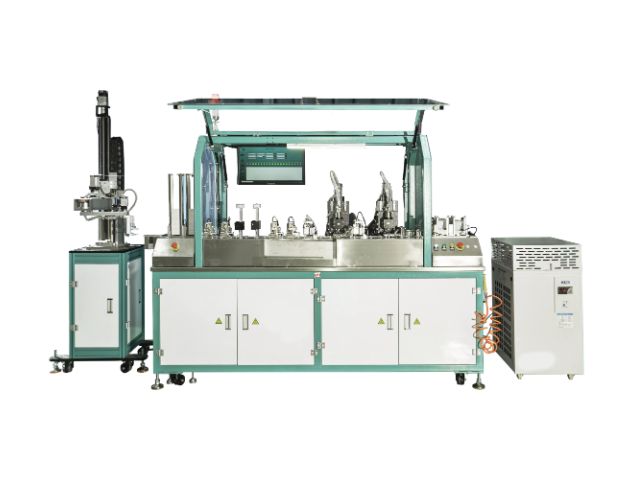
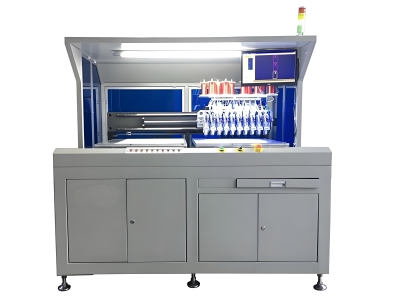
Zowinda Automatic Module Testing Machine -- comprehensive electrical validation for IC modules on smart cards and RFID devices.
Core Capabilities
Six engineered capabilities define this solution:
Multi-Chip Type Support
Tests contact (ISO 7816) chips, contactless (ISO 14443) modules, and dual-interface (COMBO) chips on the same platform via quick-change fixture.
Full Parameter Suite
Measures VCC current consumption, clock frequency tolerance, data transmission timing, EEPROM read/write endurance, and RF field strength for contactless variants.
Automated Probe System
Spring-loaded pogo-pin probes make consistent contact with module pads; self-cleaning mechanism removes oxide buildup automatically.
Programmable Test Sequences
Operators define custom test flows via touchscreen interface: power-up delay, command-response cycles, stress tests, and pass/fail criteria.
SPC Data Logging
Every test result is timestamped, logged, and fed to SPC charts tracking Cp/Cpk trends for early drift detection before out-of-spec parts appear.
Bin Sorting Output
Passing modules proceed to next stage; failing cards are ejected into separate bins by defect type (electrical, mechanical, protocol failure).
Technical Specifications
Integration Into Production Lines
This testing station connects directly upstream of the personalization encoder and downstream of the embedding machine. It receives modules on carrier tape or individual card feed, tests each unit, and routes results via bin gates or flipper arms. Manufacturers running contactless payment card lines, SIM card factories, e-Passport assembly cells, and IoT security token producers all rely on this class of tester as their final quality gate before encoding and packaging.
Ready to Boost Your Production Efficiency?
Contact us for a tailored solution and quotation.
Email: [email protected]
WhatsApp: +86 186 2085 0485
 Auto COB Pick and Placer Machi
 Auto Hole Punching Machine – P
 Auto Sheet Shearing Machine -
 Auto Antenna Embedding Machine
Please contact us with your request
We are ready to answer your questions.